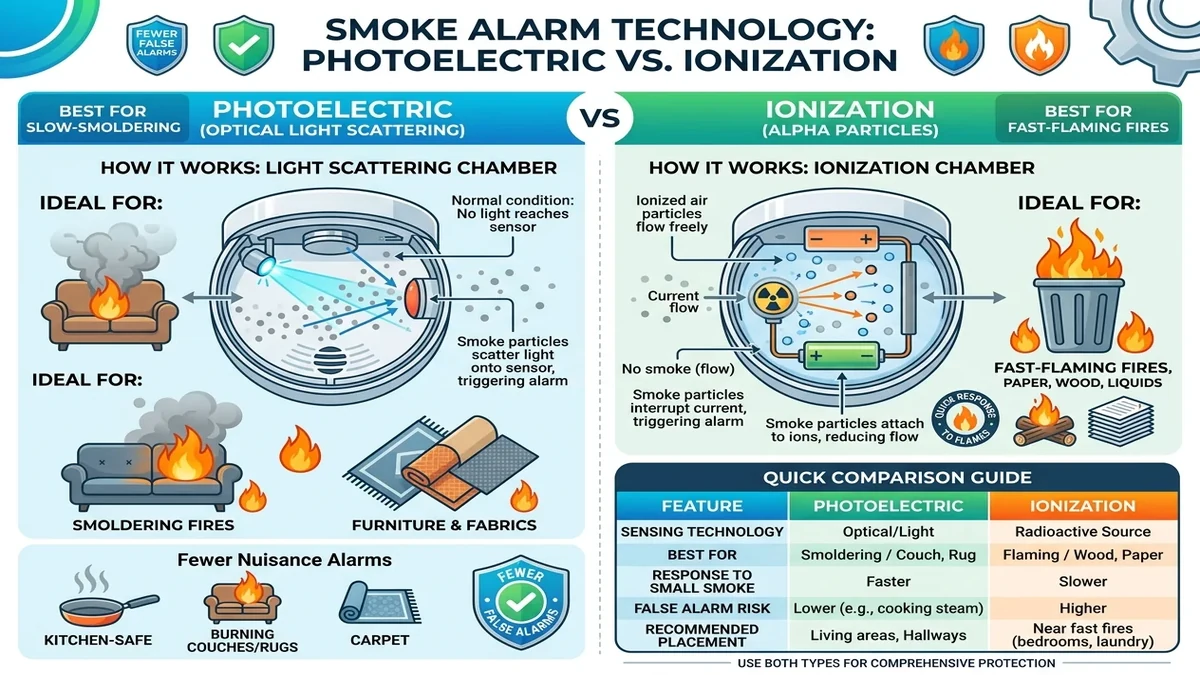
Different fire types produce distinct combustion particle sizes. Choosing the right sensor technology ensures rapid early warning while minimizing disruptive nuisance alarms.
Photoelectric vs. Ionization: Technical Comparison
| Feature | Photoelectric (Optical) | Ionization | Dual Sensor (Photo + Ion) |
|---|---|---|---|
| Operating Principle | Light-scattering optical diode and infrared receiver | Americium-241 radioactive source ionizes air molecules | Dual independent sensing chambers in a single housing |
| Best Response | Smoldering, smoky fires (foam, bedding, upholstery) | Fast-flaming fires (paper, grease, flammable liquids) | Broad detection across smoldering and flaming profiles |
| Response Time (Smoldering) | 15 to 50 minutes faster than ionization | Significantly delayed response to dense smoke | Fast response via optical chamber |
| Cooking False Alarm Resistance | High resistance; fewer nuisance triggers | Low resistance; frequently triggers from kitchen cooking | Moderate; ionization sensor can still false trigger |
| Statutory Mandates | Mandated in Australia, Scotland, multiple US states | Being phased out of residential legislation in many areas | Permitted under general residential codes |
Kitchen and High-Humidity Placement Nuance
Standard smoke alarms should not be mounted directly inside cooking zones where normal frying, toasting, or oven steam creates nuisance activations. Instead:
- Maintain a 10-foot (3 meter) radial exclusion zone from cooking appliances. Between 10 and 20 feet, photoelectric alarms or UL 217 8th/9th edition nuisance-resistant models are required.
- Where detection is required by the applicable code or regulation or desired directly inside kitchens or boiler rooms, install a certified heat alarm (Class A1/A2 thermal rate-of-rise or fixed-temperature detector) connected to the household alarm system.
Detailed Sensor & Hardware Guides
- Photoelectric vs Ionization Guide - In-depth physics and safety studies.
- Dual-Sensor Smoke Alarms - Benefits and trade-offs.
- Smart Smoke Alarms Guide - Wi-Fi, app alerts, and home automation integration.
- Smoke Alarms vs Heat Detectors - Applications for kitchens, garages, and attics.
- Combination Smoke & CO Detectors - 2-in-1 hardware review.