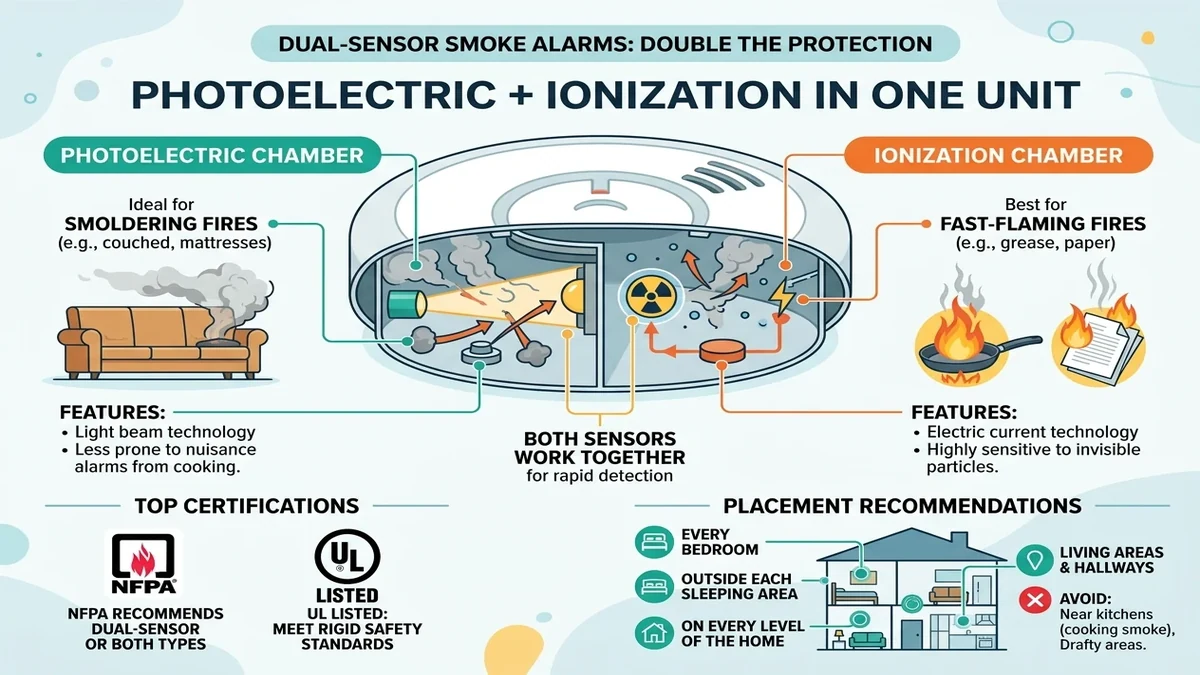
Fires in residential homes develop along unpredictable paths: some smolder for hours producing toxic smoke before igniting, while others burst into fast-moving open flames within seconds. Dual-sensor alarms protect against both profiles.
How Dual-Sensor Technology Operates
| Internal Sensor | Primary Detection Target | Fire Scenario | Response Profile |
|---|---|---|---|
| Photoelectric Optical Chamber | Large, visible smoke particles (0.3 to 10.0 microns) | Smoldering foam mattresses, electrical wire overheating, upholstered furniture | Fast response; 15-50 minutes faster than ionization in smoldering tests |
| Ionization Americium Chamber | Small, invisible combustion particles (0.01 to 0.3 microns) | Fast-flaming grease fires, burning paper, flammable liquids, dry wood | Fast response to flaming fires; 30-90 seconds faster than optical |
Benefits and Trade-Offs
- Dual-Phenomenon Detection: Eliminates guesswork regarding which fire type might occur in a given room.
- Kitchen Consideration: Because the alarm contains an ionization chamber, placing it too close to cooking stoves or toasters can still result in nuisance false alarms. For kitchen adjacent areas, dedicated photoelectric alarms are preferred.