Editorial Governance & Technical Inspection Leadership
Marcus Vance
NICET Level III Certified (Fire Alarm Systems)Marcus Vance brings over 18 years of professional field experience in commercial and residential life-safety systems. Holding active Level III certification in Fire Alarm Systems from the National Institute for Certification in Engineering Technologies (NICET Certification #142890), Marcus has supervised hundreds of residential fire alarm acceptance audits, plan reviews, and NFPA 72 compliance evaluations.
Under Marcus's editorial direction, Smoke Alarm Guide enforces an uncompromising standard of factual precision. Every diagnostic tree, voltage tolerance metric, and sensor degradation timeline is verified against official engineering documentation, UL 217 8th/9th edition test specifications, and statutory model codes (IRC Section R314/R315 and NFPA 72 Chapter 29).
Physical Bench Testing & Laboratory Apparatus
Unlike generic product review portals that aggregate manufacturer marketing claims, Smoke Alarm Guide bases technical advice on empirical hardware verification and bench diagnostic protocols. Our testing laboratory maintains calibrated equipment to evaluate residential smoke alarms and carbon monoxide detectors under real-world operating conditions:
Electrical Load & Multimeter Analysis
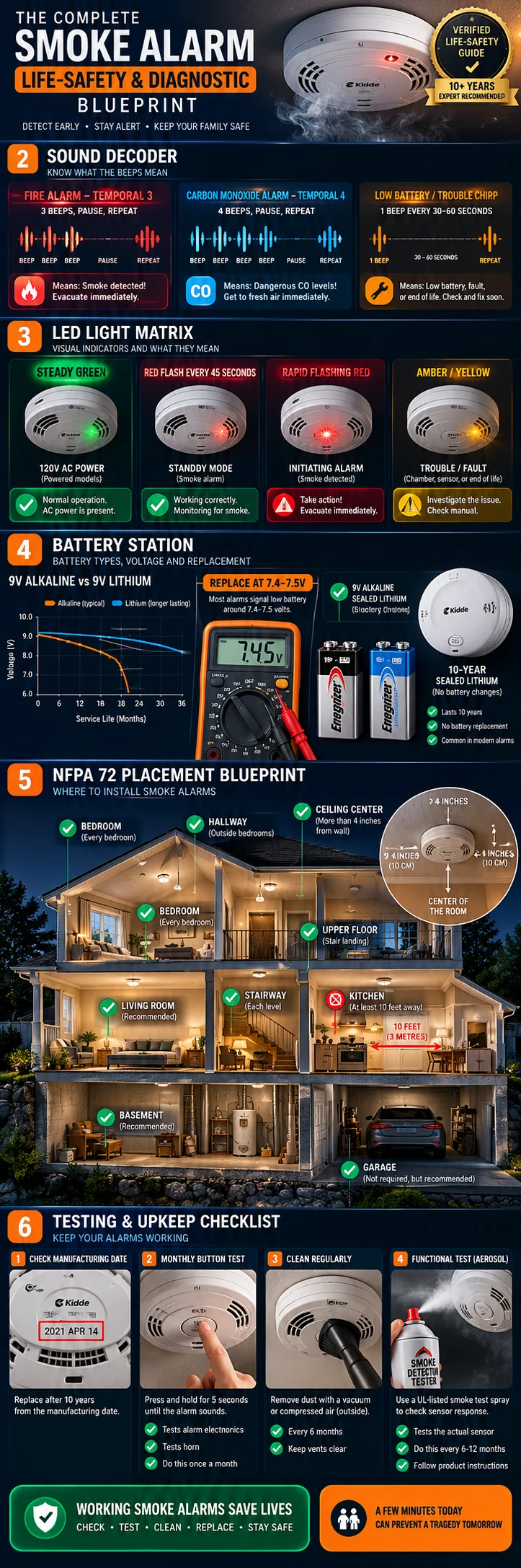
We verify quiescent standby current draw (typically 10 to 15 microamps) and peak alarm current draw (40 to 60 milliamps) across 9V alkaline, lithium, and AA battery architectures using calibrated Fluke 87V true-RMS digital multimeters to measure actual battery depletion curves.
Calibrated Sound Pressure Audits
Sounder output is measured using Type 2 sound level meters at the statutory 10-foot (3.05 meter) NFPA 72 verification distance, ensuring alarms produce a minimum of 85 dBA across the standard 3.1 kHz tonal sweep and low-frequency 520 Hz square wave protocols.
Aerosol & CO Concentration Testing
Sensor trip thresholds are validated using UL-listed functional smoke test aerosols (Solo A10) and calibrated trace carbon monoxide canisters (50 ppm, 150 ppm, and 400 ppm test gas) within sealed test chambers to evaluate electrochemical sensor response curves under UL 2034.
Evidence-Based Safety Documentation
Our mission is to bridge the gap between dense statutory fire codes and practical homeowner decision-making. Manufacturer user guides often provide brief, model-specific instructions that leave property owners uncertain about broader legal obligations, sensor technology trade-offs, or the physical causes of false alarms.
We formulate every guide using structured, evidence-based decision trees directly derived from official standards and manufacturer engineering documents. When an alarm chirps or sounds, we provide verified steps to help you distinguish between genuine life-safety emergencies, power faults, sensor contamination, and mandatory 10-year hardware expiration.
Our 7-Tier Primary Source Hierarchy
Because smoke alarms and carbon monoxide detectors are life-safety devices, factual precision is essential. We evaluate technical and regulatory information using a strict 7-tier research hierarchy:
Model-Specific Priority Rule
Smoke alarm hardware varies widely across manufacturers, series, and production years. While universal principles apply to general smoke physics, individual model documentation always supersedes generalized advice.
For instance, a single periodic chirp indicates low battery on many models, but indicates end-of-life on others. A steady green LED indicates active AC power on standard hardwired units, but a flashing green LED indicates standby polling on certain smart alarms. Wherever model-specific variations exist, our guides explicitly document these differences and cite the corresponding manufacturer procedures.
Factual Correction & Review Policy
Building codes, product standards, and manufacturer product lines evolve continuously. We conduct regular reviews of regional fire statutes and safety guidelines. If you identify an outdated code citation or technical discrepancy, contact our editorial team.
Independent Publishing & Conflict of Interest
Smoke Alarm Guide is an independent educational publisher. We do not manufacture fire safety hardware, nor do we offer commercial installation services. Our recommendations are formulated solely on public safety consensus, statutory compliance, and engineering validity.