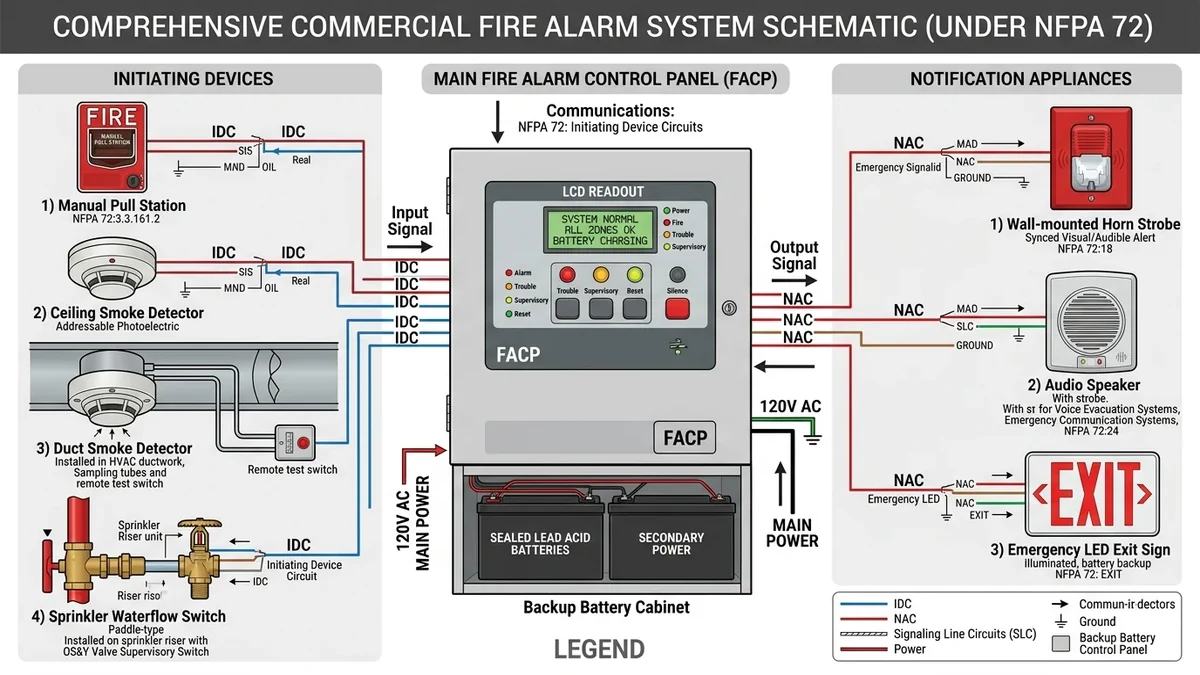
Commercial fire alarm systems provide facility-wide life-safety protection, automated HVAC shutdown, elevator recall, and emergency service notification in compliance with commercial building and fire codes.
Addressable vs Conventional Commercial Systems
| System Feature | Addressable Fire Alarm Systems | Conventional Fire Alarm Systems |
|---|---|---|
| Device Identification | Individual digital address per detector/pull station | Zoned circuit (identifies zone, not individual unit) | Wiring Architecture | Signaling Line Circuits (SLC) in Class A or Class B loops | Initiating Device Circuits (IDC) with End-of-Line resistors |
| Diagnostic Capability | Real-time chamber sensitivity and drift compensation reporting | Binary on/off contact state; no sensitivity readout |
| Facility Size | Ideal for medium-to-large complexes, hospitals, high-rises | Cost-effective for small single-story buildings and retail shops |
| System Cost | Higher initial hardware cost; lower troubleshooting/wiring labor | Lower initial hardware cost; higher installation wiring labor |
Commercial Inspection, Testing & Maintenance (ITM)
Unlike residential alarms, commercial fire systems are subject to strict statutory ITM schedules enforced by municipal fire marshals:
- Weekly/Monthly Visual Inspections: Verify FACP normal power conditions and zero unaddressed trouble indicators.
- Semi-Annual Inspection: Inspect flow switches, tamper switches, and secondary battery load voltages.
- Annual Functional Certification: 100% functional testing of all initiating devices (smoke detectors, heat detectors, pull stations, duct detectors) and audibility testing of notification appliances.
Commercial System Documentation Guides
- Commercial Fire Alarm Testing Guide - ITM procedures and certification standards.
- FACP Trouble Codes & Diagnostics - Resolving ground faults, loop open faults, and battery troubles.
- Duct Smoke Detectors - Sampling tube aerodynamics and HVAC shutdown.
- Commercial Fire Alarm Inspection Checklist - Standard facility maintenance template.