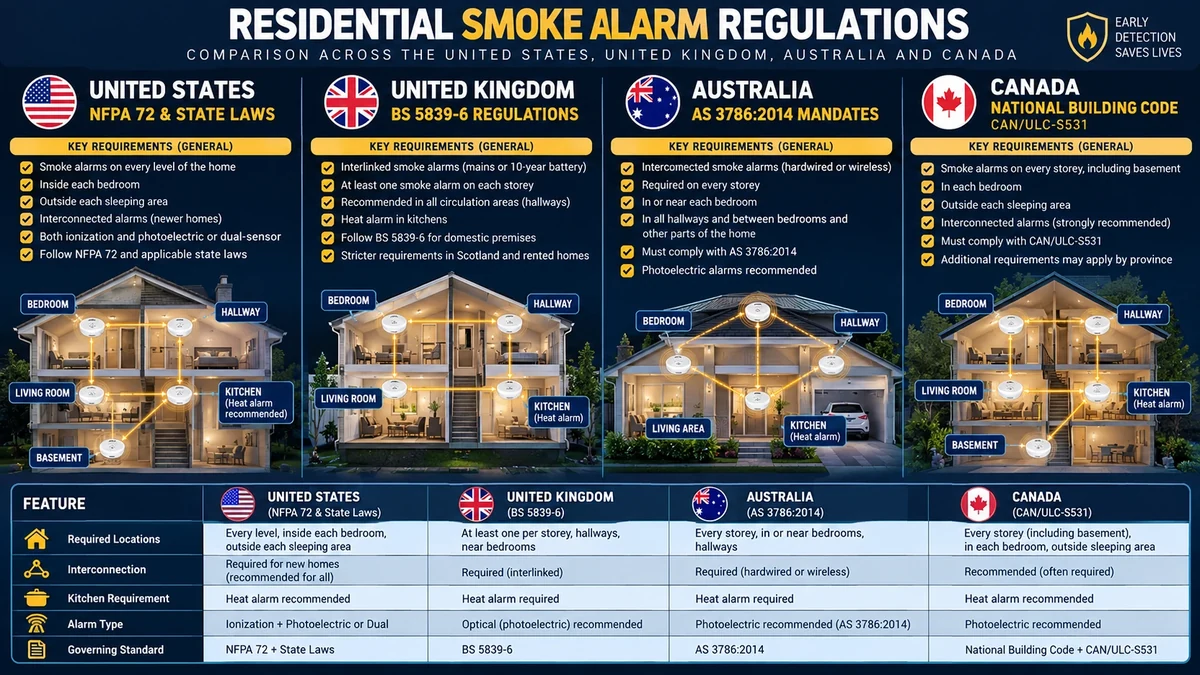
Smoke alarm legislation is established by a layered framework of national model codes, product performance standards, provincial or state statutes, and municipal fire ordinances. Legal obligations depend on four core factors: your geographic jurisdiction, property classification (single-family, multi-family, or HMO), construction or permit year, and occupancy tenure (owner-occupied vs. rented). Below is the comprehensive technical breakdown across the United States, United Kingdom, Australia, and Canada.
Framework: Which Rules Apply to Your Property?
Before evaluating code compliance, distinguish between the three primary categories of fire safety documentation:
- Model Building Codes (e.g., IRC R314, NBC Canada, NCC Australia): Apply strictly to new construction, additions, and permitted major renovations at the time of build.
- Statutory Retrofit & Rental Laws (e.g., California H&SC 13113.8, England PRS Regs, Queensland QFES): Legally binding rules that apply to existing homes, tenancy turnovers, and property sales regardless of construction year.
- Product Manufacturing Standards (e.g., UL 217, BS EN 14604, AS 3786, CAN/ULC-S531): Testing protocols that manufacturers must satisfy for equipment to be legally sold and installed.
Global Regulatory Comparison Overview
| Country / Region | Primary Model Code & Standards | Statutory Scope | Interconnection Rules | Power & Sensor Mandates |
|---|---|---|---|---|
| United States | NFPA 72, IRC Section R314, UL 217 (8th/9th Ed.) | New construction (IRC); existing rentals and retrofits governed by state statutes | Mandatory in all new builds and major alterations; optional for legacy battery retrofits unless mandated by state | Hardwired AC with battery backup for new builds; 10-year sealed lithium batteries required by state laws (e.g., CA, NY, IL, FL, MD) |
| United Kingdom | BS 5839-6, BS EN 14604, Devolved National Acts | Scotland: All tenures; England/Wales/NI: Landlords and new builds | Scotland: Mandatory interlinked across all homes; Wales: Hardwired interlinked in rentals; England: Recommended via BS 5839-6 | England: 1 smoke alarm per living storey (battery allowed); Scotland: Mains D1 preferred for new builds, 10-year sealed battery permitted for retrofits |
| Australia | NCC Volume 2 (Part 3.7.5), AS 3786:2014 | Nationwide for new builds; state-specific schedules for rentals and existing homes | Queensland: Mandatory 100% interconnected in all dwellings (final deadline 1 January 2027); NCC new builds nationally | Photoelectric sensor technology required; 240V mains hardwired or 10-year sealed tamper-proof lithium batteries |
| Canada | National Building Code (NBC 2020), CAN/ULC-S531 | Model code adopted by provinces; provincial fire codes govern existing retrofits | Mandatory in all modern construction across bedrooms, sleeping hallways, and storeys | Hardwired directly to electrical circuit with secondary battery backup; CAN/ULC-S531 certification mandatory |
1. United States Smoke Alarm Regulations (NFPA 72 & IRC R314)
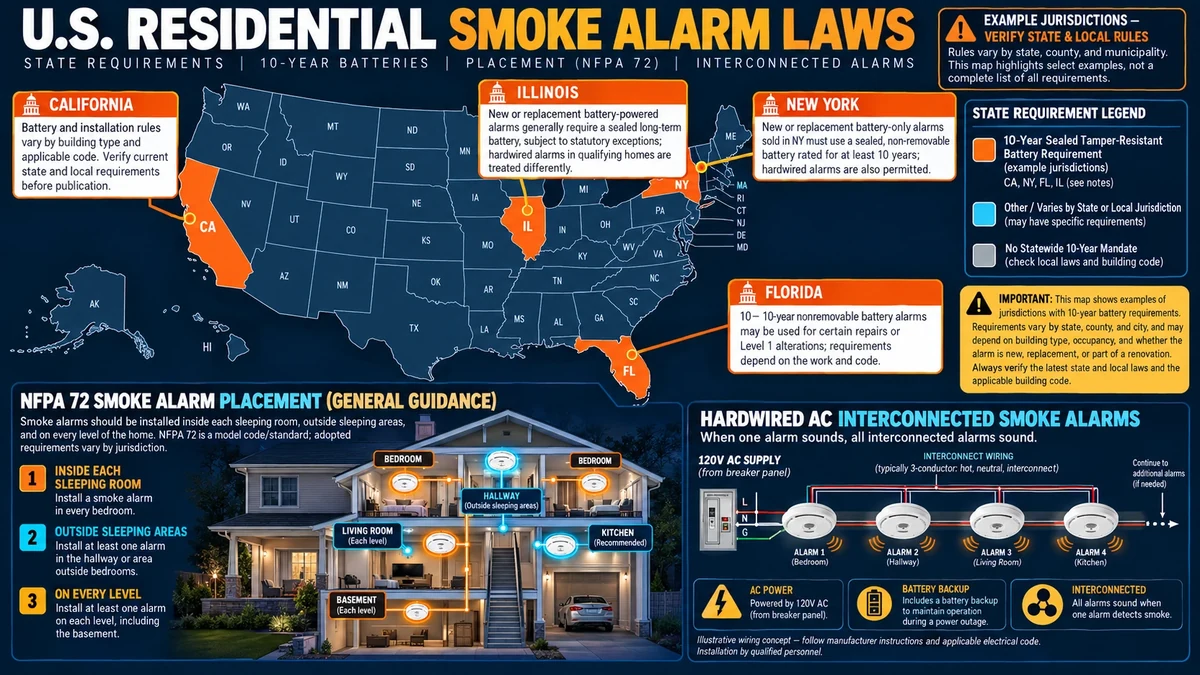
In the United States, residential fire safety is established nationally through model codes published by the National Fire Protection Association (NFPA) and the International Code Council (ICC). These model codes carry legal force once adopted and amended by individual state legislatures and municipal building authorities (the Authority Having Jurisdiction or AHJ).
New Construction vs. Existing Dwellings
- New Construction & Additions (IRC Section R314): Must be hardwired directly to commercial AC power lines with secondary battery backup. All alarms must be interconnected so that when any single device senses smoke, all units sound simultaneously.
- Existing Residential Retrofits: When replacing obsolete battery-operated alarms in existing construction where interior wall framing is closed, many states prohibit the sale and installation of replaceable 9V alkaline units, requiring sealed 10-year tamper-resistant lithium battery units.
Mandatory Placement Locations (NFPA 72 Section 29.5.1)
- Inside Every Bedroom: Mandatory in all modern construction and substantial renovations.
- Outside Each Sleeping Area: In the immediate hallway connecting bedrooms.
- On Every Habitable Story: Including basements and finished attics, placed near the path of egress.
- Distance from Cooking Appliances: Ionization alarms must be located at least 20 feet from permanently installed cooking appliances (or 10 feet if equipped with an alarm hush mechanism); photoelectric alarms must be located at least 6 feet from cooking appliances to minimize nuisance tripping.
Key US Statutory Standards
| Standard / Statute | Type | Scope & Core Requirement |
|---|---|---|
| NFPA 72 (National Fire Alarm & Signaling Code) | Model Standard | Defines installation spacing, sound pressure levels (minimum 75 dBA at pillow level), audibility, and testing schedules. |
| IRC Section R314 (International Residential Code) | Model Building Code | Governs single-family and two-family dwellings; mandates hardwired interconnection and placement. |
| UL 217 (8th & 9th Editions) | Product Safety Standard | Requires advanced polyurethane foam flaming and smoldering fire tests to improve early detection while resisting false cooking alarms. |
| State 10-Year Sealed Battery Acts | State Legislation | Enacted in states including California (H&SC 13113.8), New York (Exec. Law 378), Illinois (425 ILCS 60), Florida, and Maryland for non-hardwired replacements. |
2. United Kingdom Smoke Alarm Regulations (BS 5839-6 & Devolved Legislation)
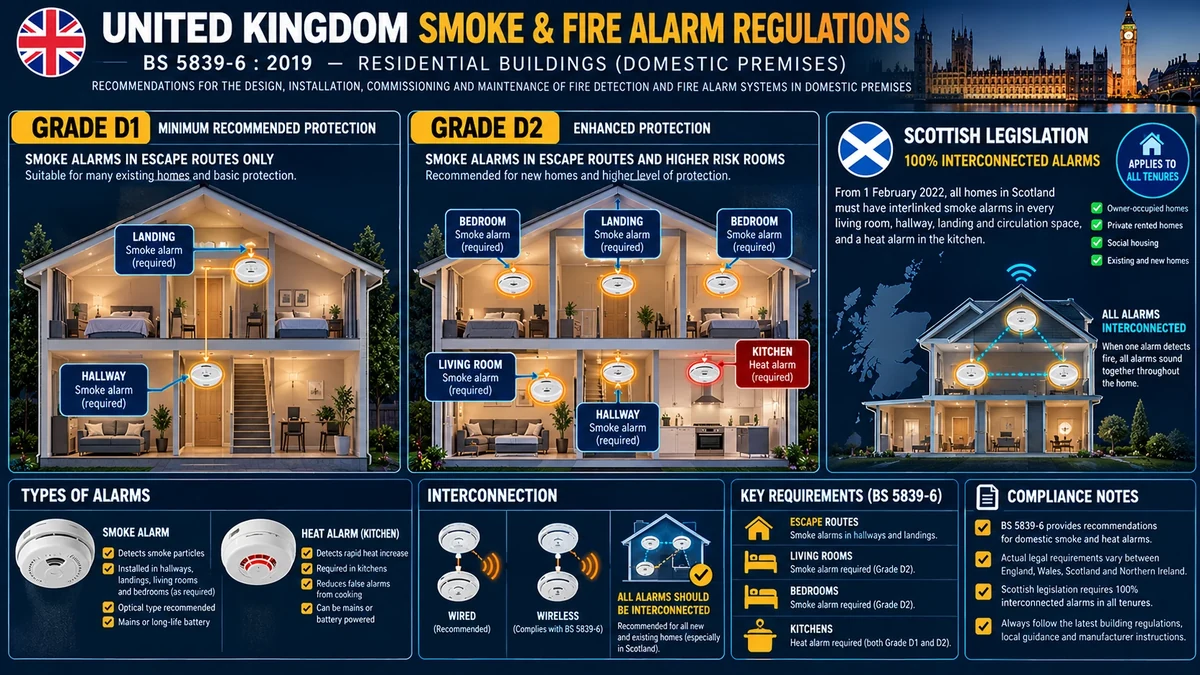
The United Kingdom establishes fire safety engineering best practices through British Standard BS 5839-6 (Code of practice for the design, installation, commissioning and maintenance of fire detection and fire alarm systems in domestic premises). However, statutory legal requirements are devolved and differ substantially across England, Scotland, Wales, and Northern Ireland.
BS 5839-6 System Grades Explained
- Grade D1: A system of one or more mains-powered alarms, each powered from the primary electrical supply with a tamper-proof, non-user-replaceable standby power supply (e.g., rechargeable lithium cells). This is the default recommendation for new residential construction.
- Grade D2: A system of one or more mains-powered alarms with a user-replaceable standby battery (e.g., 9V PP3 alkaline).
- Grade F1 / F2: Battery-powered alarm systems with tamper-proof (F1) or user-replaceable (F2) batteries.
- Category LD2 (Medium Protection): Coverage in all circulation spaces that form escape routes, plus rooms that present a high fire risk (e.g., principal living room and a dedicated heat alarm in the kitchen).
Devolved UK Jurisdictional Rules
| Jurisdiction | Statute / Standard | Legal Requirements by Tenure |
|---|---|---|
| Scotland | Housing (Scotland) Act / Tolerable Standard | Mandatory for ALL domestic properties (owner-occupied and rental): Interlinked alarms comprising 1 smoke alarm in the living room, 1 smoke alarm in each circulation space/hallway per storey, 1 heat alarm in the kitchen, and carbon monoxide detectors near all fuel-burning appliances. Mains-powered Grade D1 is the standard for new builds, while sealed 10-year tamper-proof battery interlinked units are compliant for existing retrofits. |
| England | Smoke and Carbon Monoxide Alarm (Amendment) Regulations 2022 | Mandatory for private and social landlords: At least 1 working smoke alarm on each storey used as living accommodation, and 1 carbon monoxide detector in any room containing a fixed combustion appliance (excluding gas cookers). Battery-operated alarms are legally compliant; physical or wireless interconnection is recommended under BS 5839-6 but is not a statutory requirement for existing tenancies. |
| Wales | Renting Homes (Wales) Act 2016 & Fitness for Human Habitation Regulations 2022 | Mandatory for landlords: Hardwired, interconnected smoke alarms on each storey of the dwelling, linked to the electrical circuit, and carbon monoxide alarms in every room with a fuel-burning appliance. |
| Northern Ireland | Smoke, Heat and CO Alarms Regulations (NI) 2024 (under Private Tenancies Act 2022) | Mandatory for private landlords: Certified smoke alarms installed on every storey, a dedicated heat alarm in the kitchen, and carbon monoxide detectors in rooms with combustion appliances. |
3. Australia Smoke Alarm Regulations (AS 3786:2014 & State Legislation)
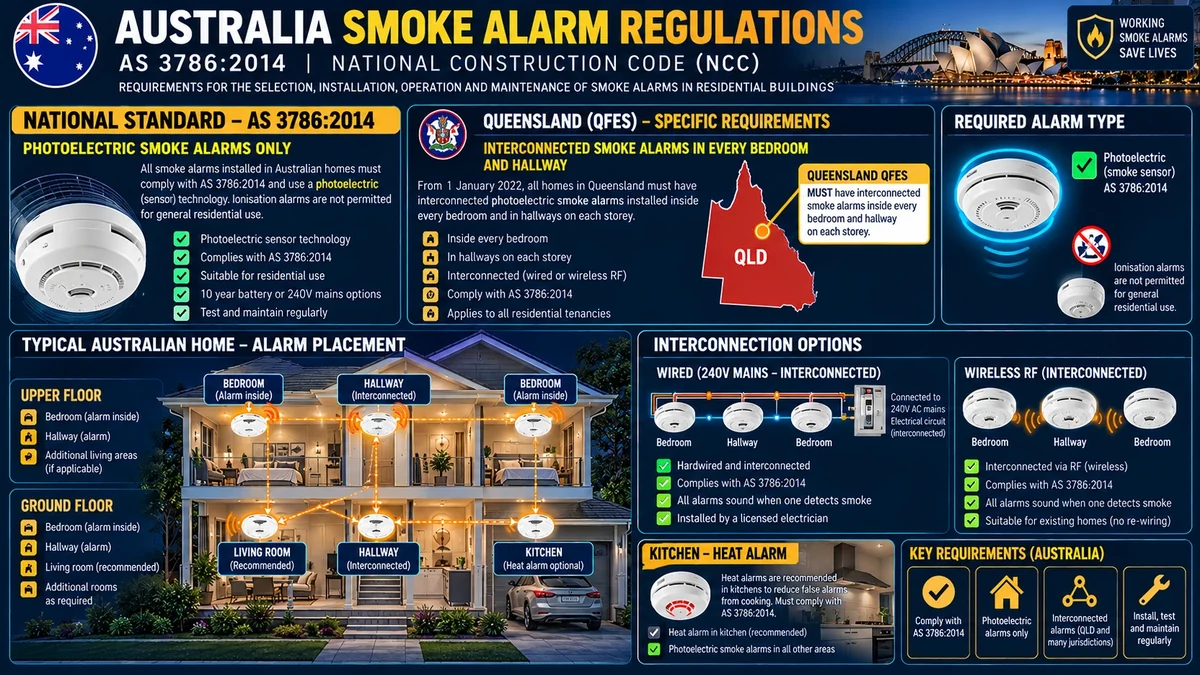
Australia enforces residential building compliance under the National Construction Code (NCC Volume 2, Part 3.7.5 / H3D6) and product certification under Australian Standard AS 3786:2014. State governments hold independent authority over tenancy and retrofit laws.
National Sensor & Technology Mandates
- Photoelectric Technology: Australian fire authorities and national building codes require photoelectric (optical) smoke alarms certified to AS 3786:2014. Ionization alarms have been systematically phased out across state tenancy laws due to significantly slower response times to smoldering household fires.
- 100% Simultaneous Interconnection: When any single alarm activates, all connected units across the residence must sound simultaneously via hardwired 240V interconnect cabling or certified wireless radio-frequency (RF) mesh.
- Permitted Power Sources: Either 240V AC mains-powered with secondary battery backup, or tamper-proof sealed 10-year non-removable lithium battery alarms.
Queensland QFES Standard (Strictest in Australia)
Queensland requires interconnected photoelectric smoke alarms in every bedroom, connecting hallways, and on every storey. The requirement is being phased in under the Fire Services Act 1990:
- 1 January 2017: New and substantially renovated dwellings
- 1 January 2022: Properties being sold or newly leased
- 1 January 2027: All remaining domestic dwellings (including existing owner-occupied homes)
Compliant alarms must be photoelectric (certified to AS 3786:2014), interconnected so that activation of any unit sounds all alarms, and powered either by hardwired 240V AC with battery backup or by a non-removable 10-year sealed lithium battery. Ionization and dual-sensor (ionization + photoelectric) alarms are not permitted.
| Stage | Effective Date | Property Scope & Compliance Mandate |
|---|---|---|
| Stage 1 | 1 January 2017 | All new residential dwellings and substantial renovations: Interconnected photoelectric alarms in every bedroom, connecting hallways, and on every storey. |
| Stage 2 | 1 January 2022 | All domestic dwellings leased, tenanted, or sold: Must be fully upgraded to interconnected photoelectric alarms in every bedroom and hallway prior to lease start or property settlement. |
| Stage 3 | 1 January 2027 | All remaining existing domestic dwellings (including all owner-occupied homes): Every residence in Queensland must have interconnected photoelectric alarms installed in all bedrooms, hallways, and levels by this final legal deadline. |
4. Canada Smoke Alarm Regulations (National Building Code & Provincial Fire Codes)
In Canada, national technical standards are published as model codes by the National Research Council (Codes Canada). The National Building Code of Canada (NBC) governs new construction once adopted by provincial and territorial governments, while existing buildings are regulated by provincial fire codes and municipal bylaws.
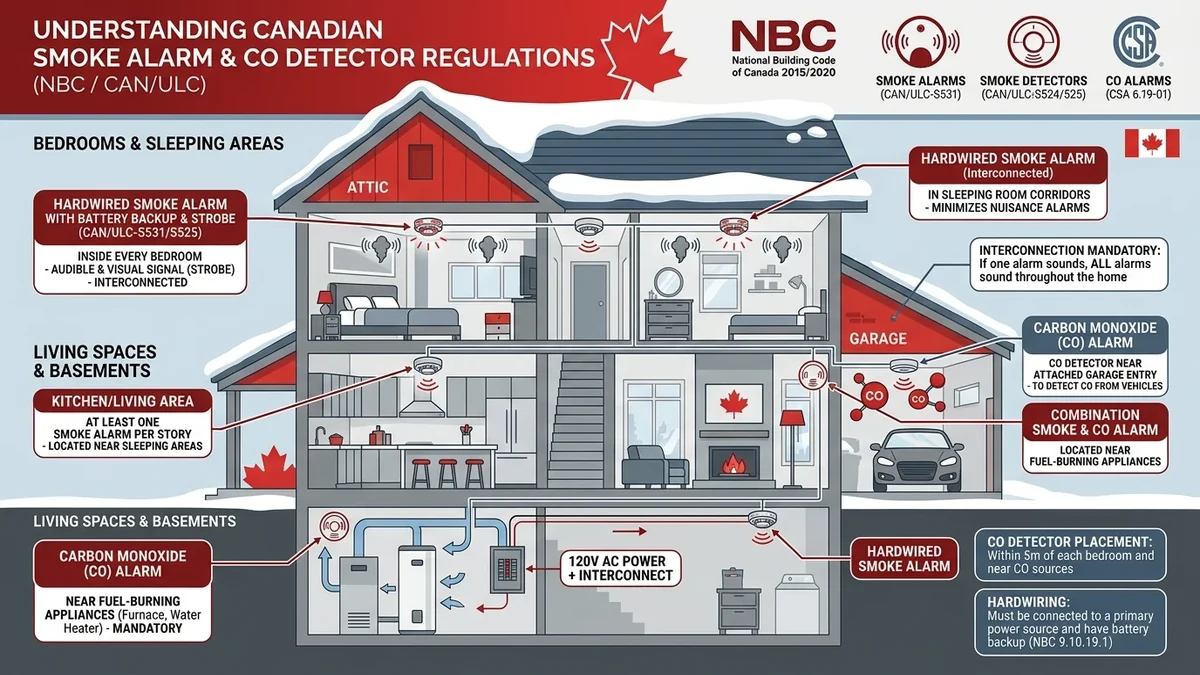
National Building Code Requirements (Division B, Subsection 9.10.19)
- Inside Each Bedroom: Since the 2015 NBC update, smoke alarms are mandatory inside every bedroom, in corridors serving sleeping rooms, and on each storey of a residential dwelling (including basements).
- Hardwired Power Supply: Alarms in new construction must be permanently hardwired directly to an AC electrical circuit with no disconnect switch between the overcurrent breaker and the alarm, accompanied by secondary battery backup.
- Audible Interconnection: Activation of any single alarm must initiate simultaneous sounding across all smoke alarms in the dwelling unit.
- Product Certification: All smoke alarms installed in Canada must be certified to national standard CAN/ULC-S531 (Standard for Smoke Alarms). Combination smoke and carbon monoxide alarms must satisfy both CAN/ULC-S531 and CAN/ULC-S588 / CSA 6.19.
Provincial Fire Codes & Landlord Maintenance (e.g., Ontario O. Reg. 213/07)
Provincial fire codes govern existing residential occupancies and impose strict statutory duties on property owners:
- Ontario Fire Code: Property owners must maintain working smoke alarms on every storey and outside all sleeping areas. Landlords must test alarms annually, replace batteries annually, test alarms prior to each new tenancy, and maintain signed compliance inspection records.
- Tenant Obligations: Under provincial laws, tenants may not disable, disconnect, or remove smoke alarm batteries without replacing them immediately, and must report any malfunction to the property owner.