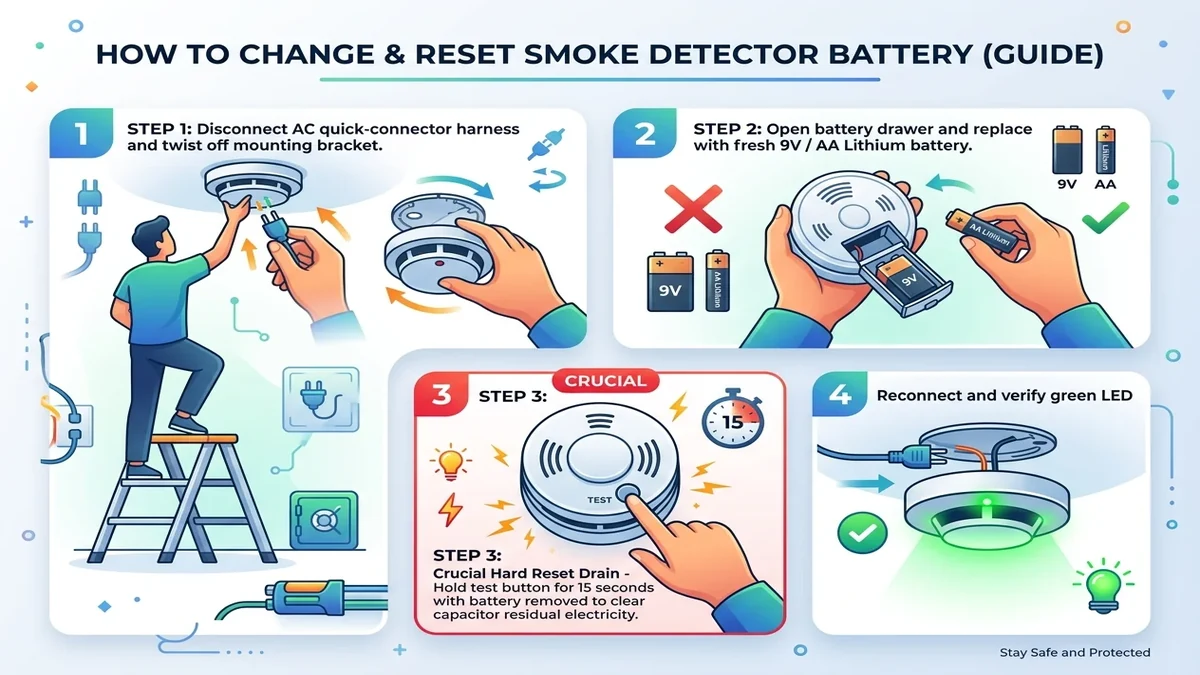
Reliable power is fundamental to smoke alarm function. Understanding your unit's battery chemistry, discharge curve, and voltage thresholds prevents unexpected low-battery chirps and ensures life-safety readiness.
Comparison of Smoke Alarm Power Technologies
| Power System | Typical Lifespan | Maintenance Cycle | Key Advantage | Primary Limitation |
|---|---|---|---|---|
| 9V Alkaline | 1 to 2 years | Annual replacement recommended | Low initial purchase cost; widely available | Steep discharge curve; sensitive to cold nighttime drops |
| 9V Lithium (Ultralife/Energizer) | 5 to 10 years | Replace every 5 to 10 years | Flat voltage curve; excellent cold-temperature performance | Higher unit cost; sudden voltage cliff at discharge |
| AA / AAA Multi-Cell Alkaline | 1 to 3 years | Annual replacement recommended | Higher milliamp-hour (mAh) capacity than standard 9V | Requires identical matching cells; risk of uneven discharge |
| 10-Year Sealed Lithium | 10 years | Zero battery swaps; replace unit at 10 years | Tamper-resistant; eliminates low-battery maintenance | Entire alarm must be discarded when battery expires |
| Hardwired AC with Battery Backup | 10 years (unit) | Replace backup cell per manufacturer guidance | Continuous mains power with emergency outage protection | Requires professional AC wiring; backup battery still degrades |
Why Smoke Alarms Chirp at Night
Low-battery warning chirps frequently begin between 2:00 AM and 6:00 AM. As ambient room temperatures drop overnight, chemical resistance inside alkaline batteries increases, causing a temporary voltage drop below the alarm's internal low-battery threshold (typically ~7.5 to 8.4V on 9V alarms). Replacing the cell with a fresh battery resolves the issue.
Detailed Power & Battery Guides
- 9V Smoke Alarm Batteries Guide - Alkaline vs. lithium performance curves.
- AA Smoke Alarm Batteries Guide - Multi-cell configuration rules.
- 10-Year Sealed vs Replaceable Batteries - Cost, compliance, and convenience comparison.
- Smoke Alarm Battery Keeps Dying - Diagnose parasitic drains and terminal issues.
- How to Change Smoke Alarm Battery - Step-by-step replacement guide.