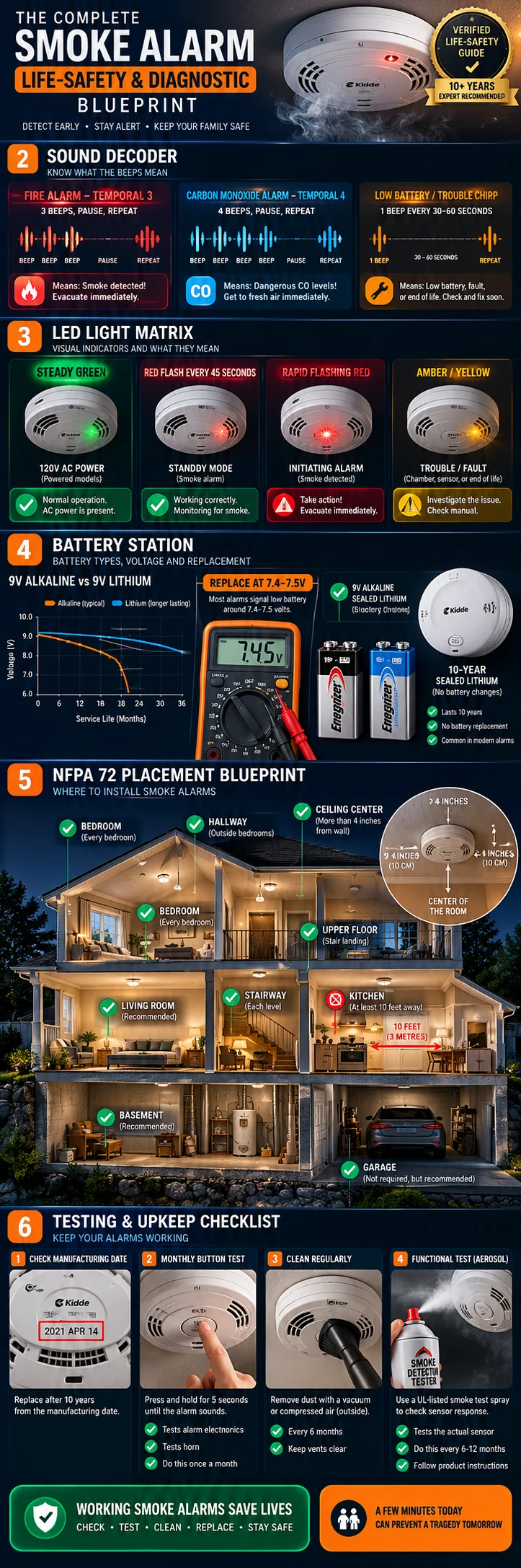
Commercial fire alarm systems protect large multi-tenant buildings, industrial plants, and healthcare facilities. Statutory Inspection, Testing, and Maintenance (ITM) ensures system reliability and regulatory compliance.
NFPA 72 Commercial ITM Schedule
| Component | Visual Inspection | Functional Test | Testing Standard & Procedure |
|---|---|---|---|
| FACP Control Unit | Weekly / Monthly | Annual | Verify normal AC power, trouble LED lamps, fuse integrity, and interconnect relays |
| Secondary Batteries | Monthly | Semi-Annual | Load-voltage test on sealed lead-acid cells; verify 24-hr standby + 5-min alarm capacity |
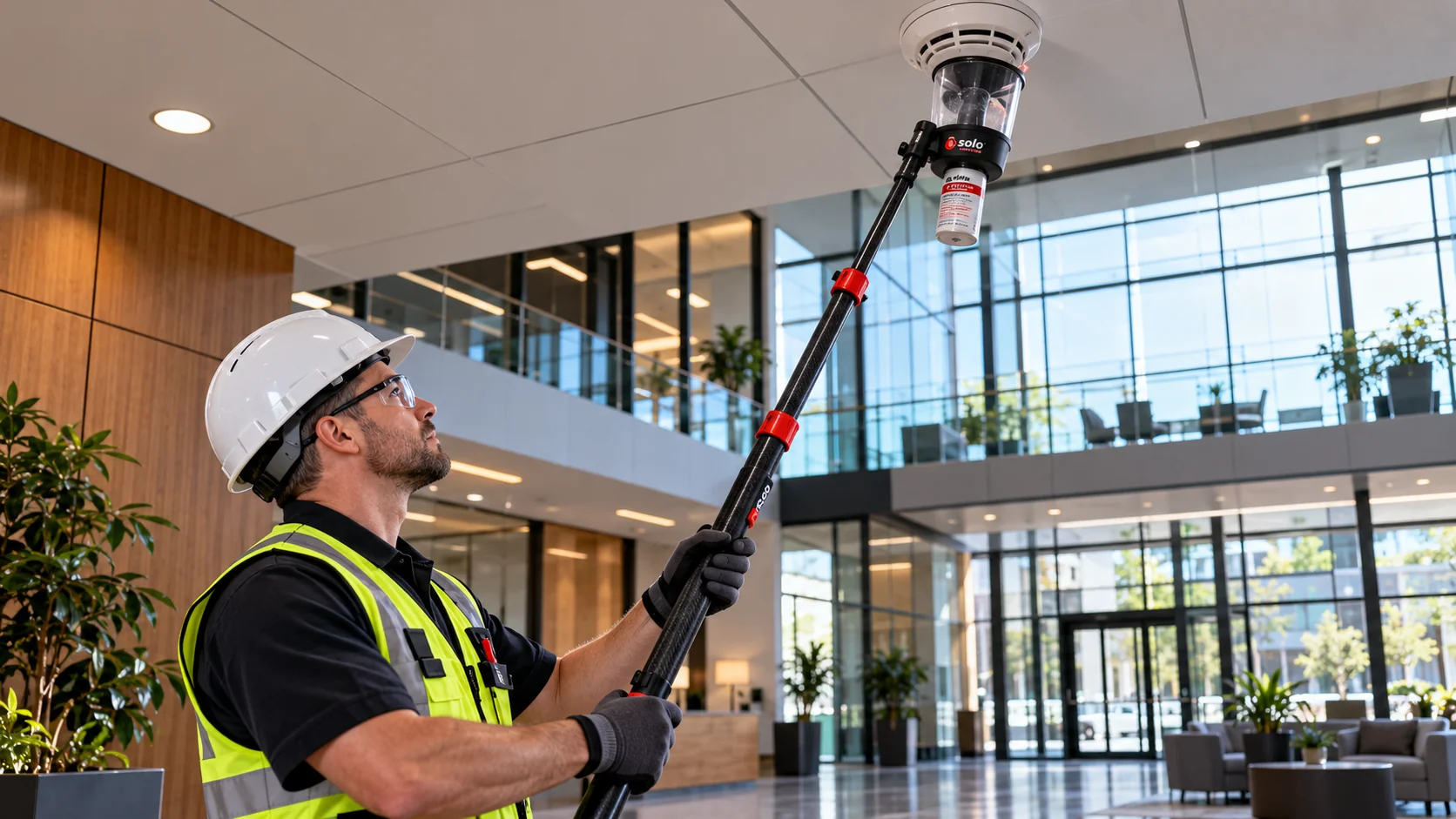
| Smoke Detectors | Semi-Annual | Annual | Test using aerosol smoke spray or calibrated dispenser; verify address at FACP |
| Duct Smoke Detectors | Semi-Annual | Annual | Verify sampling tube differential pressure with digital manometer; test HVAC fan shutdown |
| Manual Pull Stations | Semi-Annual | Annual | Manual mechanical pull; verify address latch and panel receipt within 10 seconds |
| Audible & Visual Appliances | Semi-Annual | Annual | Measure sound pressure (dBA) with calibrated sound level meter; verify strobe flash sync |
AHJ Fire Alarm Inspection Checklist: NFPA 72 Compliance Mandates
Local fire marshals and Authorities Having Jurisdiction (AHJ) inspect commercial life safety systems under International Fire Code (IFC) Section 907.8 and NFPA 72 Chapter 14. An official inspection checklist requires certified technicians to audit every subsystem:
- Control Unit & Power Supplies: Verify primary 120V/240V AC dedicated branch circuit breaker lock-out. Measure secondary sealed lead-acid battery voltage under full load to confirm 24 hours of standby power followed by 5 minutes (or 15 minutes for emergency voice alarm systems) of continuous alarm operation.
- Signaling Line Circuit (SLC) Integrity: Confirm Class A (redundant return path) or Class B supervised wiring loops. Verify panel detects opens, shorts, and ground faults without dropping addressable communication.
- Digital Communicator & Cellular Transmitters: Perform off-premises communication test to Central Station. Signals for alarm, trouble, and supervisory states must transmit and confirm receipt within 90 seconds under NFPA 72 standards.
- Emergency Control Function Interfaces: Test fire door magnetic holders for immediate release. Verify elevator phase 1 primary and alternate floor recall captures cars safely away from fire floors. Check damper actuation and stairwell pressurization fans.
- Waterflow & Tamper Switches: Test fire sprinkler riser vane-type waterflow switches. Verify retard timer delays alarm transmission by 20 to 60 seconds to filter out municipal water pressure surges. Test valve tamper switches to ensure supervisory signals trigger within two full turns of the valve stem.
Commercial Duct Smoke Detector Testing & Differential Pressure Protocol
Commercial duct smoke detectors (such as the System Sensor D4120 series) sample fast-moving air inside commercial HVAC ductwork. Testing requires specialized aerodynamic and electrical verification:
| Testing Phase | Required Equipment | Acceptable Parameter | Failure Consequence |
|---|---|---|---|
| Differential Pressure Audit | Digital Manometer or Magnehelic Gauge | 0.01 to 1.20 inches of water column (in-w.c.) | Air bypasses sampling tube; detector fails to capture passing smoke. |
| Aerosol Smoke Entry Test | UL-Listed Test Smoke with Extension Wand | Smoke enters inlet tube holes; alarm fires in < 15s | Sampling holes clogged with HVAC dust; sensor blinded. |
| HVAC Fan Shutdown Interlock | Auxiliary Form C Relay Contact Monitor | Supply/return fans de-energize immediately | Air handling unit continues circulating toxic gases through building. |
| Remote Test Station / Key Switch | RTS151 Key Station or Magnet Wand | Panel receives supervisory/alarm signal | Inaccessible high-ceiling duct units cannot be safely tested. |
NFPA 72 Smoke Detector Sensitivity Testing Protocols (§ 14.4.4.3)
Sensitivity testing measures the exact smoke obscuration threshold required to trip an initiating device. Under NFPA 72 Section 14.4.4.3, functional smoke testing (injecting aerosol) confirms circuit completion, but does not prove whether a sensor has drifted out of its listed calibration window. Dirt, airborne particulate matter, and component aging alter photocell response over time.
| Obscuration Status | Measured Range (%/ft) | System Diagnostic State | Required Maintenance Action |
|---|---|---|---|
| Factory Listed Normal | 1.5% to 2.5% obscuration/ft | Normal standby operation | Record baseline reading on NFPA 72 inspection certificate. |
| Chamber Dust Drift | 2.6% to 3.5% obscuration/ft | Pre-alarm / Maintenance alert flag | Clean labyrinth chamber with filtered dry air; re-test sensitivity. |
| Excessive High Sensitivity | < 1.0% obscuration/ft | Unstable: prone to false trips | Sensor over-sensitive; clean optical labyrinth or replace head immediately. |
| Desensitized Blind Sensor | > 4.0% obscuration/ft | Failed life-safety threshold | Detector cannot detect smoldering fires in time; replace head immediately. |
NFPA 72 mandates the initial sensitivity test within one year of system commissioning. Subsequent tests must occur every alternate year (every 2 years). If two consecutive biennial tests confirm the detector has remained within its listed sensitivity range, the testing interval may be legally extended up to a maximum of 5 years under NFPA 72 Section 14.4.4.3.3.
NFPA 72 Section 14.4.4.3.1 permits only four methods for sensitivity verification:
- Calibrated Optical Test Method: Injecting calibrated aerosol obscuration using field testing equipment (such as Solo 365 electronic dispenser).
- Manufacturer Calibrated Instrument: Connecting specialized field service meters (such as System Sensor MOD400R) directly into the detector test port.
- Listed FACP Software Diagnostics: Reading certified drift compensation and chamber obscuration levels directly from the panel LCD or software report (such as Notifier AFP, Fire-Lite MS-9600, or Simplex 4100ES TrueAlarm reports).
- AHJ-Approved Calibration Method: Other laboratory-calibrated test methods authorized by the local fire prevention bureau.
Secondary Power & Battery Standby Load Calculations (§ 10.6.7)
Commercial fire alarm panels must maintain continuous operation during complete primary AC power failure. Under NFPA 72 Section 10.6.7, secondary power supplies (typically sealed lead-acid AGM batteries) must supply 24 hours of non-alarm standby power, followed immediately by 5 minutes of full-load building evacuation alarm (or 15 minutes for Emergency Voice/Alarm Communication Systems, EVACS).
Certified technicians calculate required battery amp-hour (Ah) capacity using the standard engineering formula:
The 1.20 multiplier represents a mandatory 20 percent safety derating factor accounting for lead-acid cell aging, electrolyte evaporation, and ambient temperature degradation over time.
Routine open-circuit voltage tests (measuring terminal voltage with a voltmeter while on float charge) fail to detect internal plate sulfation. Technicians must disconnect the AC supply and conduct a true 30-minute load discharge test, or measure dynamic admittance using a digital conductance analyzer (such as a Midtronics Celltron). Batteries exhibiting less than 80 percent of original rated conductance must be replaced immediately. Under NFPA 72 guidelines, SLA batteries must be replaced every 3 to 5 years from the factory manufacturing date code, regardless of appearance.
Notification Appliance Audibility & Strobe Synchronization (§ 18.4 & § 18.5)
Audibility testing requires an ANSI S1.4 Type 2 calibrated sound level meter set to A-weighting (dBA) with fast response:
- Public Mode Notification (§ 18.4.3): Sound pressure level must reach at least 15 dBA above the average ambient sound level, or at least 5 dBA above the maximum ambient sound level having a duration of at least 60 seconds, measured 5 feet (1.5 m) above floor level.
- Sleeping Area Requirements (§ 18.4.6): Notification appliances in sleeping rooms must produce a minimum sound level of 75 dBA at pillow level, or 15 dBA above ambient. Where commercial occupancies house sleeping individuals, NFPA 72 mandates a low-frequency 520 Hz square wave audible signal to awaken high-risk occupants.
- Visual Strobe Flash Synchronization (§ 18.5.5): Where more than two visible notification appliances are in the field of view, strobes must flash in synchronized harmony at 1 Hz to 2 Hz (60 to 120 flashes per minute) to eliminate photo-induced epileptic seizure risks.
Commercial Systems vs Residential Interconnected Alarms
Understanding the regulatory boundary between commercial fire alarm systems and residential interconnected smoke detectors prevents costly building code violations:
- Supervised Wiring: Commercial systems constantly monitor all circuit conductors with a supervisory DC current. An open wire, broken splice, or ground fault instantly reports an audible trouble condition to the FACP. Residential smoke alarms do not supervise interconnect traveler wires.
- Operating Voltage: Commercial fire alarm control panels operate field devices on 24V DC filtered power over shielded twisted pair cable (FPLR/FPLP). Residential alarms operate directly on 120V AC household branch circuits with 9V or AA battery backup.
- Evidentiary Maintenance Logs: Commercial building owners must archive NFPA 72 Records of Inspection and Testing on site for a minimum of 2 years (or 5 years in many municipal AHJ jurisdictions), available for random fire marshal audits at any time.