Kidde manufactures residential fire protection devices spanning traditional ionization units, advanced photoelectric alarms, combination CO systems, and connected smart home alarms.
Kidde Product Lineup & Specification Matrix
| Model Series | Power Source | Sensor Type | Key Features |
|---|---|---|---|
| Kidde i12040 / i12060 | 120V Hardwired + 9V Backup | Ionization | Fast response to flaming fires; front-load or rear battery tray; hardwire interconnect |
| Kidde P12040 | 120V Hardwired + 9V Backup | Photoelectric | Superior smoldering fire detection; highly resistant to cooking false alarms |
| Kidde i9010 / P3010B | 10-Year Sealed Lithium | Photoelectric (P3010) / Ion (i9010) | Worry-Free 10-year sealed battery; zero battery swaps; tamper-resistant |
| Kidde TruSense Series | Hardwired or 10-Year Battery | Multi-Criteria Optical | Complies with UL 217 8th/9th edition polyurethane foam and cooking smoke standards |
| Kidde Smart Smoke + CO | 120V Hardwired + Backup | Photoelectric + Electrochemical | Wi-Fi app notifications, voice location alerts, Google Home/Alexa support |
Kidde Interconnect & Wiring Plugs
Kidde hardwired alarms use a proprietary 3-pin quick-connect harness:
- Black Wire: 120V AC Line power.
- White Wire: AC Neutral.
- Yellow or Orange Wire: 9V DC Interconnect traveler line (connects up to 24 Kidde devices).
If replacing older Firex or BRK alarms, Kidde manufactures adapter plugs (such as the Kidde KA-F) that allow new Kidde alarms to plug directly into existing wiring harnesses without wire nut splicing.
Is FireX and Kidde the Same Company? Acquisition History & Adapter Wiring
A common question during home retrofits is whether FireX and Kidde are the same company. FireX (originally manufactured by Maple Chase and Invensys Controls) was acquired in 2008 by Kidde parent organization United Technologies Corporation (UTC). Following the acquisition, the standalone FireX brand was phased out and fully integrated into Kidde life safety systems.
If your home has older FireX ceiling brackets and wiring harnesses (such as models FX1218, 120-1182, or G-6), you do not need to cut down electrical boxes or re-strip wire nuts. Kidde manufactures direct adapter harnesses:
- Kidde KA-F Adapter: Connects legacy FireX 3-pin quick-connect harnesses directly to modern Kidde smoke and combination alarms without rewiring.
- Kidde KA-B Adapter: Allows Kidde alarms to plug into existing First Alert and BRK wiring harnesses without touching electrical junction splices.
- Cross-Brand Interconnect Rule: While power adapter plugs simplify physical mounting, always ensure all interconnected alarms on the traveler wire share the same communication protocol to prevent false system triggers.
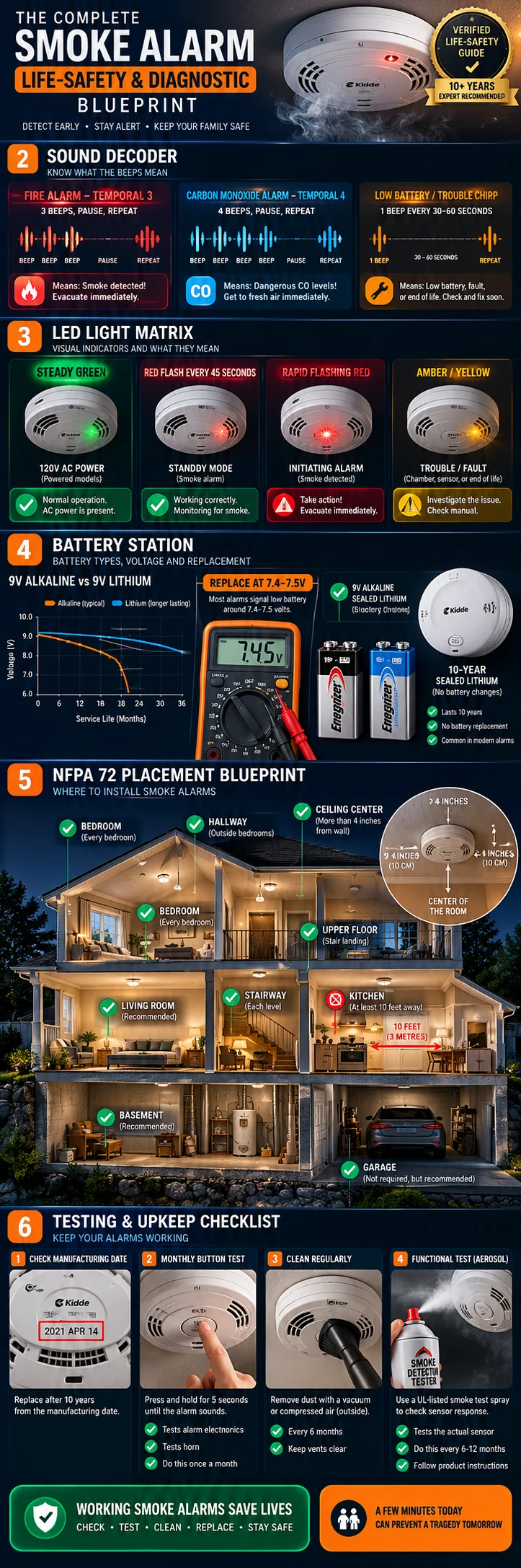
Kidde Fire Alarm LED Light Meanings: Green, Red, Orange & Amber
Kidde smoke alarms communicate operating status, power source health, and fault conditions through distinct LED light colors and blink sequences:
| LED Light Color & Pattern | Operational Meaning | Audible Status | Recommended Field Action |
|---|---|---|---|
| Steady Green Light | Normal 120V AC line power connected | Silent standby | No action required; circuit breaker and wiring are functioning correctly. |
| Flashing Green (Every 60s) | Unit operating on DC battery power only | Silent standby | Check circuit breaker or verify quick-connect harness is fully seated if AC power is expected. |
| Flashing Red (Every 1s) | Initiating alarm detecting active combustion | 85 dB Temporal-3 Siren | Evacuate premises immediately or press Hush button if confirmed nuisance cooking fumes. |
| Flashing Red (Every 10s) | Hush mode active (desensitized chamber) | Silent / Periodic soft tick | Ventilate area; unit will automatically restore full sensitivity within 8 to 10 minutes. |
| Flashing Red (Every 30-60s) | Low battery backup voltage | Single chirp every 30-60s | Replace backup battery immediately (9V alkaline or 2 AA cells depending on model). |
| Rapid Flashing Red | Alarm memory indicator | Silent standby | Identifies which specific interconnected alarm triggered the most recent emergency event. |
| Orange or Amber Light | Sensor chamber trouble or end-of-life fault | Single or double chirp | Clean sensor with compressed air; replace unit immediately if manufacture date exceeds 10 years. |