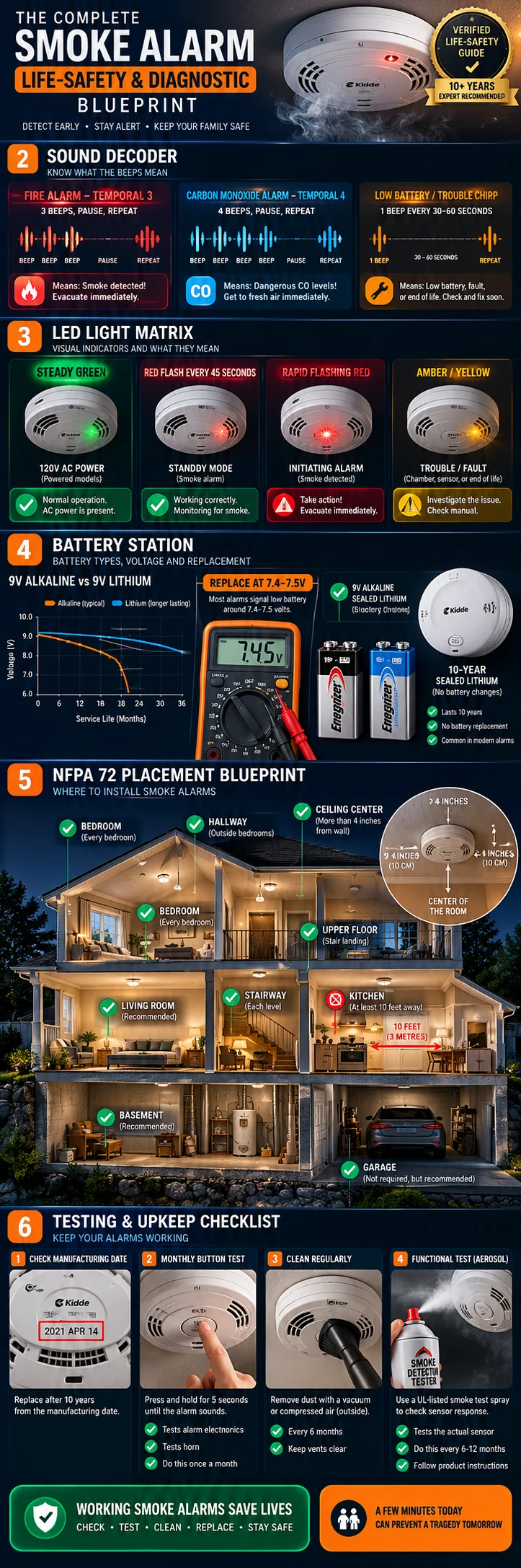
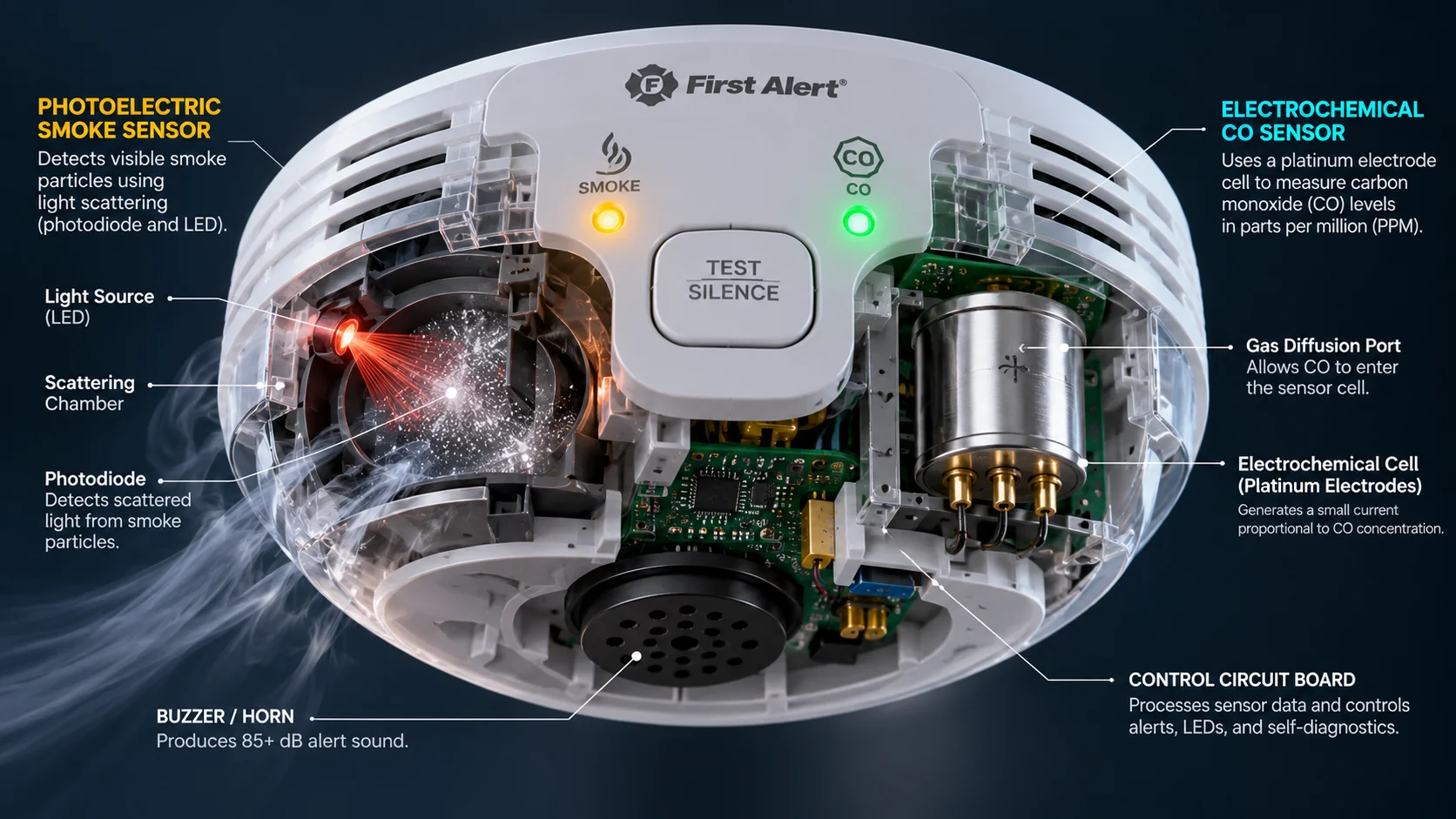
Combination smoke and carbon monoxide (CO) detectors integrate optical smoke sensing labyrinths and electrochemical CO catalytic cells into a single ceiling or wall-mounted chassis. Understanding dual-sensor warning cadences, voice location alert technology, and 10-year sensor expiration rules under NFPA 72 and UL 2034 provides complete multi-hazard home protection.
Electrochemical Lifespan: Modern 10-Year vs. Legacy 5-Year Sensors
A major purchasing dilemma centers on detector service lifespan. Historically, electrochemical carbon monoxide sensors degraded much faster than optical smoke sensors:
| Hardware Generation | CO Sensor Chemistry | Certified Lifespan | End-of-Life Audible Behavior |
|---|---|---|---|
| Legacy Units (Pre-2015) | Early liquid electrolyte cells | 5 to 7 years maximum | Emits 2-chirp or 3-chirp EOL code while smoke sensor is still operational |
| Modern Generation (UL 2034 5th Ed) | Stabilized platinum catalyst gel electrolyte | Full 10 years (120 months) | Synchronized 10-year end-of-life retirement for both smoke and CO sensors |
| Sealed 10-Year Lithium Units | Integrated LiFePO4 / Lithium Metal | Full 10 years maintenance-free | Internal ASIC countdown timer locks alarm permanently at 3,650 operating days |
Combination Detector Technology & Warning Signals
Combination detectors monitor for two entirely different physical hazards, communicating the specific threat through standardized audible and voice protocols:
| Monitored Threat | Physical Sensor Technology | Standard Acoustic Cadence | Voice Alert Announcement |
|---|---|---|---|
| Smoke & Combustion Fire | 940 nm infrared photoelectric light-scattering chamber | Temporal 3 (3 loud horn blasts, 1.5s pause, repeated) | "FIRE! FIRE!" + Location (e.g. "Smoke in Hallway") |
| Carbon Monoxide (CO Gas) | Electrochemical platinum catalyst oxidation cell | Temporal 4 (4 quick horn pulses, 5s pause, repeated) | "WARNING: CARBON MONOXIDE!" + PPM level |
| Low Battery Warning | Microprocessor analog-to-digital voltage sampling | 1 chirp every 60 seconds with amber/red flash | "LOW BATTERY" (on voice-enabled models) |
| End-of-Life Expiration | Non-volatile internal ROM countdown timer (7-10 years) | 2 or 5 chirps per minute; screen displays "End" | "REPLACE ALARM" |
The Critical Advantage of Voice Location Announcements
In high-stress emergency events, research demonstrates that human waking response (particularly among sleeping children and elderly occupants) is significantly faster when prompted by a calm, authoritative human voice than by an abstract high-frequency horn:
- Immediate Threat Identification: A continuous horn blast does not inform waking occupants whether they are facing a rapidly spreading fire (requiring immediate low crawling and egress) or an invisible carbon monoxide leak (requiring immediate outdoor evacuation). Voice alerts explicitly state the hazard.
- Programmable Location Identification: When interconnected, modern combination alarms (such as First Alert Voice & Location and Google Nest Protect) state exactly where the danger originated: "Warning: Smoke detected in the Basement" or "Carbon Monoxide in the Kitchen." This allows family members on upper floors to avoid moving toward the fire source during evacuation.
The 7-to-10 Year Expiration Rule for Combination Alarms
Homeowners frequently ask: If the smoke alarm portion of my combination unit is still functional, do I really have to replace the unit at 7 to 10 years?
The answer is an absolute yes. While optical smoke sensing chambers can technically detect particulates for a decade or more, the electrochemical carbon monoxide sensing cell relies on an aqueous chemical electrolyte that dehydrates and oxidizes over 7 to 10 years of ambient exposure.
Under UL 2034 and UL 217 dual-certification standards, combination alarms feature an automated end-of-life lockout. Once the internal timer reaches 7 or 10 years (depending on model series), the unit locks into end-of-life warning status. The entire combination device must be replaced to maintain certified CO protection.
Proper Mounting Placement for Combination Units
Because carbon monoxide molar mass (28.01 g/mol) is nearly identical to surrounding ambient air (28.97 g/mol), carbon monoxide mixes evenly throughout the atmospheric volume rather than rising or sinking:
- Because the device contains a smoke alarm, it must follow smoke alarm placement rules: mount on the ceiling at least 4 inches away from side walls, or high on a wall 4 to 12 inches down from the ceiling.
- Install combination alarms on every habitable story of the home, inside every bedroom, and in immediate sleeping hallways within 21 feet of bedroom doors.