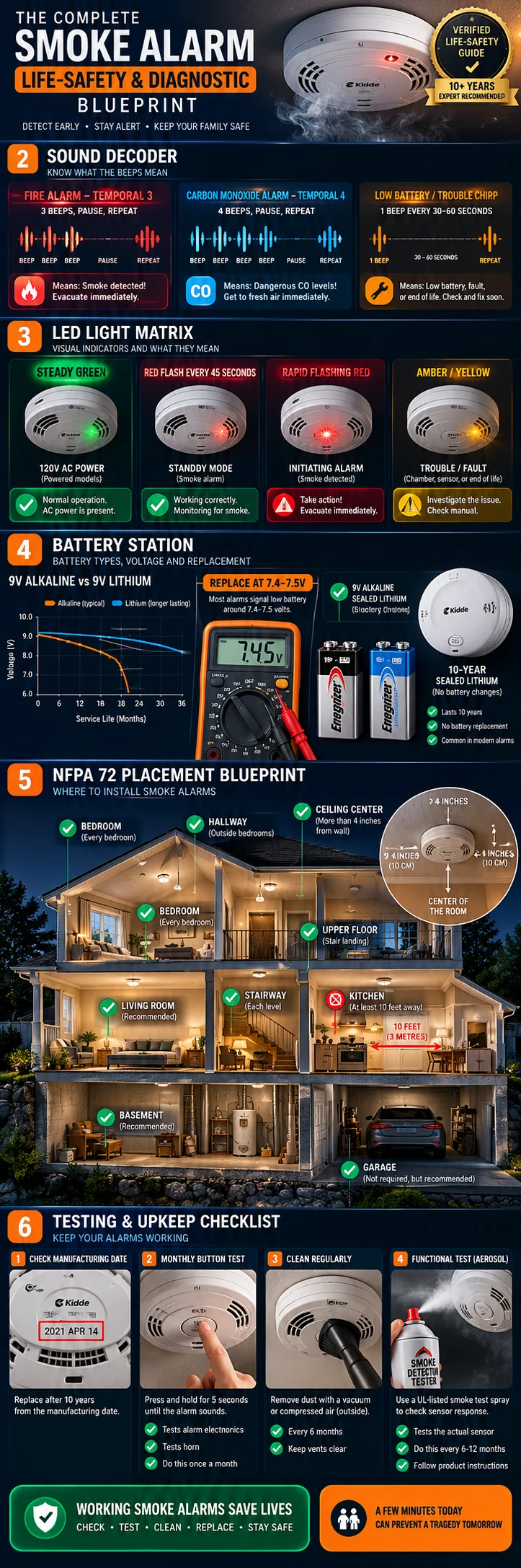
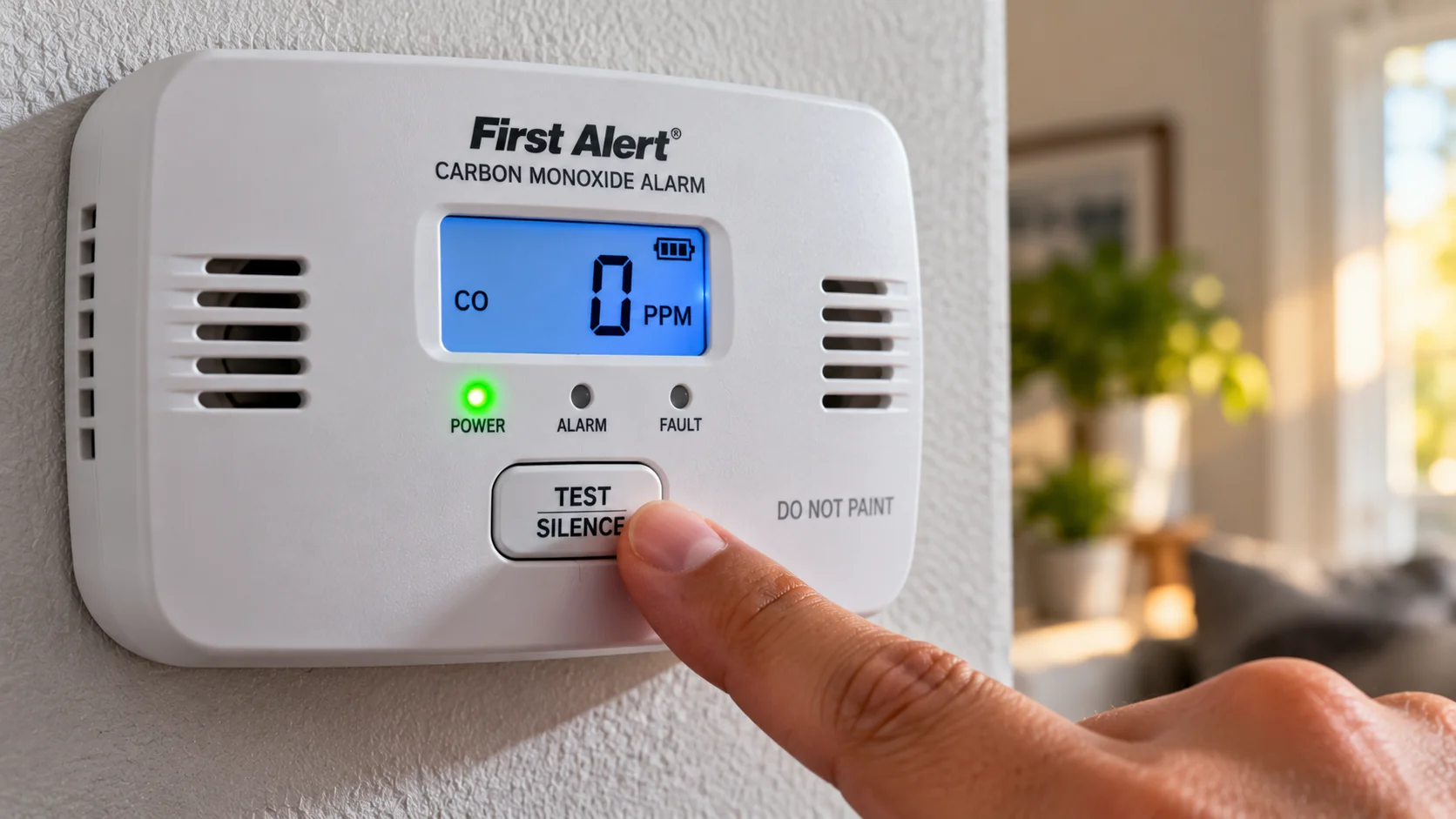
Carbon monoxide (CO) detector audible alerts adhere to strict international safety standards under UL 2034 and NFPA 72. Recognizing the precise acoustic cadence separates life-threatening toxic gas emergencies from low-battery chirps, sensor faults, and electrochemical end-of-life expirations.
Immediate Emergency Protocol: The 4-Beep Warning Pattern
If your detector sounds 4 quick horn pulses followed by a 5-second silence pause (Temporal 4 pattern), toxic carbon monoxide gas has breached dangerous exposure thresholds:
- Evacuate Immediately: Move all family members and pets into fresh outdoor air immediately. Do not stop to open windows or collect personal belongings.
- Count Occupants: Verify everyone is accounted for outside the structure.
- Call 911 / Emergency Dispatch: Dial emergency services from your mobile phone once safely outside. Inform dispatch whether anyone exhibits headaches, dizziness, nausea, confusion, or weakness.
- Do Not Re-Enter: Never re-enter the dwelling until municipal fire department personnel wearing self-contained breathing apparatus (SCBA) have surveyed the atmosphere with calibrated multigas meters and declared the premises safe.
Audible Cadence & Digital Display Diagnostic Decoder
| Audible Beep Cadence | LCD Display / LED Status | Underlying Operational State | Immediate Field Action Required |
|---|---|---|---|
| 4 Beeps → 5s Pause → 4 Beeps | Flashing Red LED / Active PPM Number | EMERGENCY: Dangerous CO concentration | Evacuate structure immediately to fresh outdoor air; dial 911 |
| 1 Chirp every 60 seconds | Red LED flashes with chirp; "Lb" or "bAt" | Low Backup Battery Voltage | Install fresh 9V or AA industrial alkaline cells |
| 1 Chirp every 30 seconds | Flashing Amber LED; "Err" or "E01" | Internal Microprocessor / Sensor Fault | Perform 15-second capacitor reset; replace if code persists |
| 2 to 5 Chirps every 30 to 60 seconds | Solid Amber / "End" displayed on screen | Electrochemical Sensor Depleted (7-10 Yrs) | Replace entire carbon monoxide alarm; sensor is permanently spent |
The Electrochemical Sensor Lifespan: Why CO Detectors Expire
Unlike smoke alarms that utilize optical infrared photodiodes capable of sensing indefinitely, carbon monoxide detectors rely on an aqueous electrochemical cell.
Inside the cell, platinum and ruthenium catalytic electrodes react chemically with airborne carbon monoxide molecules, oxidizing CO into carbon dioxide (CO2) and generating a measurable micro-ampere electric current proportional to gas concentration. Over 7 to 10 years of ambient exposure, the liquid acidic electrolyte gradually dehydrates and the catalytic surfaces undergo chemical poisoning from background household VOCs.
Under UL 2034 5th Edition safety mandates, every certified CO alarm incorporates an internal countdown timer running on non-volatile ROM. When the operational ceiling is reached (typically 7 years for older units, 10 years for modern units), the alarm sounds a permanent end-of-life signal and displays "End". Once this occurs, no battery swap or electrical reset will restore operation. The entire alarm device must be retired and replaced.
CO vs CO2: Clearing the Chemical Confusion
A common inquiry from homeowners is why their "CO2 detector" is beeping. In residential dwellings, life-safety detection devices monitor Carbon Monoxide (CO), an odorless, colorless, and non-irritating toxic gas created by incomplete combustion of fossil fuels (natural gas furnaces, water heaters, gas stoves, fireplaces, and attached garage vehicle exhaust).
Residential homes do not have Carbon Dioxide (CO2) life-safety alarms. Carbon dioxide is a natural byproduct of human respiration and ambient outdoor air (typically 400 to 1,200 PPM indoors). If your wall or ceiling unit is beeping, it is an alarm for toxic Carbon Monoxide (CO).
Troubleshooting Environmental False Triggers and Cross-Sensitivity
While true false alarms on modern electrochemical detectors are rare, certain volatile chemical compounds can trigger cross-sensitivity alarms:
- Lead-Acid Battery Outgassing: Charging golf carts, electric wheelchairs, or large solar/UPS battery banks inside attached garages releases hydrogen gas (H2). Electrochemical CO sensors are chemically cross-sensitive to hydrogen and will sound full alarms if batteries overcharge.
- High-VOC Cleaning Solvents: Applying heavy silicone lubricants, floor strippers, oil-based polyurethanes, or solvent adhesives within 5 feet of a detector can overwhelm the catalyst, triggering temporary false readings.
- Furnace Flue Backdrafting: On windy winter days, downdrafts in furnace chimneys can briefly spill combustion exhaust into living quarters, causing authentic low-level CO spikes (20 to 40 PPM) that trigger early warning algorithms.