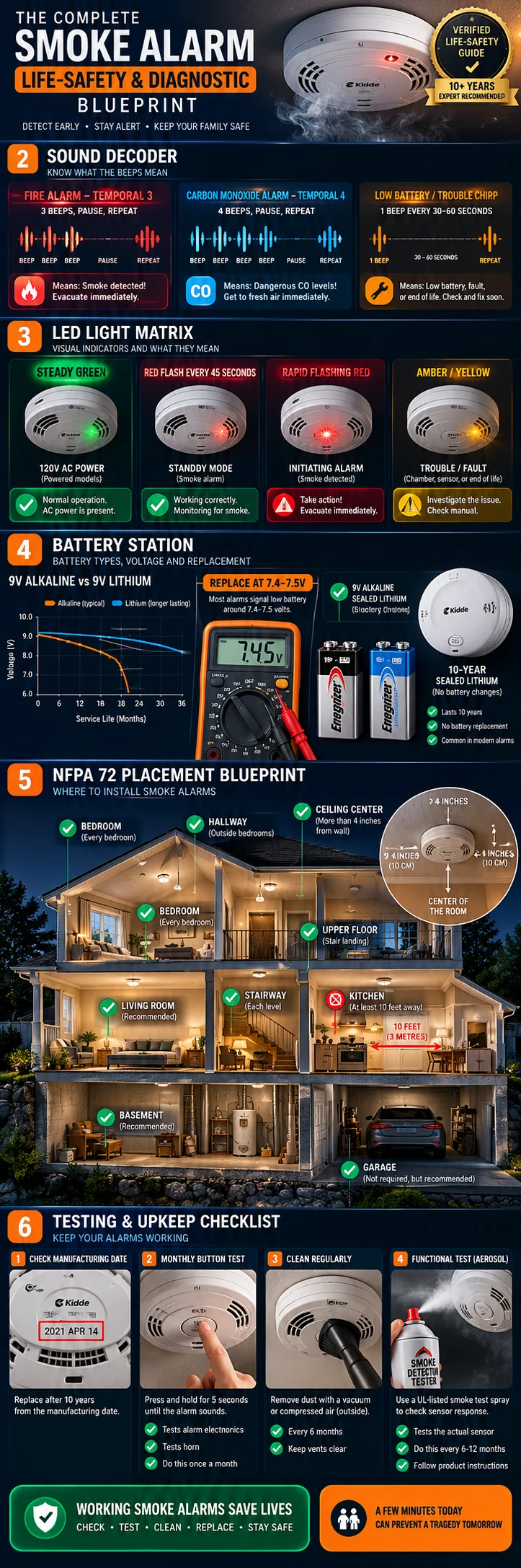
Photoelectric (optical) and ionization smoke alarms utilize fundamentally different physical detection principles to sense combustion particulates. Understanding their sensory physics, response response times to smoldering versus flaming fires, and modern UL 217 9th Edition standards explains why fire service authorities and municipal building codes increasingly mandate photoelectric technology for residential protection.
UL 217 9th Edition Standards: Particle Physics & Nuisance Immunity
The standard governing residential smoke alarms, Underwriters Laboratories standard UL 217 (8th and 9th Editions), introduced mandatory performance tests addressing the differing particle dynamics of household fires:
| Test Fire Profile | Dominant Particle Size | Photoelectric Response | Ionization Response | UL 217 9th Ed Mandate |
|---|---|---|---|---|
| Smoldering Polyurethane Foam | 0.3 to 10.0 microns (Large visible particulate) | Rapid detection (under 15 minutes) | Sluggish or failed detection (> 45 minutes) | Mandatory response before smoke reaches 12% obscuration per foot |
| Flaming Polyurethane Foam | 0.1 to 1.0 microns (Fast-moving combustion) | Reliable early detection | Fast initial detection | Mandatory response before smoke reaches 5% obscuration per foot |
| Cooking Nuisance (Frozen Hamburger) | 0.01 to 0.5 microns (High aerosol oil vapors) | Immune to nuisance tripping | Severe nuisance false tripping | Must remain completely silent throughout the cooking broil test |
| Smoldering Wood (Oak) | 0.5 to 5.0 microns (Dense wood smoke) | Rapid response (5 to 10 minutes) | Delayed response (20 to 35 minutes) | Standardized baseline detection curve across all certified devices |
Operating Physics & Performance Characteristics
| Engineering Characteristic | Photoelectric (Optical Light Scattering) | Ionization (Americium-241 Radioactivity) |
|---|---|---|
| Physical Detection Mechanism | 940 nm infrared LED and photodiode using the Tyndall optical light-scattering principle | Americium-241 alpha radiation ionizing air molecules to maintain a micro-ampere current |
| Target Fire Type | Smoldering, smoky fires (burning upholstery, foam mattresses, electrical wire jackets) | Fast-flaming, clean-burning fires (paper, dry kindling, flammable liquids) |
| Optimal Particle Sensitivity | Large visible smoke particles (0.3 to 10.0 microns in diameter) | Invisible sub-micron combustion particles (0.01 to 0.3 microns in diameter) |
| Smoldering Fire Response Speed | 15 to 50 minutes faster than ionization in real room smolder tests (NIST studies) | Significantly delayed; can allow fatal toxic gas build-up before activating |
| Cooking Nuisance Resistance | High resistance; ignores invisible sub-micron cooking aerosols | Prone to false alarms from normal stovetop cooking, baking, and toasting |
| Statutory Regulatory Status | Mandated by state and local codes (Massachusetts, Vermont, Queensland, Australia) | Phased out or restricted in sleeping corridors by modern building regulations |
The Physics of Photoelectric (Optical) Detection
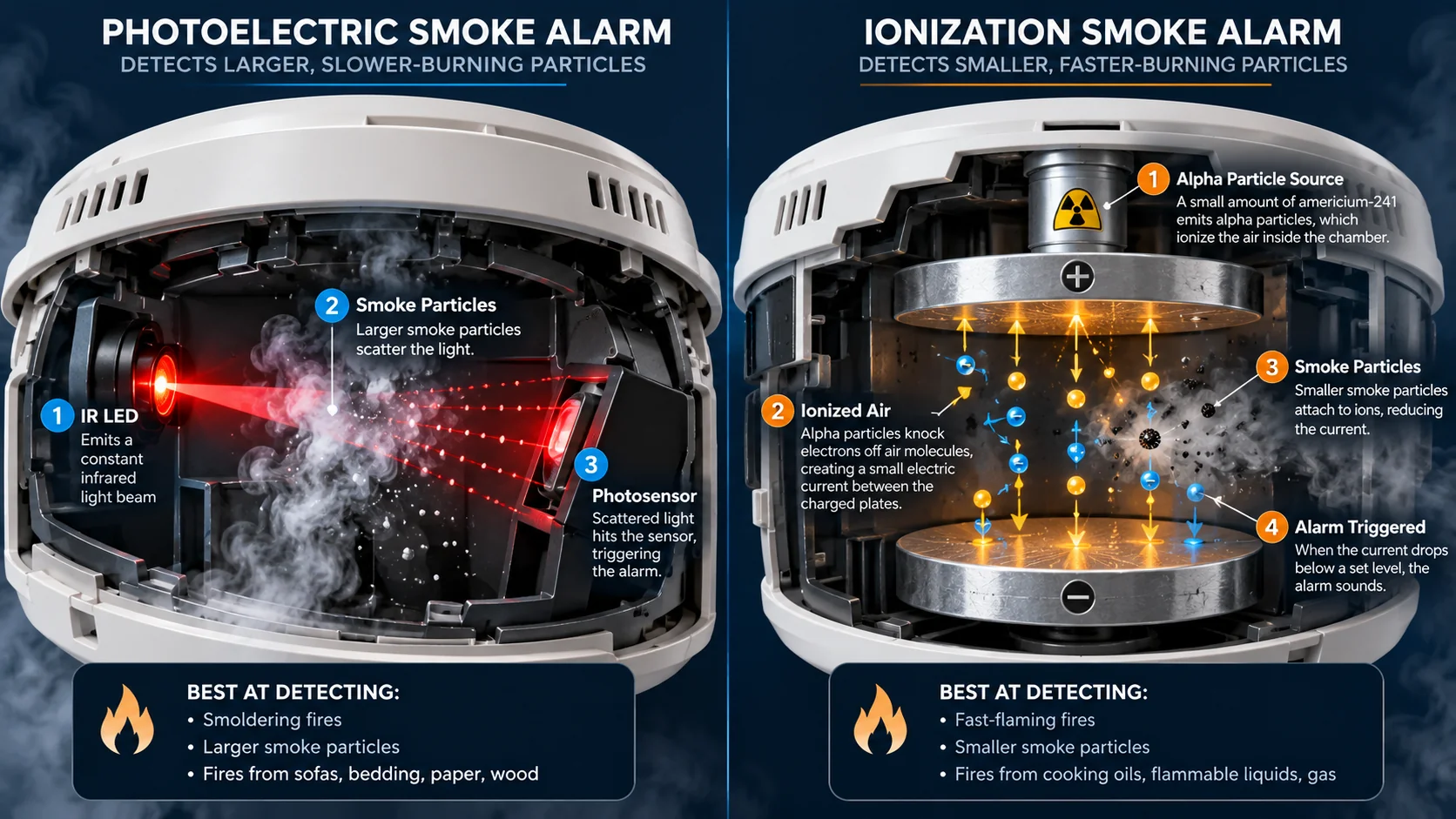
Photoelectric smoke alarms operate on the Tyndall optical light-scattering effect. Inside the alarm casing sits a light-baffled darkroom labyrinth:
- An infrared light-emitting diode (LED) projects a beam of pulsed light across the chamber into a light absorption trap.
- A light-sensitive photodiode sits off-axis at an angle (typically 120 to 135 degrees), positioned where the infrared beam cannot strike it directly during normal, clear-air conditions.
- When combustion begins in a smoldering fire (such as a cigarette dropped on a couch or an overheating electrical appliance), high volumes of large, visible smoke particulates (0.3 to 10 microns) drift into the chamber.
- These large particles reflect, refract, and scatter the infrared light beam. Scattered light photons hit the off-axis photodiode, generating a proportional electrical voltage that commands the microprocessor to sound an immediate 85-decibel Temporal 3 alarm.
The Physics of Ionization Detection
Ionization smoke alarms utilize a minute quantity (approximately 0.9 to 1.0 microcurie) of americium-241 (Am-241), an artificially produced radioactive isotope with a half-life of 432 years:
- The americium source continuously emits alpha particles into an internal ionization chamber containing two electrically charged metal plates.
- The alpha particles collide with oxygen and nitrogen molecules in the air, knocking off electrons to create positive ions and free electrons. This creates a tiny, steady electrical current (roughly 10 to 50 pico-amperes) flowing across the gap between the plates.
- When a fast-flaming fire erupts (burning paper, wood shavings, or gasoline), millions of invisible sub-micron combustion particles (0.01 to 0.3 microns) enter the chamber.
- These tiny particles attract and attach to the ionized air molecules, neutralizing their electrical charge and causing the current between the plates to drop below a calibrated trip threshold, triggering the horn.
Why the Fire Service Recommends Photoelectric Technology
Extensive forensic fire research conducted by the National Institute of Standards and Technology (NIST) and Texas A&M University demonstrates why residential codes prioritize photoelectric technology:
- The Nature of Modern Home Fires: Modern home furnishings consist predominantly of synthetic polyurethane foam, polyester fabrics, and composite plastics. When synthetic furnishings ignite, they undergo extended smoldering pyrolysis, generating dense clouds of lethal carbon monoxide (CO) and hydrogen cyanide (HCN) for 30 to 60 minutes before open flaming occurs.
- The Life-Safety Escape Window: Photoelectric detectors trigger 15 to 50 minutes earlier during smoldering phases than ionization units, providing sleeping occupants with the additional minutes required to safely evacuate before air becomes toxic.
- Preventing Alarm Disconnection: Ionization detectors trigger frequent nuisance false alarms from minor cooking fumes and bathroom steam. Studies show that occupants frequently disconnect batteries on nuisance-prone ionization alarms, leaving entire households unprotected. Photoelectric alarms drastically reduce false alarms, ensuring units remain continuously powered.
UL 217 8th & 9th Edition Standard Updates
To resolve the historical performance trade-offs between optical and ionization technologies, Underwriters Laboratories updated standard UL 217 (8th and 9th Editions) with two mandatory performance criteria:
- Flaming Polyurethane Foam Test: Smoke alarms must demonstrate rapid response times during rapid-growth synthetic foam fires.
- Cooking Nuisance Smoke Test: Alarms must remain silent during standardized broiling hamburger cooking smoke tests while still detecting real fire particulates.
Modern multi-criteria and advanced optical smoke alarms meeting UL 217 9th Edition provide superior detection across all fire types while virtually eliminating household nuisance alarms.