Smoke Alarm Diagnostic Troubleshooter
Identify why your smoke alarm or carbon monoxide detector is chirping, beeping, false alarming, or flashing. Follow safety-first screening and model-specific resolution procedures for Kidde, First Alert, BRK, Google Nest, and X-Sense.
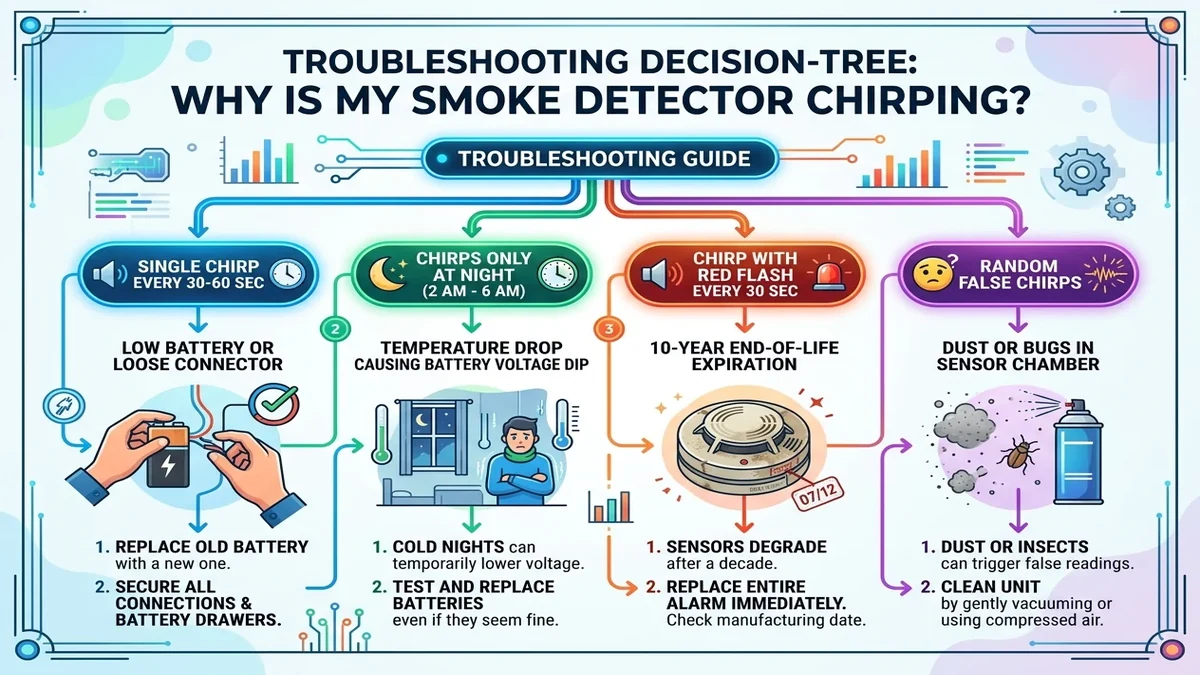
How to Use This Diagnostic Tool
Follow 4 quick steps to identify alarm beeps, flashing codes, and safe resolution procedures.
Confirm there is no active smoke, fire, or carbon monoxide emergency before troubleshooting.
Listen for single periodic chirps, full emergency sirens, or observe flashing LED light colors.
Select your brand and model number from the back label to unlock exact manufacturer manuals.
Follow verified resolution steps to silence nuisance chirps, clean dust, or replace expired units.
Interactive Smoke Alarm Diagnostic Tool
Answer the 4 quick screening steps below to isolate your alarm symptom and view manufacturer-verified repair procedures.
Quick Sound & LED Decoder Reference Matrix
Residential smoke alarms communicate hardware status through standardized sound cadences and LED flashes. Use this table to quickly decode your device before performing maintenance.
| Sound Cadence / LED Code | Device Meaning | Likely Cause | Required Action |
|---|---|---|---|
| 1 Chirp every 30 to 60s | Low Battery Warning | Battery voltage dropped under operational threshold | Replace with fresh battery (9V/AA) |
| 1 Chirp + LED Flash | Sensor Chamber Fault | Dust, insect intrusion, or sensing drift | Vacuum sensing chamber with soft brush |
| 2 Chirps every 30 to 60s | End of Life Warning | Unit has reached 10-year service life limit | Replace entire alarm unit immediately |
| 3 Loud Beeps (Temporal 3) | Smoke / Fire Alarm | Combustion particles or severe cooking smoke | Evacuate building and call 911/emergency |
| 4 Loud Beeps (Temporal 4) | Carbon Monoxide Alarm | Toxic CO gas buildup detected | Evacuate to fresh air and call emergency |
| 3 Beeps every 60s (Combo) | Sensor Malfunction | Electrochemical CO sensor failure | Replace alarm unit |
| Solid Green LED | AC Power Normal | Receiving continuous 120V electrical supply | Normal condition - no action needed |
| Flashing Red (No Sound) | Standby or Hush Mode | Normal standby pulse (every 45s) or Hush active | Hush will automatically reset in 8 to 10 min |
Manufacturer-Specific Troubleshooting Guidelines
While universal fire safety codes govern all alarm responses, each manufacturer implements distinct microprocessor reset sequences, battery door latches, and silence controls.
Kidde Smoke & Combination Alarms (i9010, i12040A, P4010, TruSense)
Kidde models commonly experience low-battery error chirping after battery replacement due to residual capacitor charge. To reset a Kidde alarm, disconnect it from AC power, remove the battery, press and hold the front Test button for 15 seconds, reinsert fresh batteries, and reconnect to power.
Read Full Kidde Troubleshooting Guide →First Alert & BRK Electronics (9120B, SM210, SC9120B, SMCO100)
First Alert alarms utilize side-loading battery drawers. If the drawer is slightly ajar or the battery contact pins are bent, the alarm will emit periodic error chirps. Ensure the battery drawer is fully closed until it snaps into place. For hardwired interconnected units, check that the orange interconnect line is securely wire-nutted.
Read Full First Alert Troubleshooting Guide →Google Nest Protect & X-Sense Alarms
Google Nest Protect uses a multi-color light ring (Nightly Promise). A yellow ring indicates low AA Energizer Ultimate Lithium batteries, expired hardware, or sensor issues accompanied by spoken voice messages. X-Sense 10-year sealed lithium alarms feature an irreversible deactivation switch on the mounting plate that permanently disables the buzzer once activated for disposal.
Read Smart Smoke Alarm Guide →Frequently Asked Questions: Smoke Alarm Diagnostics
Why is my smoke detector chirping every 30 to 60 seconds?
A single periodic chirp is primarily a low-battery indicator. Even in hardwired 120V systems, the 9V or AA backup battery can drain and trigger chirping. Other causes include dust inside the optical sensor chamber, loose electrical terminal screws, or an end-of-life signal notifying you that the 10-year sensor has expired.
Why does my smoke alarm keep beeping after changing the battery?
Smoke alarms have internal capacitors that retain residual voltage. When you swap batteries, this residual charge can trick the microprocessor into believing the old, low battery is still installed. Perform a residual drain: turn off the breaker, pull the battery, hold the Test button for 15 seconds, install the new battery, and turn the power back on.
What is the difference between a blinking green light and a flashing red light?
A green light confirms AC mains power. Solid green means normal AC power is supplied; a blinking green light every 60 seconds indicates normal standby operation on battery. A flashing red light indicates standby monitoring (flashes once every 45-60 seconds), temporary hush mode activation, or alarm memory latch indicating that unit initiated a previous alarm event.
What do 3 beeps mean on a Kidde or First Alert smoke alarm?
A continuous series of 3 beeps with short pauses is the standardized Temporal 3 fire alarm signal indicating active smoke detection. On combination smoke and CO alarms, a pattern of 3 quick chirps separated by 30-60 seconds indicates an internal sensor failure or sensor chamber error requiring full replacement.
How do I know if my smoke alarm is expired and needs full replacement?
Under NFPA 72 §29.8.1.4.1 and UL 217 standards, smoke alarms have an operational lifespan of 10 years from the date of manufacture. Twist the alarm counter-clockwise off its mounting bracket and check the date stamp on the back. If the date is 10 or more years old, the unit must be replaced. Expired units emit an end-of-life signal (typically 2 chirps every 30-60 seconds) that cannot be silenced with new batteries.
Diagnostic Logic & Safety Reference Hierarchy
This diagnostic engine synthesizes technical user manuals from leading manufacturers (Kidde, First Alert/BRK, Google Nest, and X-Sense) with consensus fire safety protocols from NFPA 72 (National Fire Alarm and Signaling Code) and UL 217 / UL 2034 product safety standards.