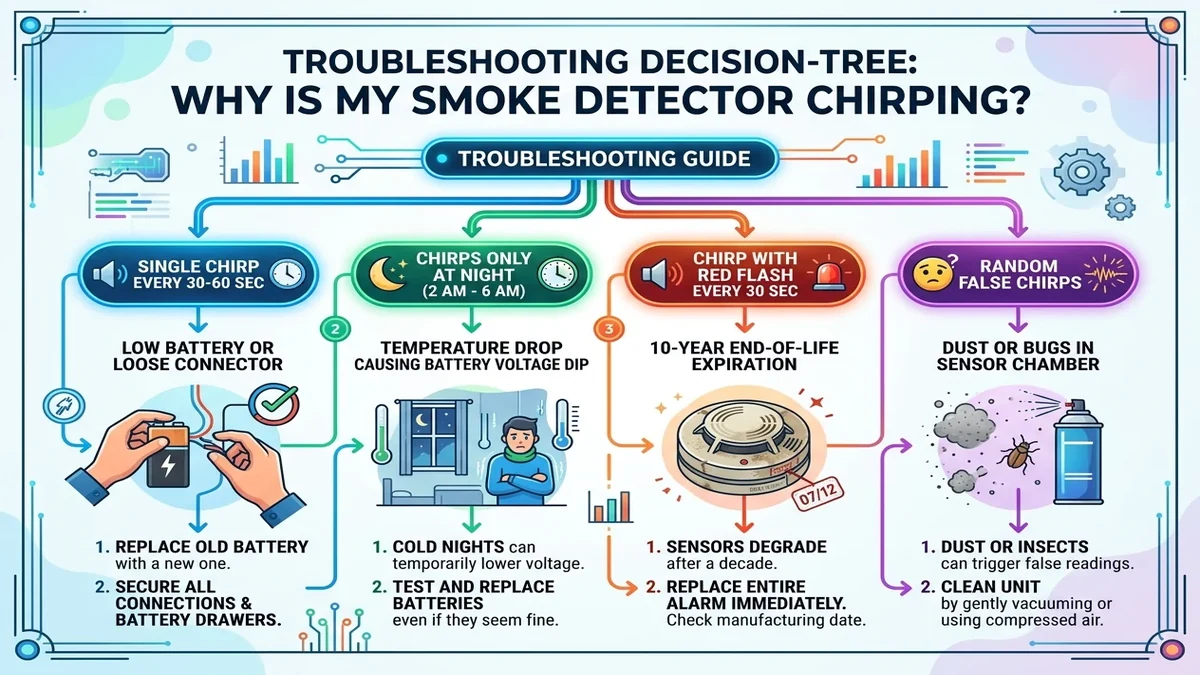
An intermittent smoke alarm chirp is an automated alert signaling an operational trouble condition. Identifying the specific trigger restores quiet operation while maintaining essential life-safety protection.
The 6 Most Common Causes of Smoke Alarm Chirping
- Low Battery Voltage: When battery voltage drops below the internal threshold (typically ~7.5 to 8.4V on 9V alarms), the unit emits a periodic chirp once every 30 to 60 seconds.
- Nighttime Temperature Drops: Chemical resistance in alkaline batteries increases as ambient temperatures drop overnight, causing temporary voltage drops between 2:00 AM and 6:00 AM.
- Dust, Cobwebs & Insect Contamination: Dust accumulation in the optical sensing chamber scatters infrared light, tricking the microprocessor into signaling a chamber fault.
- Residual Electrical Charge: After inserting a new battery on hardwired alarms, internal capacitors may retain fault memory. A manual discharge reset clears the circuit.
- AC Power Interruption: On hardwired units, a tripped circuit breaker, loose wire nut, or unlatched quick-connect plug triggers a backup-power warning chirp.
- 10-Year Sensor Expiration: Smoke alarms have an engineered lifespan of 10 years. An un-silenceable double or triple chirp often indicates end-of-life.
How to Perform a Residual Power Reset
If your alarm continues chirping after installing a brand-new battery, perform this standard reset procedure:
- Turn off the circuit breaker powering the hardwired smoke alarm circuit.
- Disconnect the quick-connect wiring harness from the back of the alarm.
- Remove the backup battery from the battery compartment.
- Press and hold the Test/Hush button for a full 15 seconds to discharge internal capacitors.
- Reinsert a fresh, unexpired battery, reconnect the AC wiring plug, and turn the breaker back on.
For a step-by-step walkthrough, read our guide on smoke alarm chirping with a new battery.