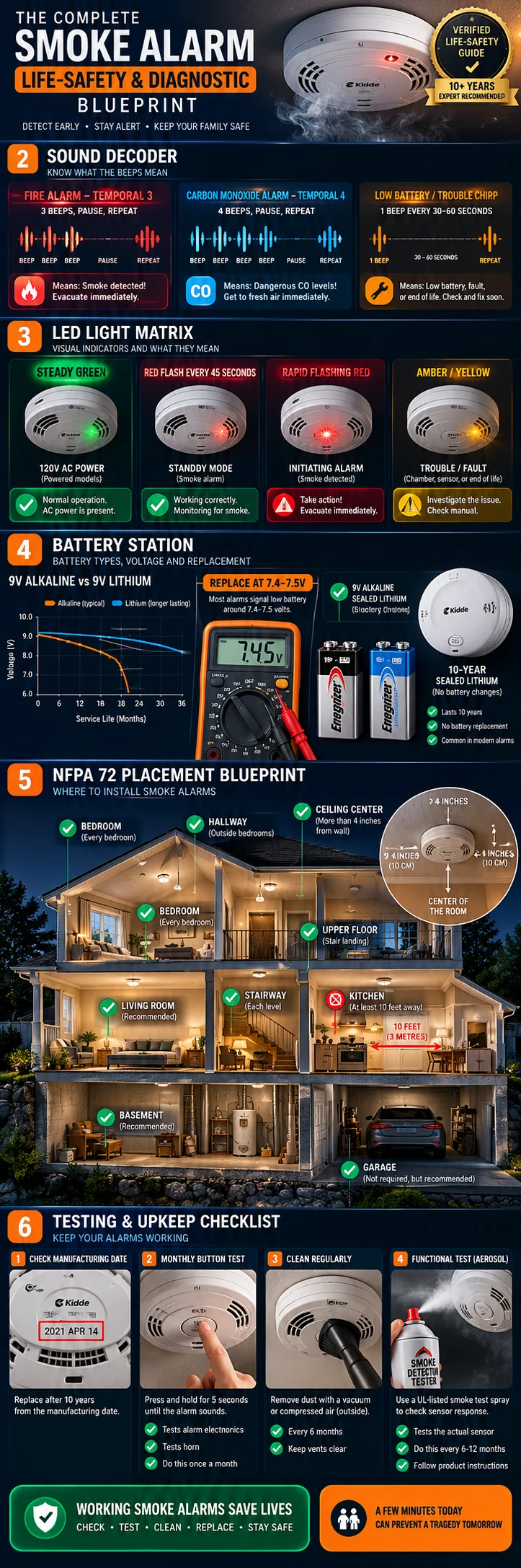
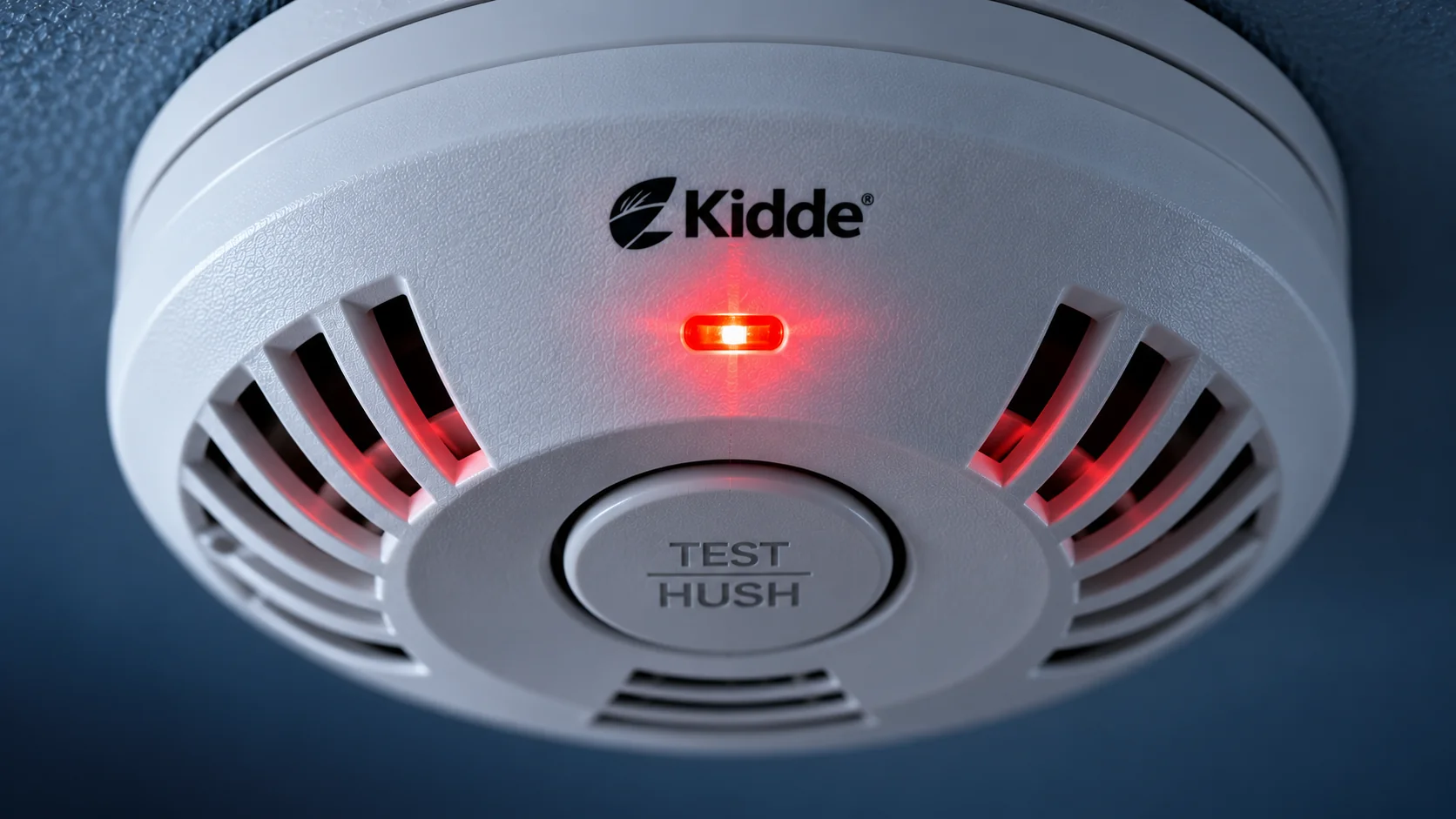
A blinking red light on a residential smoke alarm is a visual diagnostic indicator managed by internal microcontroller firmware under NFPA 72 standards. Distinguishing between a routine silent operational heartbeat, an active alarm memory latch, a hush desensitization cycle, and a low-battery trouble warning prevents unnecessary device replacements and preserves early-warning safety.
Red LED Status Diagnostic Decoder
Modern smoke alarms communicate specific operational conditions through the repetition frequency and audible coordination of the red light-emitting diode (LED):
| Red LED Flash Frequency | Acoustic State | Underlying Operational Condition | Required Homeowner Action |
|---|---|---|---|
| 1 flash every 40 to 60 seconds | Completely Silent (No Sound) | Normal Standby Heartbeat: Microcontroller confirms operational circuitry | No action required; alarm is functioning correctly |
| 1 flash every 30 to 45 seconds | Synchronized single chirp | Low Backup Battery Warning: Terminal voltage has dropped below 7.5V DC | Replace backup battery with fresh industrial alkaline cell |
| Rapid strobe (1 to 4 flashes/sec) | Full 85 dB Temporal 3 horn | Active Initiating Fire Alarm: Unit is detecting combustion smoke | Evacuate structure immediately if fire exists; press Hush if cooking |
| 1 flash every 8 to 10 seconds | Silent (No Sound) | Hush / Silence Mode: Sensor is temporarily desensitized for 8-10 mins | Allow timer to expire; unit returns to normal standby automatically |
| 1 flash every 15 to 20 seconds | Silent (No Sound) | Latching Alarm Memory: This specific unit triggered an alarm within 24 hrs | Press Test / Hush button once to clear the latching memory register |
| 3 or 5 flashes every minute | Synchronized multiple chirps | 10-Year Hardware Expiration: Non-volatile operational timer has expired | Replace complete alarm; end-of-life timers cannot be reset |
Brand-Specific Red Light Decoders: Kidde, First Alert, BRK & Nest
While national standards govern alarm sounds, LED light pulse rates are configured by manufacturer firmware. Below is a brand-by-brand comparison of red LED behavior:
| Manufacturer / Brand | Normal Standby Heartbeat | Active Fire / Smoke Alarm | Hush / Silence Mode | Low Battery / Fault Warning |
|---|---|---|---|---|
| Kidde (e.g. i9010, 29-FR, TruSense) | Flashes red once every 40 to 45 seconds | Flashes once every 1 second in sync with Temporal 3 horn | Flashes once every 10 seconds for 8 to 10 minutes | Flashes red once every 30 to 40 seconds synchronized with an audible chirp |
| First Alert & BRK (e.g. 9120B, SA310B) | Flashes red once every 45 to 60 seconds | Rapid red flash (up to 4 times per second) on initiating unit | Flashes red once every 10 seconds while horn is desensitized | Chirps once every 40 seconds with synchronized red LED blink |
| X-Sense (e.g. SD01, SC07-W) | Flashes red once every 56 seconds | Continuous rapid red flash (1 flash per second) with siren | Flashes red once every 5 seconds for 9 minutes | Flashes red once with 1 chirp every 60 seconds |
| Google Nest Protect | Green glow during Nightly Promise; no daytime flash | Outer 360-degree light ring pulses bright RED with voice warning and horn | Yellow pulse indicates Heads-Up; press large Nest button to silence | Yellow pulse with spoken voice message and phone app notification |
Model Verification Rule: Always check the exact model number printed on the rear specification label. If an LED flash sequence does not match the tables above, locate your model in our Manufacturer Brand Directory or consult the official engineering user manual.
The 40-to-60 Second Silent Pulse: The Standby Heartbeat
The single most frequent inquiry regarding smoke alarms is why the red light blinks silently once every 40 to 60 seconds.
This silent flash is the factory operational heartbeat. Every 40 to 60 seconds, the internal microprocessor wakes from sleep mode, fires a microsecond infrared pulse through the optical labyrinth, checks battery terminal potential under brief load, and confirms sensor continuity. The brief red flash confirms to occupants that the sensor, power supply, and processor logic are 100% operational. It is not an error; it is proof of life-safety readiness.
The Rapid Red Strobe During Alarms: Identifying the Initiator
In hardwired or wireless interconnected residential alarm systems, every detector sounds when a single unit trips. To determine which room triggered the event:
- The Initiating Alarm: Pulses its red LED rapidly (flashing once per second or four times per second) in direct synchronization with the 85-decibel horn. This is the unit detecting smoke or suffering from chamber contamination.
- Follower Alarms: Sound the horn to wake occupants, but display a steady green AC power light with no red LED flashing (or flash red only once every 10 seconds).
- Silencing the Network: Pressing the Hush button on the initiating unit silences every connected alarm across the home.
The Latching Alarm Memory Feature
If your smoke alarm network sounded while you were away from home and ceased before you returned, the unit that caused the event activates its Alarm Memory Latch:
- The initiating alarm continues flashing its red LED once every 15 to 20 seconds while remaining completely silent.
- This visual trail allows homeowners to identify which room experienced a smoke condition or false trigger.
- To clear the memory register: Press and hold the Test / Silence button for 2 seconds. The LED will return to standard 60-second standby polling.
Red LED vs Green LED on Hardwired Smoke Alarms
Hardwired alarms utilize two distinct LED indicators on the faceplate:
- Solid Green LED: Indicates healthy 120V AC household line power supplying the unit from the dedicated electrical branch circuit. If the green light goes out, check for a tripped circuit breaker or unlatched quick-connect harness plug.
- Flashing Red LED: Monitors battery backup status, optical chamber polling, and fire alarm initiation independent of the AC line power.