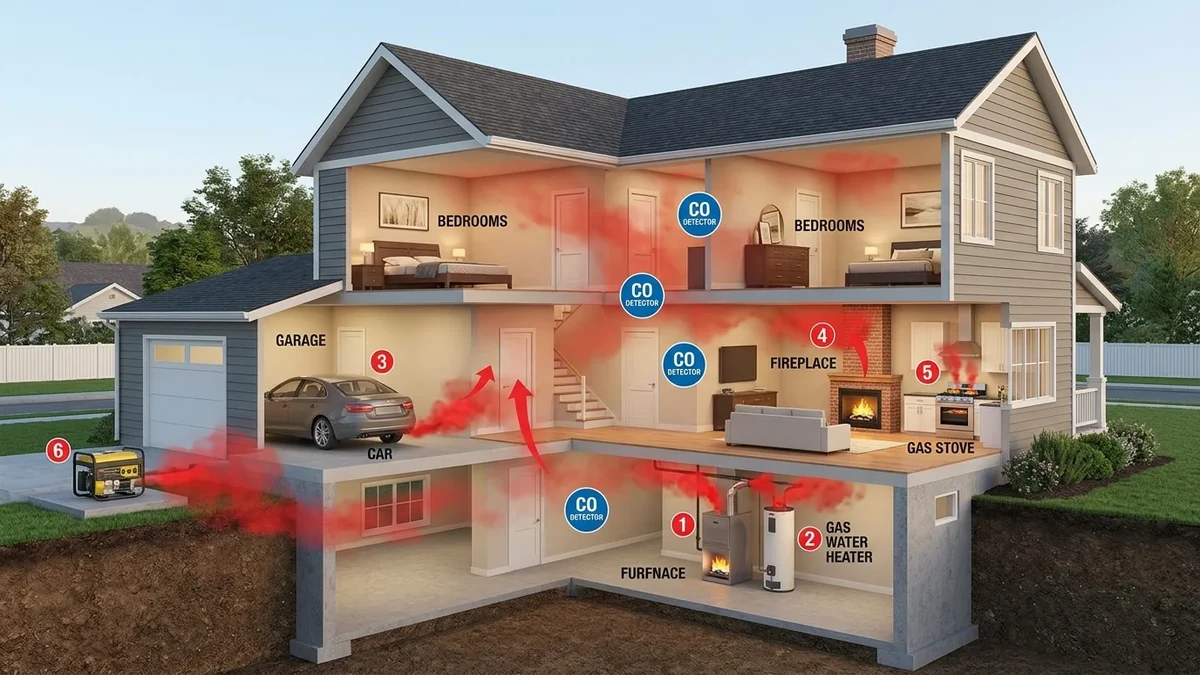
Carbon monoxide (CO) is often called the "silent killer" because it is completely undetectable by human senses. Understanding CO alarm operation, toxicity thresholds, and placement standards helps protect household occupants from dangerous exposure.
Understanding the 4-Beep Emergency Sequence
Under international safety standards (UL 2034 in North America and EN 50291 in Europe), residential carbon monoxide alarms follow a standardized audible alert cadence:
- 4 Rapid Beeps → 5-Second Pause → 4 Rapid Beeps: This is a confirmed emergency alarm indicating dangerous levels of carbon monoxide. Evacuate immediately.
- Single Chirp Every Minute: This is an operational trouble signal indicating a low battery or sensor fault.
CO Concentration (PPM) & Response Thresholds
| CO Level (PPM) | UL 2034 Standard Alarm Response Window | Physiological Impact & Health Context |
|---|---|---|
| 30 PPM | Alarm must NOT sound within 30 days | Normal short-term background fluctuations from traffic or cooking |
| 70 PPM | Alarm must sound within 60 to 240 minutes | Mild headaches, fatigue after prolonged exposure (2+ hours) |
| 150 PPM | Alarm must sound within 10 to 50 minutes | Moderate headache, dizziness, nausea within 1 hour |
| 400 PPM | Alarm must sound within 4 to 15 minutes | Severe headache, confusion, loss of consciousness; life-threatening within 2 hours |
Where to Install Carbon Monoxide Alarms
Because carbon monoxide mixes evenly with ambient room air (having nearly the same molar density as air), CO detectors can be mounted on ceilings or walls:
- Install at least one CO detector on every level of the home that contains fuel-burning appliances.
- Install a CO alarm inside or directly outside every sleeping area so alarms are clearly audible to sleeping occupants.
- Mount at least 15 feet (4.5 m) away from fuel-burning appliances to prevent false initial startup readings.
Carbon Monoxide Guides
- CO Detector Beeping Diagnostic - Emergency vs. maintenance chirp breakdown.
- Carbon Monoxide PPM Levels & Toxicity Chart - Health exposure curves and response times.
- Where to Install CO Detectors - Ideal height and placement rules.
- How to Test a CO Detector - Button test vs. functional canned CO spray.
- Smoke Alarms vs CO Detectors - Understanding the differences.