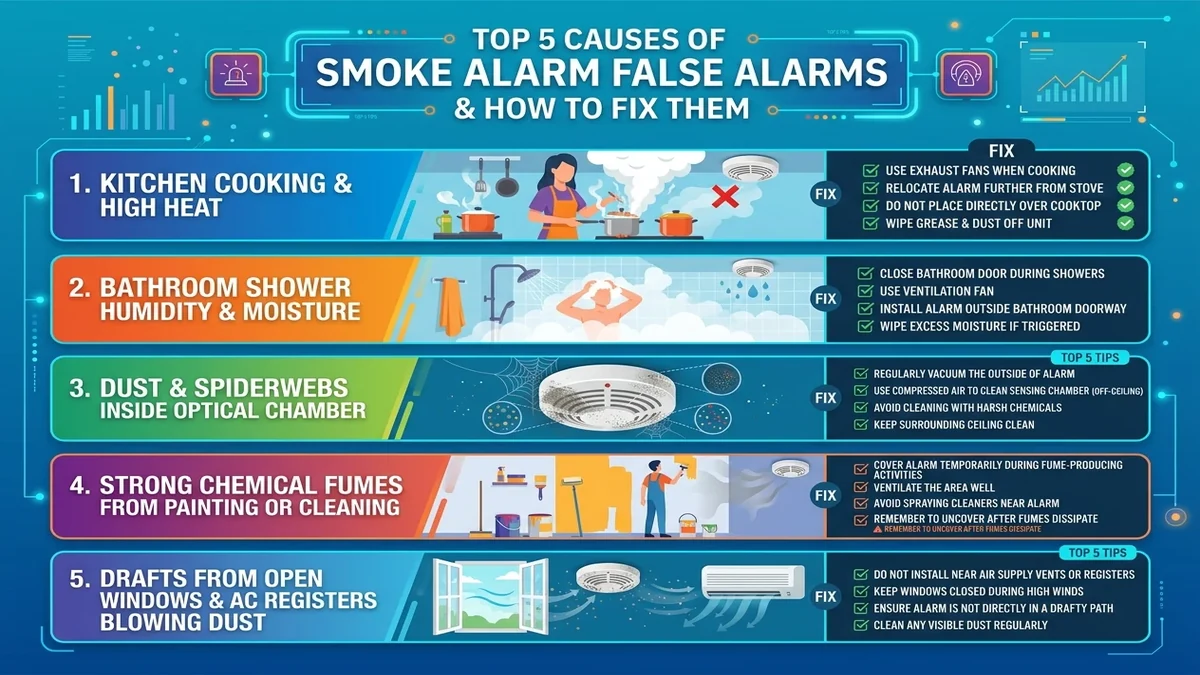
Nuisance false alarms are a major life-safety hazard because they tempt occupants to disable alarms, leaving the home unprotected during a real fire.
Kitchen Proximity & Nuisance Prevention
The most common cause of nuisance alarms is proximity to cooking. Install photoelectric smoke alarms (or dual-sensor units with strong nuisance resistance) and maintain a minimum 10-foot horizontal distance from fixed cooking appliances. If space is limited, a listed photoelectric alarm may be placed as close as 6 feet. Avoid ionization-only alarms near kitchens whenever possible.
Common False Alarm Triggers & Solutions
| False Trigger | Mechanism | Long-Term Prevention |
|---|---|---|
| Cooking Smoke & Steam | Fine combustion particles and oil droplets enter ionization/optical chambers | Maintain 10-20 ft clearance from stoves; upgrade to photoelectric technology with Hush button |
| Bathroom Water Vapor | Dense humidity condenses on optical lenses, refracting infrared beam | Install alarms at least 3 feet (0.9 m) away from bathroom doors |
| Dust & Spider Webs | Settled dust reflects sensor light or traps stray particles | Vacuum exterior grilles semi-annually with a soft brush hose attachment |
| Electrical Transients & Surges | HVAC compressor startup or grid spikes induce voltage ripples on interconnect line | Ensure tight wire nut connections; install whole-house surge protection |
| Small Insects (Thrips/Spiderlings) | Insects enter dark warm sensing chamber, blocking the optical diode | Vacuum vents thoroughly; avoid spraying chemical insecticides into the alarm |
How to Silence a False Alarm Safely
- Verify there is no active fire, flame, or toxic smoke.
- Locate the initiating unit (the alarm flashing its red LED rapidly).
- Press the Hush / Silence button firmly. This desensitizes the sensor for approximately 8 to 10 minutes, allowing air to clear.
- Open windows and turn on kitchen exhaust fans to accelerate chamber ventilation.