
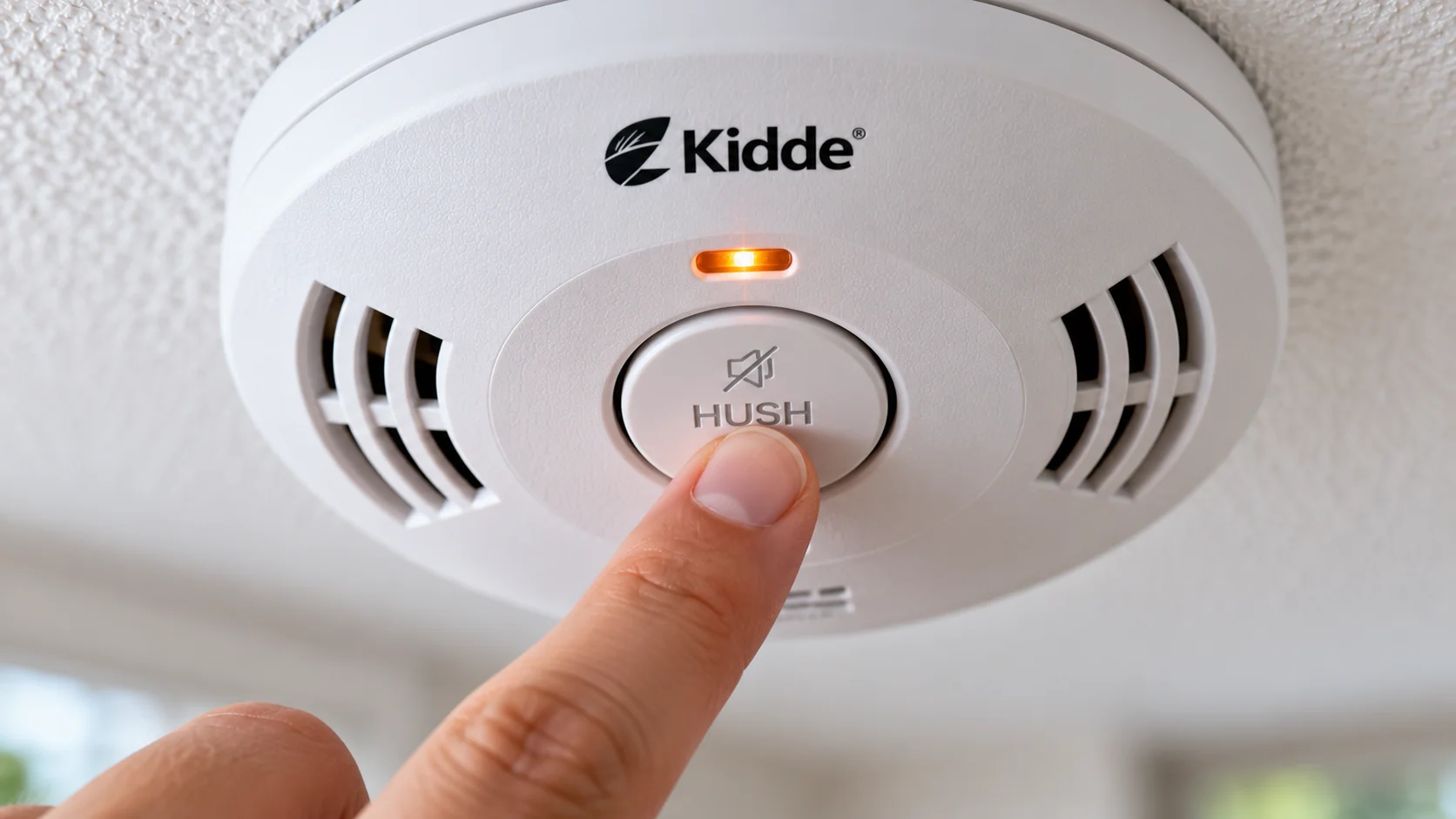
The Hush or Silence button (labeled "Push to Hush" or "Press to Silence" on Kidde, First Alert, and BRK models) is a safety engineering feature governed by UL 217 and mandated under NFPA 72 Section 29.8.3.4 for smoke alarms installed within 10 to 20 feet of cooking appliances. Understanding its desensitization cycle, 8-to-10 minute analog/digital timer, safety smoke override threshold, and battery trouble chirp limitations prevents occupants from removing power during cooking events.
Push to Hush Mechanism & Operational Meaning
When the phrase "PUSH TO HUSH" is printed on a smoke alarm faceplate, it indicates that depressing the primary center button temporarily alters the internal comparator trip threshold rather than permanently disabling the life-safety circuit:
| Operational Stage | Horn Sounder State | Visual LED Indication | Internal Circuit Behavior |
|---|---|---|---|
| 1. Active Fire Alarm | 85 dBA Temporal-3 siren | Rapid flashing red LED (1 to 4 pulses/sec) | Smoke obscuration exceeds factory 1.5% to 2.0% trip threshold |
| 2. Hush Button Engaged | Silenced immediately | Flashing red LED once every 8 seconds | Comparator threshold elevated; 8-to-10 minute timer running |
| 3. Low-Smoke Dissipation | Remains completely silent | Returns to normal 60-second flash | Timer expires; sensor resets to baseline 1.5% obscuration sensitivity |
| 4. High-Density Flare-Up | Siren re-activates at 85 dBA | Rapid flashing red LED | Obscuration exceeds 4.0%/ft; safety override defeats Hush mode |
| 5. Low-Battery Chirp Event | Chirps continue every 30s | Flashing red or amber LED | Hush fails to silence; independent voltage comparator active |
How the Push to Hush Feature Operates Internally
In modern smoke detector Application-Specific Integrated Circuits (ASICs), depressing the Hush button initiates an internal timing and voltage shift routine:
- Comparator Threshold Shifting: Under normal standby, the photodiode output voltage is compared against a reference voltage (V_ref) corresponding to roughly 1.5% smoke obscuration per foot. Pressing the Hush button switches an internal resistor ladder, elevating V_ref to correspond to approximately 4.0% to 5.0% obscuration per foot. Minor smoke from burnt toast or kitchen steam no longer crosses this elevated threshold.
- The 8-to-10 Minute Precision Timer: An internal counter driven by the low-frequency RC oscillator counts down approximately 500 to 600 clock cycles (8 to 10 minutes). During this window, the alarm flashes its red LED once every 8 to 10 seconds to inform occupants that the device is running in desensitized mode.
- Automatic Resensitization: Once the timer elapses, the microchip switches the resistor divider back to normal sensitivity. If cooking aerosols have dissipated through open windows or range hood exhaust, the alarm remains silent. If smoke is still dense, the horn immediately re-sounds.
- Life-Safety High-Obscuration Override: Under UL 217 standards, smoke alarms are prohibited from remaining silent during an actual structural fire. If combustion particulate accumulates rapidly, driving obscuration above 4.0% per foot, the ASIC comparator overrides the Hush timer immediately and sounds the full 85-decibel siren.
Can You Hush a Low-Battery Chirp?
Homeowners frequently press the Hush button when an alarm chirps in the middle of the night, only to find that the chirping continues without pause.
The reason is structural: in smoke alarm architecture, the low-battery detection circuit is completely separate from the smoke detection sensing path:
- The smoke comparator evaluates optical photodiode current.
- The low-battery circuit evaluates terminal potential across a bandgap voltage reference (typically tripping at 7.2V to 7.6V on a 9V rail).
On older standard alarms, pressing the Hush button has zero impact on the low-battery circuit; the unit will continue to chirp every 30 to 40 seconds. However, modern high-end units (such as specific Kidde and First Alert models certified to recent UL standards) incorporate a "Low Battery Hush" feature:
- Pressing the Hush button during a low-battery chirp temporarily silences the audible chirp for up to 12 hours.
- This convenience window allows sleep-deprived homeowners to sleep through the night before purchasing a fresh battery the following morning.
- Once the 12-hour window expires, the chirp resumes and cannot be hushed again until a fresh cell is installed.
Why the Hush Button May Fail to Silence the Alarm
When pressing the Hush button fails to silence an active alarm siren, one of five technical conditions is present:
| Failure Condition | Root Technical Cause | Required Homeowner Action |
|---|---|---|
| Smoke Exceeds 4.0% Obscuration | Smoke layer is too dense; UL 217 safety override active | Evacuate structure immediately; do not attempt further silence |
| Secondary Interconnected Alarm | The unit you pressed is a slave alarm, not the initiator | Find the alarm with the flashing red LED; only the initiator can be hushed |
| Carbon Monoxide Alarm Active | CO gas detected (Temporal-4 tone); CO cannot be hushed | Evacuate immediately to fresh outdoor air; dial 911 |
| Mechanical Switch Failure | Internal tactile dome switch oxidized or snapped off PCB | Dismount alarm; disconnect AC harness; replace broken alarm unit |
| End-of-Life 10-Year Lockout | Firmware locked at 3,650 operating days | Unit permanently expired; replace entire smoke alarm chassis |
Brand-Specific Hush Button Characteristics
Kidde Smart Hush
- Press the center Test/Hush button firmly for 2 seconds.
- The 85dB horn silences immediately. The red LED flashes once every 8 seconds for approximately 8 minutes.
- If the unit is interconnected, pressing Hush on any non-initiating alarm will NOT silence the network. You must locate the initiating alarm (flashing red rapidly) and press Hush on that specific unit.
First Alert / BRK Silence Feature
- Depress the center Test/Silence button for 1 to 2 seconds.
- The unit silences, and the red LED blinks twice every 10 seconds to indicate silence mode.
- First Alert models feature a 15-minute maximum silence cycle. If smoke is still present after 15 minutes, the horn re-triggers.
Google Nest Protect App Silence
- Nest Protect allows silencing from the Nest smartphone app via Bluetooth Low Energy (BLE) or by pressing the large center button.
- Under UL regulations, you must be in the same room and within line-of-sight (within 20 feet) of the Nest Protect to silence it via the mobile app.
- App silence is disabled if smoke levels exceed 4.0% obscuration or if carbon monoxide levels exceed 150 PPM.