Emergency Safety Notice
If the alarm is sounding a continuous emergency siren (repeated 3-pulse or 4-pulse pattern) or you observe smoke, fire, or odor, immediately evacuate all occupants and call emergency services. Never troubleshoot an alarm while in potential danger.
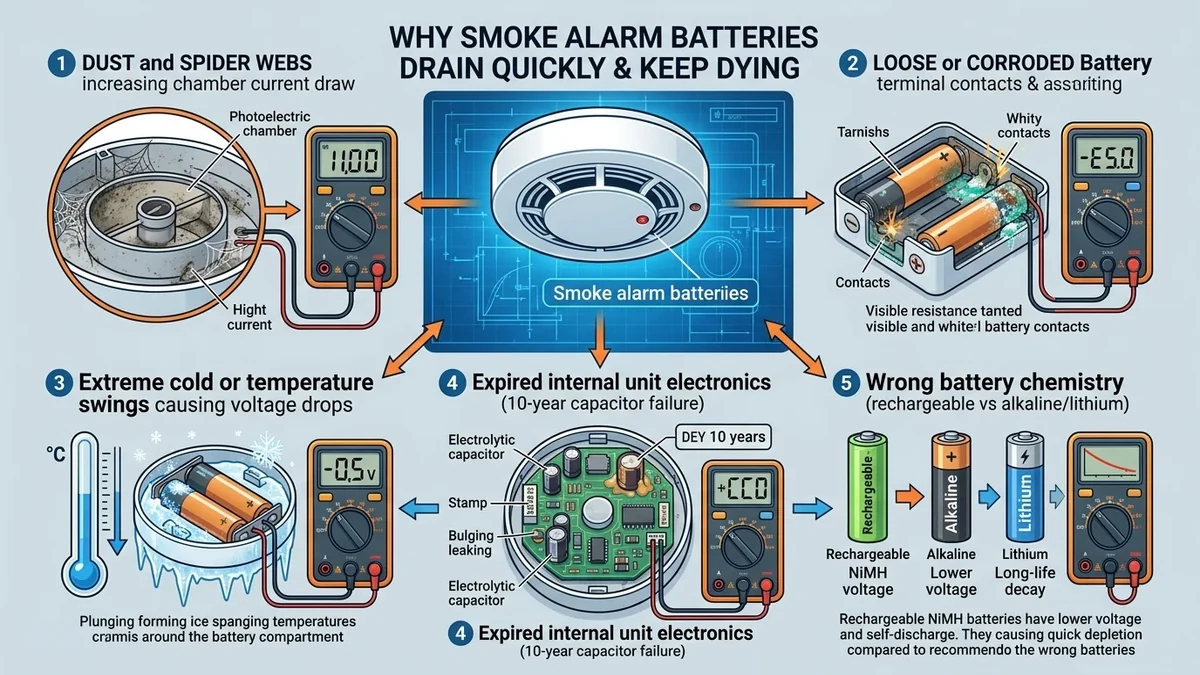
A smoke alarm battery that depletes in weeks or months is typically caused by severe optical chamber dust causing constant high-current processing, extreme temperature fluctuations, corroded terminal contacts, ungrounded AC electrical line noise, or internal component degradation in alarms older than 10 years.
Note: Exact end-of-life chirp and LED patterns vary by manufacturer and model (commonly 2 to 5 chirps per minute). Always check the specific unit's label or manual for the correct signal.
Battery Chemistry & Voltage Quick Reference
Rapid Drain Diagnostic:
• Chamber Dust: Microprocessor runs continuously at high power to compensate for dust → Vacuum vents thoroughly.
• Cold Room (< 40°F / 4°C): Alkaline chemical reaction slows → Upgrade to 9V lithium battery.
• Hardwired Unit on Battery Power: Blown AC breaker causes unit to drain backup battery continuously → Reset AC breaker.
• Alarm Over 10 Years Old: Degraded capacitors draw excessive standby current → Replace the alarm.
Standard alkaline smoke alarm batteries should reliably power an alarm in standby mode for at least 12 months. If batteries deplete within months, diagnosing parasitic drain restores normal longevity.
Primary Causes of Rapid Battery Depletion
-
Continuous Battery Operation on Hardwired Alarms: If a hardwired unit's circuit breaker is tripped or the AC wiring plug is loose, the alarm runs 100% on its small backup battery, exhausting it in 3 to 6 months.
-
Chamber Dust & Optical Gain Compensation: Modern smart microprocessors increase sensor diode power when dust accumulates to maintain sensitivity. This automatic drift compensation draws 3x to 5x higher standby current.
-
Low Ambient Temperatures: Installing alarms in unheated garages, attics, or near drafty windows causes alkaline voltage to drop prematurely.
-
Expired Internal Capacitors: Electrolytic capacitors in alarms older than 10 years develop high equivalent series resistance (ESR), creating a constant parasitic electrical load.
Important Safety Guideline
If an alarm depletes two consecutive brand-new batteries within 6 months after thorough cleaning, the internal circuitry is defective. Discard and replace the unit.