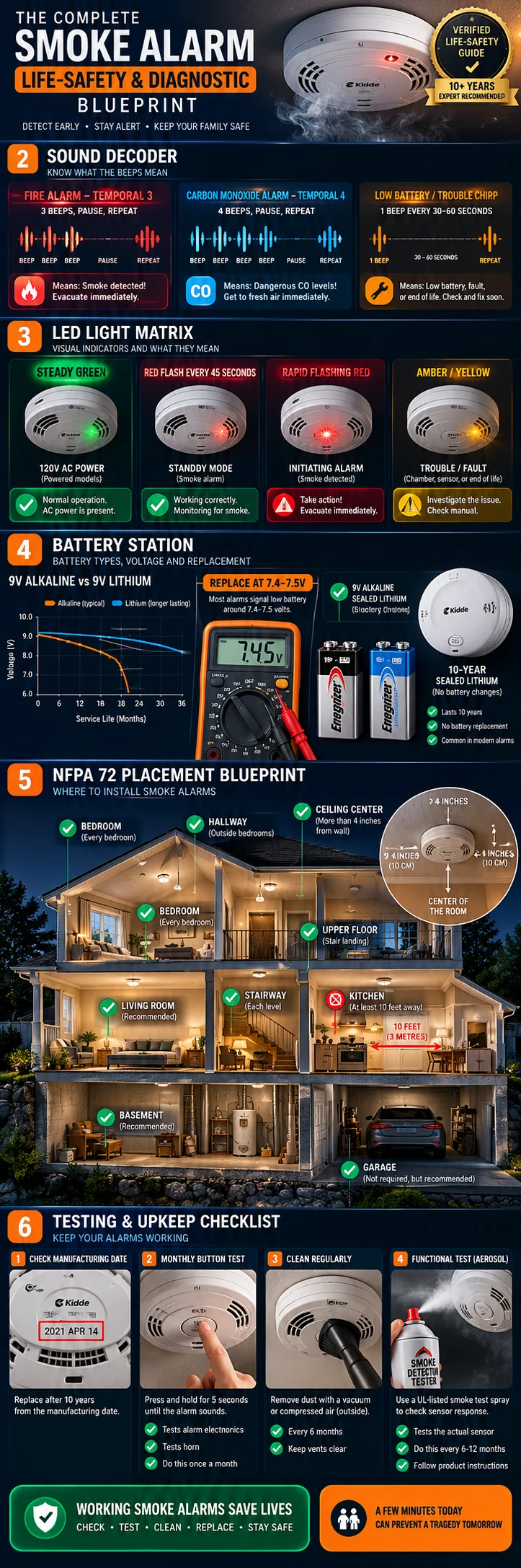
Dust, lint, cobwebs, and tiny insects regularly enter smoke alarm sensing chambers through perimeter ventilation grilles. Semi-annual cleaning prevents nuisance false alarms and low-voltage chirp faults.
Step-by-Step Cleaning Instructions
- Remove Power & Detach Unit: Shut off the AC circuit breaker for hardwired units. Twist the alarm counter-clockwise off its ceiling bracket and disconnect the wiring plug.
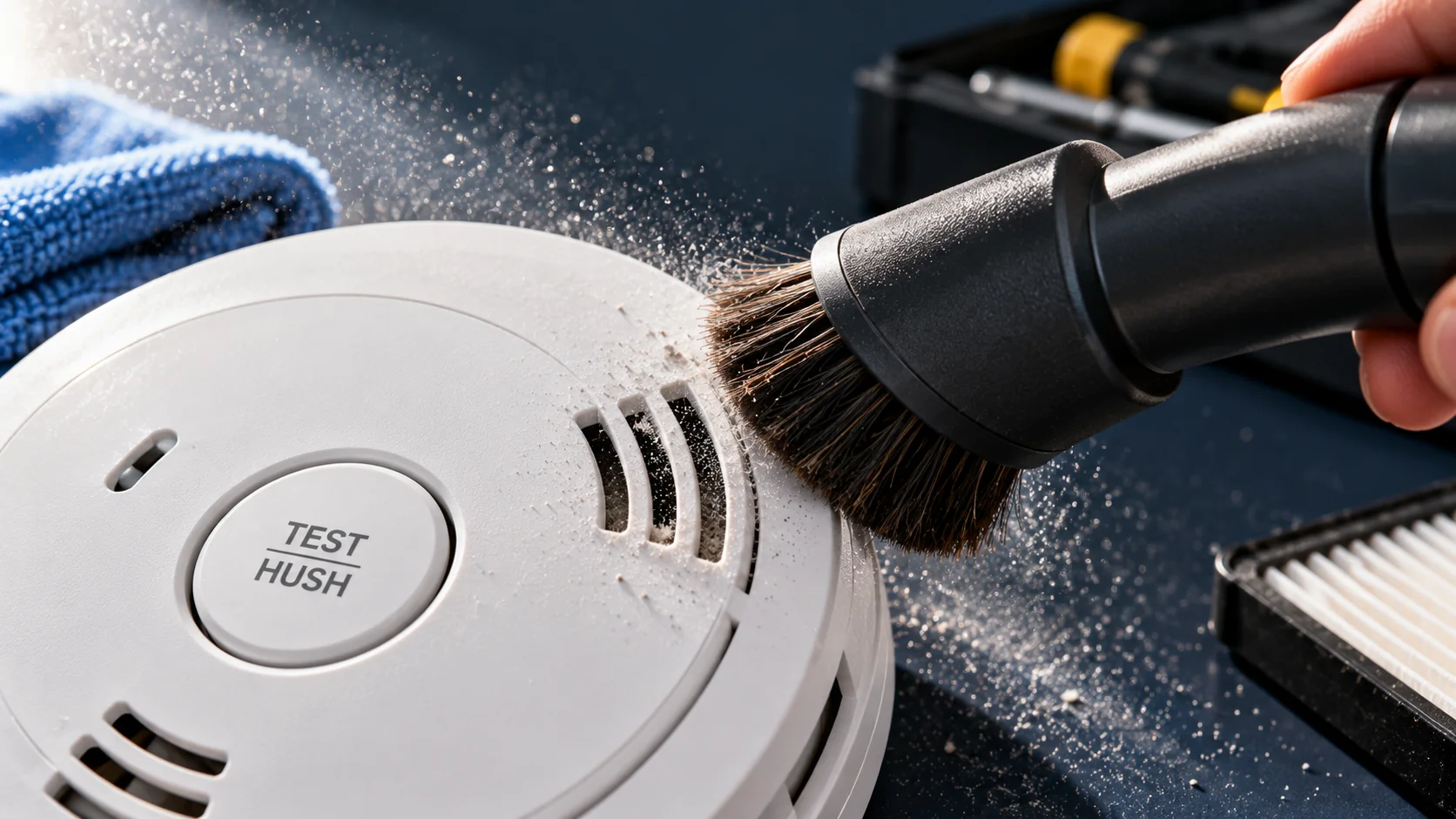
- Vacuum Exterior Vents: Attach a soft brush nozzle to your vacuum cleaner. Move the brush slowly around the entire outer circumference of the alarm, drawing settled dust out of the intake grilles.
- Apply Compressed Air: Hold a can of compressed air 2 to 3 inches away from the vents and deliver short, gentle bursts to blow fine particles out of the optical chamber.
- Wipe the Outer Face: Use a clean, dry microfiber cloth to wipe the exterior plastic cover.
- Reinstall & Test: Reconnect the AC wiring harness, twist the alarm clockwise onto the bracket, restore breaker power, and press the Test button for 5 seconds.
Why Dust & Spiders Trigger 3:00 AM False Alarms: Optical Scattering Physics
Over 70 percent of midnight false alarms trace directly to settled household dust and spider intrusion rather than combustion. Understanding the internal physics of the sensing chamber reveals why routine cleaning is essential:
- Photoelectric Light Scattering: Inside an optical smoke chamber, an infrared LED pulses a light beam through an internal darkroom. A photodiode sits at an off-axis angle and cannot see the beam under clean conditions. When microscopic lint, drywall dust, or insect webbing drifts into the light path, it reflects the infrared photons directly into the photodiode. When reflected light exceeds the factory threshold (typically 1.5 to 3.0 percent obscuration per foot), the microprocessor registers combustion and fires the horn.
- The 3:00 AM Temperature Drop Effect: Homes cool down in the early morning hours. As ambient room temperature drops, relative humidity rises slightly. Settled dust particles absorb ambient moisture, expanding in volume and shifting position just enough to scatter the infrared light beam and sound the alarm.
- Ionization Current Interruption: In ionization alarms, an Americium-241 source ionizes air molecules between two metal plates to maintain a constant electrical current. Fine dust coats the plates and traps ions, reducing the current flow in the exact same manner as combustion smoke particles.
How to Clean a Commercial Fire Alarm Head vs Residential Smoke Detector
Property managers and commercial facility personnel frequently ask how to clean a commercial fire alarm head compared to residential units. The procedure requires strict life safety coordination:
| Feature / Requirement | Residential Smoke Detector | Commercial System Sensor Head |
|---|---|---|
| Central Monitoring Notification | Not applicable (local residential siren) | Mandatory: Place FACP zone on Test Mode with monitoring company before touching head. |
| Mounting Mechanism | Twist-off ceiling bracket with 3-pin AC plug | Twist-lock head mounted into 2-wire or 4-wire base (e.g. System Sensor B401). |
| Chamber Disassembly | Factory sealed; never open internal case | Removable optical cover and field-replaceable insect screen (on approved models). |
| Cleaning Method | Vacuum brush and short compressed air bursts | UL-listed vacuuming or factory sensitivity recalibration following NFPA 72 Table 14.4.3.2. |
Approved Cleaning Tools vs Prohibited Solvents
Using improper cleaning liquids can permanently ruin optical lenses or strip protective conformal coatings from the internal printed circuit board:
- Vacuum Cleaner with Soft Dusting Brush: Safe and recommended. Gently brush around the outer perimeter slots to draw loose dust outward without pushing particles deeper into the darkroom.
- Moisture-Free Compressed Gas Duster: Safe and recommended. Hold the can strictly upright 3 inches away from the vents. Deliver two 1-second bursts. Never shake the can or invert it, as liquid refrigerant spray can frost and crack the internal photodiode.
- Dry Microfiber Cloth: Safe for wiping exterior plastic covers and faceplates.
- Rubbing Alcohol, Bleach & Chemical Cleaners: Strictly prohibited. Chemical vapors leave a residue on optical lenses and desensitize electrochemical carbon monoxide sensors.
- Direct Water Immersion: Strictly prohibited. Water corrodes electrical leads, shorts capacitors, and permanently destroys the device.