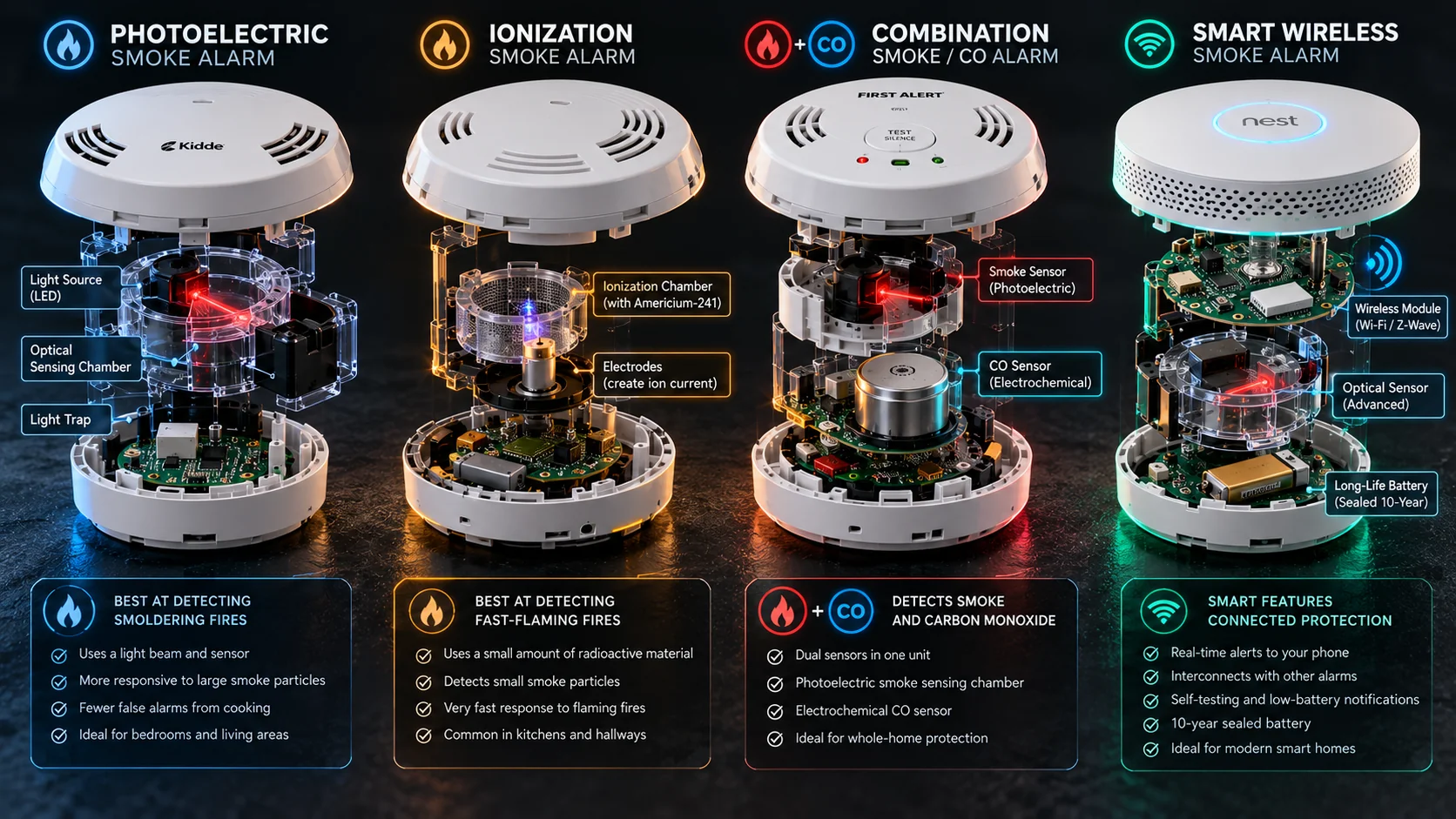
Smoke Alarm Battery Keeps Dying: Causes & Fixes
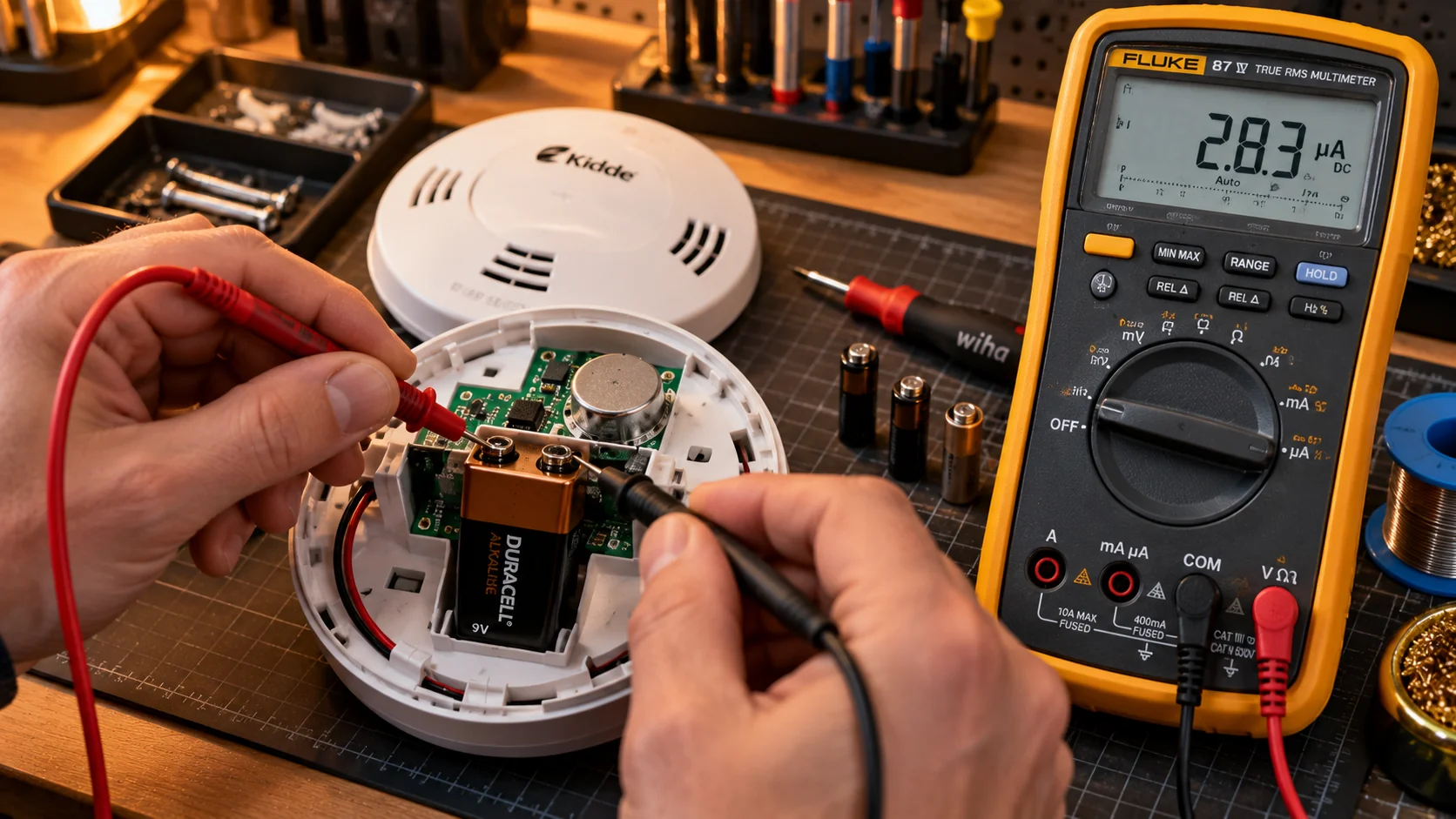
Smoke alarm batteries die prematurely due to unpowered 120V hardwired lines (forcing units to run 100% on battery), heavy optical chamber dust causing accelerated microprocessor polling, internal electrolytic capacitor leakage on aged units, or corroded terminal snaps with high contact resistance.
Smoke Alarm Battery Depletion Diagnostics & Electrical Specifications
| Diagnostic Parameter | Normal Operating Specification | Failure / Rapid Depletion Threshold |
|---|---|---|
| Quiescent Standby Current Draw | 15 μA to 25 μA continuous DC current | > 50 μA indicates chamber dust or leaky capacitor |
| 120V AC Power Failure Mode | 0.0 μA battery draw (AC powers unit; battery on standby) | Unit runs 100% on battery; drains fresh 9V cell in 14-28 days |
| 9V Alkaline Fresh Terminal Voltage | 9.4V to 9.6V DC unloaded open-circuit potential | ≤ 8.4V DC indicates battery capacity exhausted > 70% |
| Low-Battery Trouble Cutoff Voltage | Operating window ≥ 7.6V DC under pulsed load | ≤ 7.2V to 7.5V DC trips low-battery chirp (UL 217 § 61) |
| Normal 9V Alkaline Lifespan | 12 to 18 months continuous standby operation | Dying within 2 weeks to 3 months indicates hardware fault |
| 9V Ultralife Lithium Lifespan | 5 to 10 years continuous standby operation | Premature drain indicates high-frequency accelerated polling |
| Terminal Contact Resistance | < 0.10 Ohms clean mechanical clamping pressure | > 0.50 Ohms causes voltage sag during 30 mA pulse |
| Electrolytic Capacitor Health | Zero measurable DC shunt leakage across 47 μF capacitor | Capacitor dielectric breakdown on units > 10 years old |
| Maximum Unit Service Life | 10 years maximum from date of manufacture | Mandatory replacement required under NFPA 72 § 29.8.1.4.1 |
A residential smoke alarm that repeatedly drains brand-new batteries within a few weeks or months is suffering from an active electrical, physical, or mechanical defect. In normal quiescent standby, a properly functioning smoke alarm draws mere microamperes of electrical current, allowing a standard 9V alkaline battery to operate reliably for 12 to 18 months, and a lithium cell for 5 to 10 years. When a battery collapses prematurely, simply swapping in another fresh battery does not solve the underlying failure. Identifying the root cause requires diagnosing unpowered 120V line circuits, optical chamber dust contamination that forces accelerated microprocessor polling, internal electrolytic capacitor dielectric leakage on aging units, or high contact resistance across terminal snaps.
The Electrochemistry & Physics of Premature Battery Failure
To diagnose why a smoke alarm battery depletes rapidly, one must understand the basic electrical math governing quiescent power consumption:
1. Standard Quiescent Current Budget: A standard modern photoelectric smoke alarm operating from a primary DC battery supply utilizes an ultra-low-power CMOS microcontroller. In clean, quiescent standby:
- The internal microprocessor remains in a deep sleep state for approximately 99.8% of each operating cycle, drawing only 5 to 10 microamperes ($0.005 ext{ to }0.010 ext{ mA}$).
- Every 8 to 10 seconds, an internal timer awakens the processor for approximately 10 milliseconds. The processor pulses the infrared light-emitting diode (LED) inside the optical labyrinth, takes an analog-to-digital converter (ADC) sample of the photodiode receiver, checks battery terminal potential under load, and immediately returns to deep sleep.
- The pulsed current draw during this 10-millisecond window reaches 15 to 25 milliamperes ($15 ext{ to }25 ext{ mA}$).
- When averaged over time, the total equivalent continuous quiescent current ($I_{avg}$) measures between 15 μA and 25 μA ($0.015 ext{ to }0.025 ext{ mA}$).
T_life = Battery Capacity (mAh) / [Average Current Draw (mA) × 8760 hours/year]
For a standard 9V alkaline battery with 550 mAh rated capacity:
T_life = 550 mAh / (0.020 mA × 8760 h/yr) = 550 / 175.2 ≈ 3.14 Years
In real-world residential environments, annual manual push-button testing (which draws 30 to 50 mA to drive the piezoelectric horn) and self-discharge chemistry reduce this theoretical 3-year lifespan to a practical, manufacturer-rated service life of 12 to 18 months.
When a battery dies in 2 to 4 weeks, the average continuous current draw has surged from $20\,\mu ext{A}$ to over 800 μA to 1,500 μA (0.8 to 1.5 mA), representing a 40-fold to 75-fold parasitic load increase.
Cause 1: Unpowered Hardwired Units (Running 100% on Backup Battery)
In residential homes equipped with 120V AC hardwired smoke alarms, the single most common cause of rapid battery depletion is the complete loss of commercial AC line power.
The Dual-Power Steering Architecture: Hardwired smoke alarms incorporate an internal step-down transformer or switch-mode power supply, a bridge rectifier, and a diode-OR steering circuit:
- AC Mode: When 120V AC commercial power is energized, the rectified DC voltage rail operates at approximately 10.5V to 12.0V DC. Because this voltage is higher than the nominal 9.0V DC of the backup battery, the steering diode reverse-biases, blocking the battery from discharging. The 9V battery sits in 100% passive reserve, drawing virtually 0.0 μA of current.
- DC Backup Mode: If 120V AC power is cut, the rectified internal rail drops to zero. The steering diode immediately forward-biases, seamlessly transferring the entire electrical load (microprocessor, sensing chamber, and status LEDs) to the 9V backup battery.
Why Hardwired Alarms Drain Batteries in 3 Weeks: A hardwired smoke alarm is not engineered for long-term standalone battery operation. When operating 100% on DC backup power without AC line voltage, the alarm maintains power to its entire circuit board, continuously driving internal comparator networks and status indicators. Under this continuous operating load, a standard 9V alkaline cell is completely exhausted in 14 to 28 days.
| Physical 120V Power Interruption Point | Root Electrical Failure Mechanism | Diagnostic Multimeter Verification Method |
|---|---|---|
| Tripped Circuit Breaker | The breaker supplying the smoke alarm branch circuit is switched OFF or tripped. | Check main electrical panel; verify green AC LED on alarm face is illuminated. |
| Loose Wire Nut Splice in Box | The black 120V line conductor has pulled free from the wire nut inside the ceiling junction box. | De-energize panel; drop ceiling plate; test for 120V AC across black and white wires. |
| Unlatched Quick-Connect Plug | The 3-pin pigtail harness plug is not pushed completely into the rear chassis receptacle. | Inspect plug; press firmly until the locking plastic tab clicks over the retaining latch. |
| Wall Switch Interruption | The branch circuit was improperly wired downstream of a standard wall light switch. | Verify circuit voltage with wall switches flipped in both ON and OFF positions. |
Cause 2: Optical Chamber Dust & Accelerated Microprocessor Polling
Airborne dust, pet dander, microscopic sawdust from home renovations, and insect debris represent the primary physical cause of premature battery drain in standalone battery-powered smoke alarms.
Optical Chamber Baseline Drift: As airborne particulates settle inside the dark optical labyrinth, dust coats the internal anti-reflective light baffles and photodiode lens. In clean air, the infrared LED beam terminates into the light trap. However, when dust coats the chamber, the pulsed infrared light reflects off dust particles, scattering a small amount of background light onto the photodiode even when zero combustion smoke is present.
The Accelerated Polling Loop: Modern smoke alarm firmware incorporates an adaptive calibration algorithm designed to prevent dust false alarms:
- As dust accumulates, the quiescent baseline signal sampled by the ADC rises toward the alarm trip threshold (typically 1.5% obscuration per foot).
- When the baseline signal exceeds a preset pre-alarm warning band, the microprocessor enters Accelerated Verification Polling.
- Instead of pulsing the infrared LED once every 8 to 10 seconds, the processor commands the LED to fire once every 1.5 to 2.0 seconds to monitor whether a fast-growing fire is developing.
- Firing the infrared emitter 5 times more frequently multiplies the average current consumption from $20\,\mu ext{A}$ to over 80 μA to 120 μA.
- This accelerated sampling burns through the battery reserve, exhausting a brand-new 9V alkaline cell in 2 to 4 months instead of the normal 18 months.
Thoroughly cleaning the sensing chamber using a vacuum cleaner brush attachment clears the accumulated particulate, allowing the microprocessor to reset its baseline calibration and return to its 10-second deep-sleep polling interval.
Cause 3: Internal Electrolytic Capacitor Breakdown on Units Over 10 Years Old
Smoke alarms that have been in continuous service for 8, 10, or 12 years frequently begin draining brand-new batteries within two to three weeks, even after thorough vacuum cleaning. This condition indicates internal component failure: dielectric breakdown of the power-rail electrolytic capacitors.
Capacitor Dielectric Evaporation: Smoke alarm printed circuit boards contain one or more aluminum electrolytic filter capacitors (typically rated at $47\,\mu ext{F}$ to $100\,\mu ext{F}$ at 16V or 25V). These capacitors smooth internal voltage rails, provide pulse energy for the piezoelectric horn, and filter out high-frequency electromagnetic noise.
- Electrolytic capacitors contain a liquid or gel electrolyte separating microscopic aluminum oxide dielectric layers. Over 10 years of continuous 24/7 exposure to room ambient temperatures, this liquid electrolyte slowly evaporates through the rubber end seals.
- As the electrolyte dries, equivalent series resistance (ESR) surges, and the aluminum oxide dielectric layer develops microscopic conductive fissures.
- Parasitic DC Leakage Current: Instead of acting as an open circuit to direct current (DC), the degraded capacitor develops a heavy DC leakage current. The capacitor effectively transforms into an internal 5,000-ohm to 10,000-ohm parasitic shunt resistor connected directly across the battery terminals.
- This internal shunt continuously bleeds 500 μA to 1,000 μA (0.5 to 1.0 mA) of current to ground 24 hours a day, draining any fresh 9V battery to below its 7.2V cutoff threshold within 15 to 25 days.
Under NFPA 72 § 29.8.1.4.1, all residential smoke alarms must be completely replaced 10 years from their manufacturing date. Attempting to keep an expired, fast-draining alarm operational by continually inserting new batteries is dangerous; an alarm suffering from capacitor breakdown may fail to sound during a real fire event.
Cause 4: Substandard Battery Chemistry & Temperature Impedance Spikes
The physical chemistry of the replacement battery installed in a smoke alarm dictates its discharge curve and operating longevity. Installing inappropriate battery types is a primary cause of premature failure:
| Battery Chemistry Classification | Nominal Voltage & Capacity | Internal Resistance (R_int) | Suitability for Smoke Alarms & Failure Modes |
|---|---|---|---|
| Zinc-Carbon / "Heavy Duty" | 9.0V nominal; 250 to 300 mAh capacity | High (> 10 Ohms at 50% drain) | STRICTLY PROHIBITED: Voltage collapses under 30 mA horn pulse; dies in 60 to 90 days. |
| Rechargeable NiMH / NiCd | 7.2V to 8.4V nominal; 175 to 250 mAh | Moderate; high self-discharge (1%/day) | STRICTLY PROHIBITED: Starts near the 7.2V cutoff threshold; triggers false chirps within weeks. |
| Standard Alkaline (Zn/MnO2) (Duracell, Energizer Max) | 9.0V nominal; 550 to 600 mAh capacity | Low (1.5 to 2.5 Ohms fresh) | MANUFACTURER APPROVED: Flat discharge curve; provides 12 to 18 months of reliable standby. |
| Lithium (Li/FeS2 or Li/MnO2) (Ultralife 9V, Energizer Ultimate) | 9.0V to 9.8V nominal; 1,200 mAh capacity | Ultra-Low (< 0.5 Ohms); zero freeze sag | PREMIUM STANDARD: Extreme temperature tolerance (-40°F to 140°F); lasts 5 to 10 years. |
The 3:00 AM Temperature Spike (The Arrhenius Law): Why do smoke alarm batteries always seem to trigger their low-battery trouble chirp in the middle of the night?
The electrochemical reaction kinetics inside alkaline batteries are governed by the Arrhenius Equation: chemical reaction rates decrease and internal resistance ($R_{int}$) increases exponentially as temperature falls. Between 2:00 AM and 5:00 AM, residential indoor temperatures reach their diurnal minimum (often dropping to 60°F to 64°F / 15°C to 18°C).
When the smoke alarm awakens to fire its 15 mA optical LED pulse, the loaded terminal voltage drops according to basic circuit laws:
V_loaded = V_open - [I_pulse × R_internal]
Where:
• V_open = Open-circuit battery voltage.
• I_pulse = Pulsed current drawn during LED or horn firing (Amperes).
• R_internal = Internal electrochemical resistance of the battery (Ohms).
If a battery has expended 70% of its capacity, its daytime loaded voltage might measure 7.4V DC (just above the 7.2V trip threshold). When nighttime temperatures drop, internal resistance spikes from 3 ohms to 8 ohms. The next 15 mA LED pulse causes $V_{loaded}$ to dip to 7.15V DC, tripping the low-battery comparator and initiating the persistent 30-to-40-second trouble chirp.
Cause 5: Corroded Terminal Snaps & Mechanical Contact Resistance
In many instances where homeowners believe a battery has died, the battery itself is chemically full, but electrical current is blocked by high contact resistance across mechanical terminal snaps.
Contact Degradation Mechanics: Standard 9V smoke alarms utilize nickel-plated brass or steel snap terminals. Over years of service:
- Atmospheric moisture and airborne sulfur compounds cause superficial oxidation, forming a micro-thin layer of non-conductive oxide film across the contact surfaces.
- Past battery leakages leave microscopic traces of potassium carbonate ($K_2CO_3$) salt residue.
- The female circular snap socket expands mechanically over repeated insertions, losing its spring-clamping tension and creating a loose, high-resistance joint ($R_{contact} > 1.0\,\Omega$).
When the smoke alarm pulls its 15 mA sampling pulse, contact resistance causes an instantaneous voltage drop ($\Delta V = I imes R_{contact}$) right at the connector. The alarm internal power rail drops below 7.2V, causing the unit to chirp as if the battery were dead, even though the battery tests at 9.4V DC on a benchtop multimeter.
Digital Multimeter Diagnostic Testing Workflow
Follow this professional electronic troubleshooting workflow to diagnose and isolate fast-draining battery faults:
| Diagnostic Step | Testing Tool & Multimeter Setting | Testing Procedure & Execution | Target Result & Action |
|---|---|---|---|
| 1. Test 120V Line Power (Hardwired) | True-RMS Multimeter set to AC Volts (VAC) | Probe Black (Line) and White (Neutral) terminals on the ceiling pigtail harness plug. | Must read 114V to 126V AC. If 0.0V AC, troubleshoot panel breaker or wire splices. |
| 2. Test Open-Circuit Battery Voltage | Digital Multimeter set to DC Volts (VDC) | Touch black probe to negative terminal, red probe to positive terminal of removed battery. | Fresh cell must read ≥ 9.4V DC. If reading is ≤ 8.4V DC, discard and replace. |
| 3. Test Battery Voltage Under Load | Multimeter DC Volts + 100-ohm 1W resistor | Place 100-ohm resistor across battery terminals (drawing 90 mA load); probe terminal voltage. | Good cell holds ≥ 8.8V DC under load. If voltage plummets below 7.5V DC, cell has high internal resistance. |
| 4. Check Unit Date of Manufacture | Visual inspection of rear label | Locate stamped manufacturing date code on the back of the detector chassis. | If unit is > 10 years old, discard and replace the entire alarm immediately. |
| 5. Inspect Mechanical Terminal Snaps | Visual inspection under bright flashlight | Examine battery clips for green/white corrosion salts or loose female snap sockets. | Clean with isopropyl alcohol and cotton swab; gently squeeze female clips with needle-nose pliers. |
Step-by-Step Resolution Protocol: How to Fix Fast-Draining Alarms Permanently
Execute this structured 6-phase engineering procedure to resolve premature battery depletion:
Phase 1: Verify 120V AC Power Integrity (Hardwired Units)
Look at the front status light. If the solid green AC power light is unlit, commercial power is absent. Check the electrical distribution panel to confirm that the circuit breaker has not tripped. If the breaker is ON, isolate power, drop the ceiling bracket, and verify that the black and white line conductors are securely fastened inside their twist-on wire nuts.
Phase 2: Check Manufacturing Date & Retire Expired Units
Remove the alarm from its bracket and inspect the rear casing label. If the manufacturing date is older than 10 years, do NOT waste money installing new batteries. The internal electrolytic capacitors have suffered dielectric breakdown, creating an internal parasitic shunt that will drain any replacement battery within weeks. Replace the entire detector.
Phase 3: Deep Vacuum Optical Chamber Cleaning
Use a vacuum cleaner hose equipped with a soft dusting brush attachment. Thoroughly vacuum all perimeter ventilation louvers for 30 to 60 seconds to extract accumulated airborne dust and pet dander. Follow with a short burst of clean compressed air to clear internal light baffles. This resets the baseline obscuration signal and terminates the high-frequency accelerated polling loop.
Phase 4: Clean and Tension Battery Snap Terminals
Dampen a cotton swab with 90%+ isopropyl alcohol and scrub the metal terminal contacts inside the battery compartment to dissolve oxidation and ionic salt films. If the female circular snap clip feels loose, take needle-nose pliers and gently squeeze the sides of the clip inward slightly to restore strong mechanical spring tension against the battery stud.
Phase 5: Execute 20-Second Capacitor Bleed & Hard Reset
With the old battery removed and the 120V harness disconnected, press and hold the central Test button continuously for 20 seconds. This drains all residual electrical charge stored within the power supply capacitors, clearing corrupt memory registers and forcing an internal hardware reboot.
Phase 6: Install Premium Unexpired Battery & Verify
Install a brand-new, premium alkaline battery (Duracell Coppertop, Energizer Max) or an extended-life lithium cell (Ultralife 9V Lithium) verified with a multimeter to have at least 9.4V DC open-circuit potential. Verify correct polarity alignment (+ to + and - to -). Re-mount the alarm onto its ceiling plate, verify the solid green AC light, and depress the Test button for 5 seconds to confirm full-volume 85 dBA operation.
Frequently Asked Questions
Why did my smoke alarm battery die after only 2 weeks?
If a battery dies within 2 to 4 weeks on a hardwired 120V alarm, the alarm is not receiving commercial AC power. A tripped circuit breaker, loose wire nut in the ceiling box, or unlatched harness plug forces the alarm to run 100% on battery backup, draining a fresh 9V cell in approximately 20 days. Check the front indicator: if the green power LED is off, commercial 120V line power is missing.
Can dust inside a smoke detector cause the battery to drain faster?
Yes. When dust and lint accumulate inside the optical sensing labyrinth, they reflect infrared light, raising the background baseline signal. To prevent false alarms, the internal microprocessor enters an accelerated verification mode, pulsing the infrared sensing LED once every 1.5 to 2.0 seconds instead of the normal 10-second interval. This increases power consumption by up to 500%, draining fresh batteries in a few months.
Why do smoke alarms always beep at night when the battery is low?
This is caused by the electrochemical relationship between temperature and battery internal resistance (the Arrhenius effect). Between 2:00 AM and 5:00 AM, indoor temperatures reach their lowest daily point. As temperatures cool, the internal resistance of the battery increases. When the alarm draws its periodic sampling pulse, the loaded terminal voltage sags below the 7.2V cutoff threshold, triggering the low-battery trouble chirp.
Can I use rechargeable batteries in a smoke alarm?
No. Rechargeable batteries (NiMH or NiCd) are strictly prohibited in smoke alarms. Standard rechargeable 9V batteries produce only 7.2V to 8.4V nominal voltage, meaning they start dangerously close to the 7.2V low-battery cutoff threshold. Furthermore, rechargeable batteries have high internal self-discharge rates (losing 1% to 2% of their charge daily), causing them to fail and chirp within a few weeks. Always use high-quality alkaline or lithium batteries.
Why does my smoke alarm keep chirping with a brand-new battery?
If an alarm continues chirping after installing a verified fresh battery, the three most common causes are: (1) internal capacitors holding residual charge, requiring a 20-second test-button reset; (2) the alarm has reached its 10-year expiration date, triggering an un-silenceable end-of-life microchip signal; or (3) expanded, loose female terminal snaps causing high contact resistance and voltage sag.
How long should a smoke alarm battery realistically last?
In a properly functioning smoke alarm, a standard 9V alkaline battery lasts 12 to 18 months. On hardwired 120V units receiving steady commercial power, the backup battery can last up to 2 years (though annual replacement is recommended by the NFPA). Advanced 9V lithium batteries (such as Ultralife Lithium) last 5 to 10 years, and sealed 10-year lithium alarms operate for an entire decade without battery replacement.
Can a bad smoke alarm drain batteries on other alarms in the house?
Only if there is an electrical short circuit on the red traveler interconnect line. If an alarm develops an internal short between its traveler input pin and ground, it can load down the signaling bus, causing other interconnected units to continuously pulse their input comparators and drain their secondary batteries prematurely. Isolating alarms one by one with a multimeter identifies the shorted unit.
What is the 20-second capacitor drain reset?
Smoke alarm circuit boards contain electrolytic capacitors that store residual electricity to maintain microprocessor memory during brief battery swaps. If an error code or low-battery latch is stored in volatile memory, the processor continues chirping even after a fresh battery is installed. Removing the battery, disconnecting AC power, and holding the Test button for 20 seconds discharges these capacitors completely, forcing an internal hardware reboot.
Verified Primary Sources & Reference Standards
- NFPA 72: National Fire Alarm and Signaling Code (§ 29.6 Power Supplies)
- UL 217 Standard for Safety: Single and Multiple Station Smoke Alarms (§ 61 Low Battery)
- International Residential Code (IRC) Section R314: Power Supply Mandates
- U.S. Consumer Product Safety Commission: Smoke Alarm Battery Reliability
- ANSI C18.1M Standard for Portable Primary Cells and Batteries
Smoke Alarm Guide Editorial Team
This technical battery diagnostic guide was authored by certified electronic systems technicians and fire alarm inspectors. Content is strictly calibrated against the UL 217 standard, NFPA 72 Chapter 29, and empirical battery impedance testing protocols.
Related Guides & Next Steps
- Why Is My Smoke Alarm Chirping?: Master troubleshooting manual for electrical and acoustic chirps.
- Smoke Alarm Batteries Guide: Battery chemistries, terminal voltage testing, and 10-year lithium rules.
- How to Test a Smoke Alarm: Button test vs real aerosol smoke response verification.
- Hardwired Smoke Alarm Installation: Master electrical guide for 120V circuit wiring.
Complete Smoke Alarm & Life-Safety Master Infographic
Refer to our comprehensive visual reference for complete residential layout, circuit interconnections, and statutory compliance timelines: