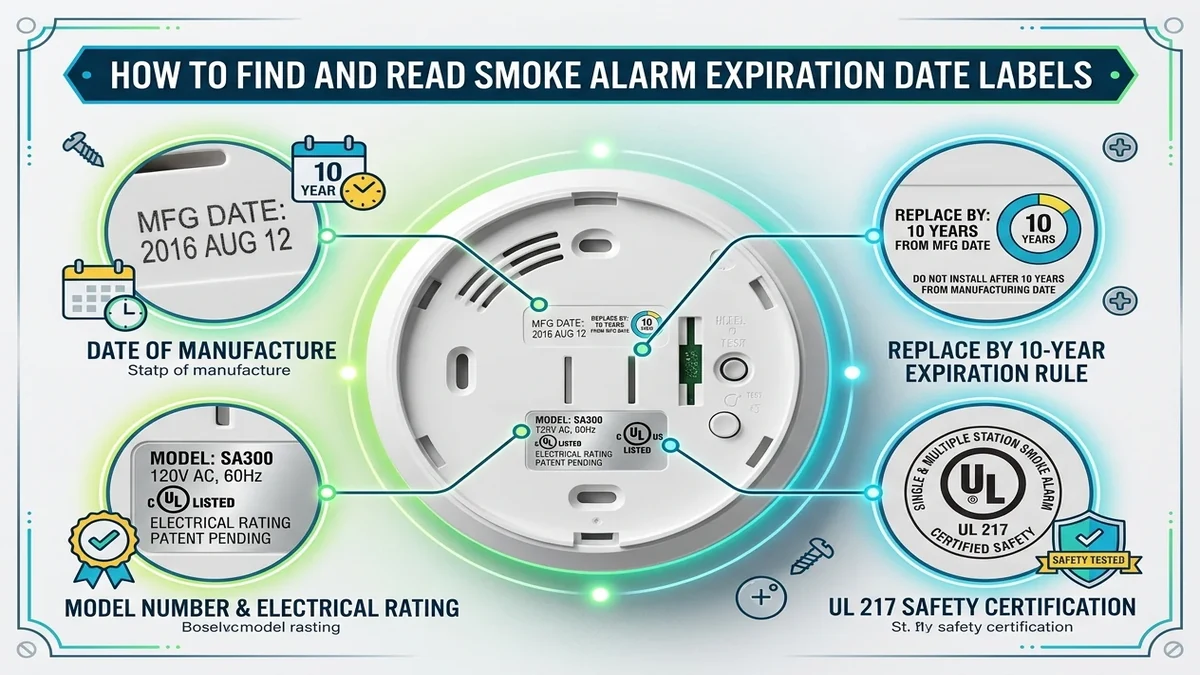
Unlike household appliances that fail noticeably, an expired smoke alarm may appear completely functional while its internal sensor fails to detect real fire combustion particles.
10-Year Replacement Rule (Manufacture Date)
Smoke alarms must be replaced 10 years after the date of manufacture (not the date of installation). The manufacture date is stamped on the rear label of the unit. When an alarm reaches the end of its service life it will typically emit a distinctive end-of-life chirp pattern (exact pattern varies by manufacturer, commonly 2 to 5 chirps). At that point the entire unit must be replaced; changing the battery will not restore reliable detection.
Why Smoke Alarms Expire After 10 Years
- Optical Diode Degradation: The infrared LEDs inside photoelectric chambers lose optical output power after 87,000+ hours of continuous operation, reducing sensitivity to smoke.
- Ionization Americium Decay & Oxidation: Ionization chambers experience metal corrosion and radioactive source fouling, altering the ion balance.
- Electronic Component Drift: Capacitors, resistors, and circuit traces degrade from ambient temperature cycles and humidity, causing erratic false alarms or sensor blindness.