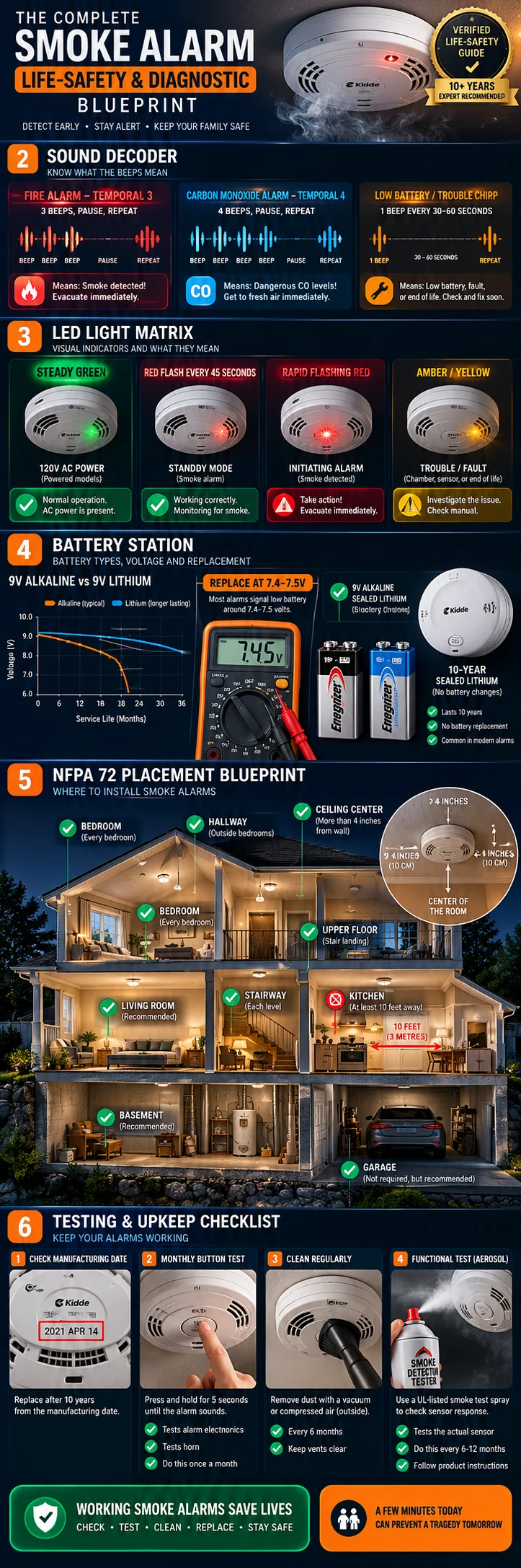
Under National Fire Protection Association standard NFPA 72 Section 14.4.7, residential smoke alarms have a maximum working service life of 10 years from the date of manufacture. After 10 years (87,600 continuous operating hours), component degradation significantly increases the risk that an alarm will fail to detect smoke during a fatal residential fire.
The 10-Year Replacement Mandate (NFPA 72 & UL 217)
A common homeowner assumption is that as long as the test button beeps when pressed, a smoke alarm remains fully protective. Fire research disproves this assumption:
| Device Component | 10-Year Degradation Mechanism | Real-World Failure Risk |
|---|---|---|
| Infrared Sensing LED | Lumen depreciation and diode aging reduce emitted infrared intensity | Fails to detect light scattering during smoldering fires |
| Optical Chamber Labyrinth | 87,600 hours of ambient airflow coat lenses in oily household dust | Blinds photodiode sensor or triggers persistent false alarms |
| Electrolytic Board Capacitors | Liquid electrolyte dries out under continuous 120V operating heat | Cannot filter AC line ripple; parasitic DC current drains batteries |
| Piezoelectric Horn Sounder | Ceramic disc experiences mechanical fatigue from thermal cycles | Sound volume drops below the mandatory 85 dBA awakening threshold |
| Electrochemical CO Sensor (Combos) | Aqueous catalyst electrolyte naturally oxidizes and dehydrates | Completely loses ability to detect toxic carbon monoxide gas |
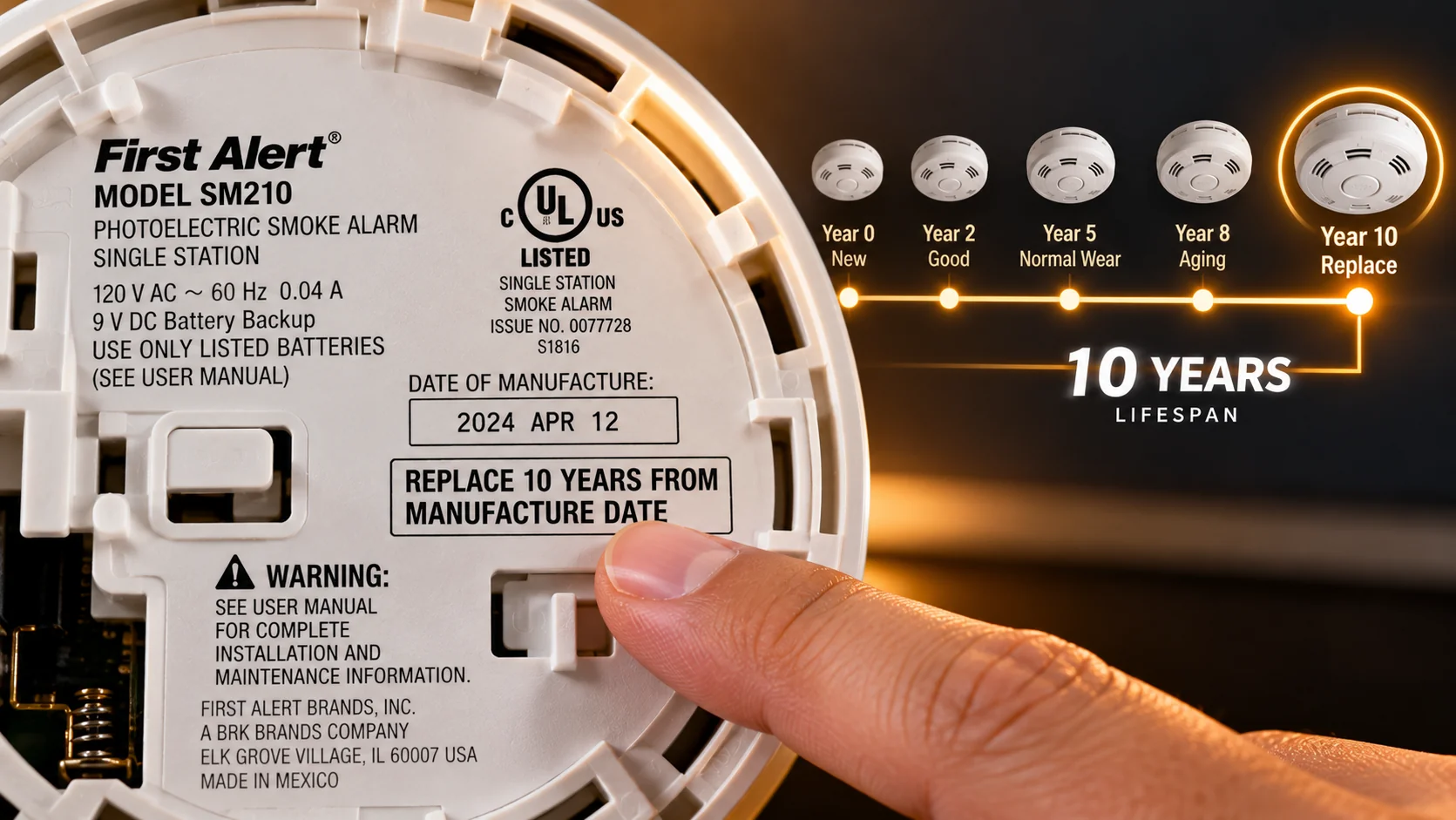
How to Read the Manufacture Date on the Rear Casing
The 10-year lifespan is calculated from the date of manufacture, not the date you purchased or moved into the home:
- Dismount the alarm by rotating the unit counterclockwise 15 degrees from the ceiling mounting ring.
- Examine the white or silver certification label on the back of the alarm chassis.
- Look for a printed date stamp. Common manufacturer formats include:
- Standard Date: "2016 MAY 14" or "MFG DATE: 05/14/2016".
- Julian Date Code: A 5-digit number such as "16135", where "16" represents the year 2016, and "135" represents the 135th day of that year (May 15).
- Missing Date Warning: If the label contains no visible manufacture date, the unit was manufactured prior to 1999 (when date labeling became mandatory under UL 217) and is dangerously obsolete. Replace it immediately.
Lifespan by Device Type: Smoke vs CO vs Combination Units
| Alarm Category | Engineered Lifespan | Mandatory Replacement Criterion |
|---|---|---|
| Standalone Smoke Alarms (Ionization or Optical) | 10 Years Max | Replace 10 years from rear casing date stamp (NFPA 72 § 14.4.7) |
| Standalone Carbon Monoxide (CO) Alarms | 7 to 10 Years | Replace when unit displays "End" or reaches 7-10 years (UL 2034) |
| Combination Smoke + CO Alarms | 7 to 10 Years | Governed by the shorter CO sensor lifespan; replace at 7-10 years |
| Hardwired Commercial Duct Detectors | 10 to 15 Years | Requires annual calibrated aerosol sensitivity testing (NFPA 72 § 14.4) |
Understanding Automated End-of-Life Warning Signals
Modern smoke alarms manufactured after 2014 include an internal hardware countdown timer programmed into non-volatile memory.
When 10 years (3,650 operating days) elapse, the internal microchip automatically initiates an irreversible end-of-life signal. On Kidde units, this sounds as 2 chirps every 30 seconds; on First Alert alarms, it sounds as 5 chirps every minute. Once an alarm enters end-of-life status, no battery replacement, cleaning, or capacitor drain reset will silence the sound. The entire unit must be uninstalled and replaced with a certified new device.