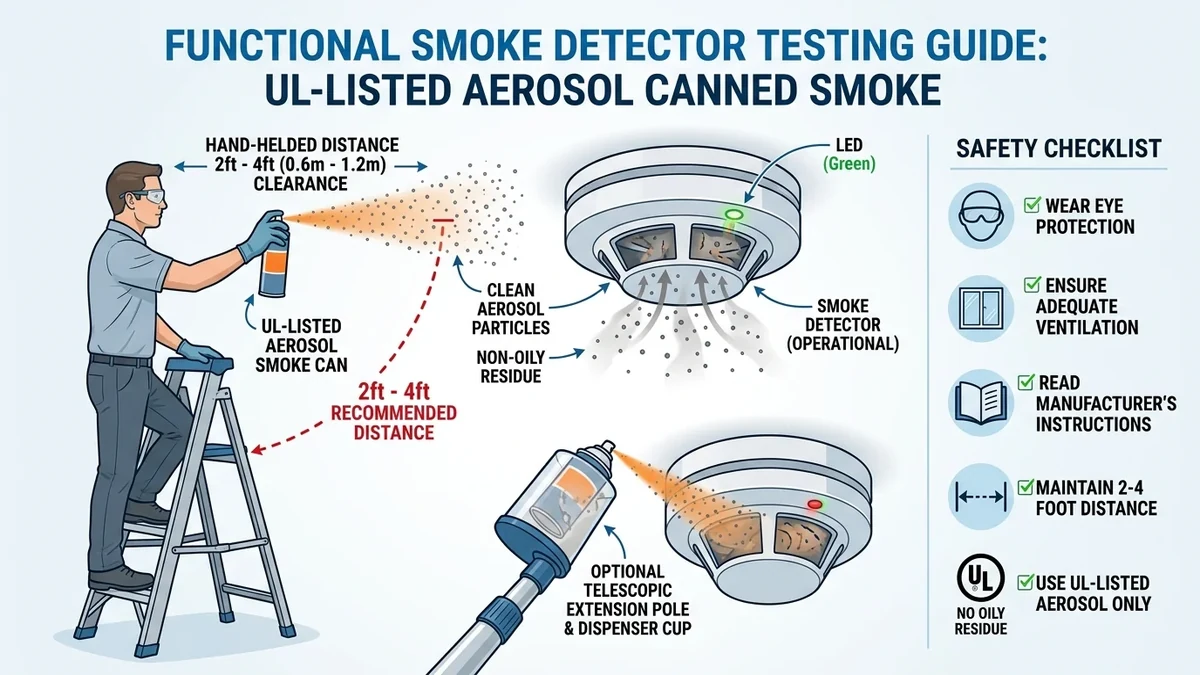
While pressing an alarm's Test button verifies battery voltage and sounder circuitry, it does not confirm whether smoke particles can enter the sensing chamber. Approved simulated-smoke aerosol testers offer a method to check sensing response without using hazardous open flames.
Push-Button Testing vs Aerosol Smoke Testing
| Test Feature | Push-Button Test | Aerosol Smoke Tester |
|---|---|---|
| What It Tests | Battery voltage, horn diaphragm, microprocessor logic | Physical particle entry, optical diode refraction, airflow vents |
| Recommended Frequency | Monthly | When specified by manufacturer or commercial maintenance procedures |
| Tool Required | None (manual finger press or broom handle) | Certified aerosol canister (plus extension pole for high ceilings) |
| Sensor Residue Risk | Zero | Extremely low when using certified residue-free formulations |
How to Use an Aerosol Smoke Tester Safely
- Notify building occupants and any connected central monitoring stations before testing.
- Stand safely beneath the alarm and aim the nozzle at the side intake vents from 2 to 4 feet away.
- Deliver a single 1 to 2 second burst of simulated smoke.
- The alarm should activate within 5 to 15 seconds.
- Allow the synthetic aerosol to clear naturally, or wave a clean cardboard piece to accelerate chamber clearing until the siren silences.
For routine maintenance schedules, see our guide on how often should you test a smoke alarm.