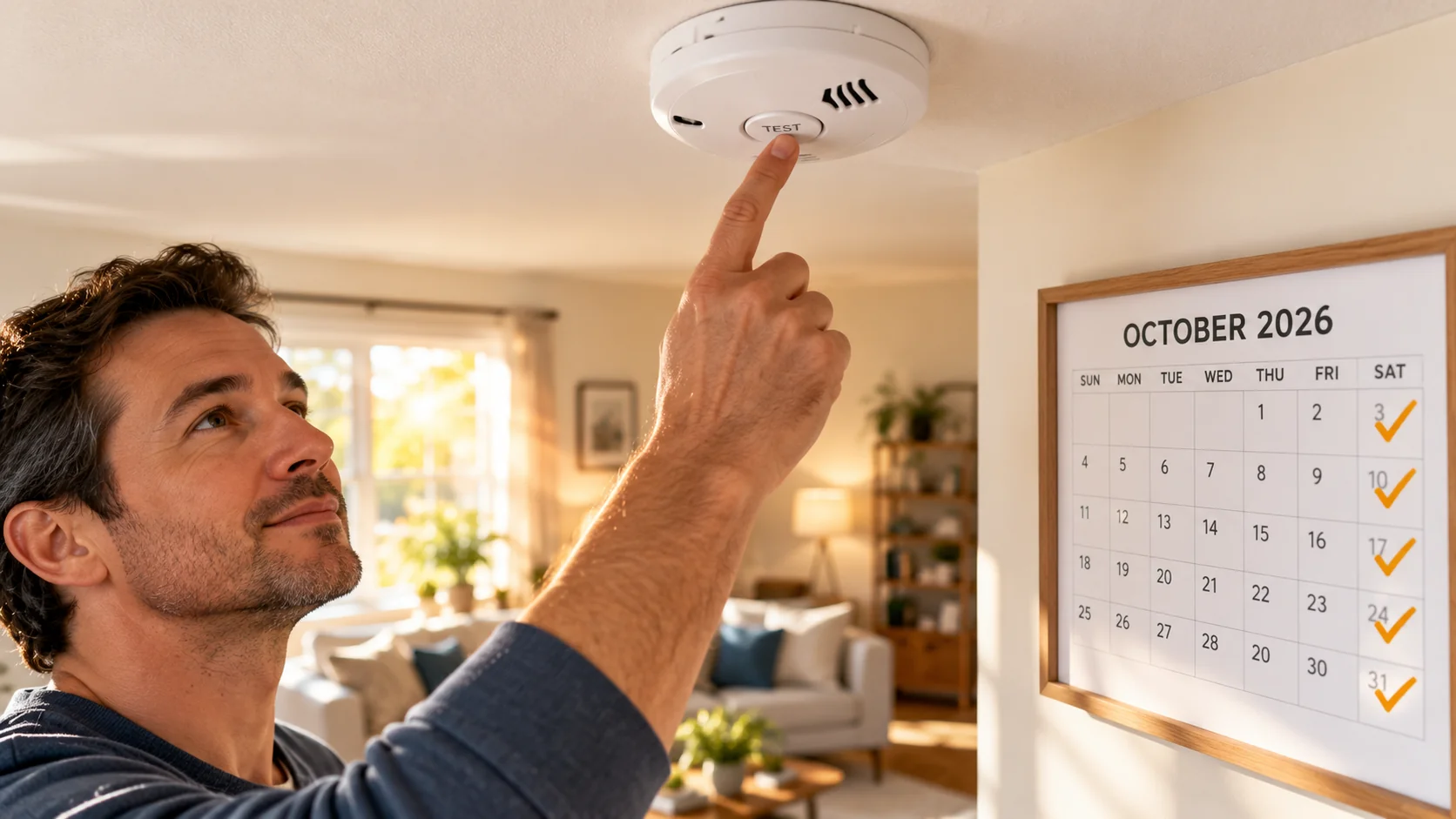
Test your smoke alarms on the first weekend of every month by holding the test button for five full seconds. Vacuum exterior sensor vents every six months to clear accumulated dust and pet hair. Once each year, perform a functional chamber check using certified aerosol spray to verify that smoke particles penetrate the sensing chamber.
Residential smoke alarm inspection, testing, and maintenance frequencies are codified under National Fire Protection Association standard NFPA 72 Section 14.4. Following a disciplined multi-tiered maintenance schedule guarantees both electrical horn circuitry and physical optical sensing chambers operate reliably when a real home fire occurs.
The NFPA 72 Standard Smoke Alarm Maintenance Schedule
| Maintenance Interval |
Mandatory Inspection Task |
Standard Operating Procedure |
Compliance Verification Criteria |
| Monthly |
Electronic Push-Button Check |
Depress center Test button for 3 to 5 seconds |
85 dBA Temporal 3 horn sounds immediately; LEDs flash |
| Semi-Annually (Every 6 Months) |
Exterior Vent Cleaning & Vacuuming |
Vacuum perimeter grilles using soft horsehair brush |
All dust, pet hair, and cobwebs cleared from sensing vents |
| Annually (Every 12 Months) |
Backup Battery Replacement |
Install fresh 9V or AA industrial alkaline cells |
New date-coded cell installed; terminal tension checked |
| When Specified / Commercial |
Functional Aerosol Smoke Entry Test |
Apply UL-listed aerosol where authorized by manufacturer manual |
Sensing chamber detects aerosol and triggers in < 15 seconds (NFPA 72 § 14.4.4.3) |
| Every 10 Years |
Complete Unit Replacement |
Remove entire alarm and install brand-new certified unit |
Rear casing manufacture date verified; new unit tested |
Why Monthly Push-Button Testing Is Necessary
National fire safety guidelines from the NFPA and USFA recommend that residential smoke alarms undergo an electronic push-button check at least once every month. Over 30 days of standby operation:
- Battery terminal connections can experience microscopic corrosion or contact relaxation.
- Electrical power surges can trip circuit breakers unnoticed on hardwired circuits.
- Piezoelectric horn sounders can suffer solder fatigue or mechanical failure.
- Pressing the button for 3 to 5 seconds verifies the power supply, microchip logic, and horn sounder without requiring special testing equipment.
Semi-Annual Cleaning Protocol
A convenient best practice is to clean smoke alarms twice a year during daylight saving time clock changes:
- Disconnect AC power if hardwired.
- Gently pass a vacuum cleaner nozzle fitted with a soft horsehair brush attachment over all exterior perimeter grilles for 30 seconds per unit.
- Follow with short, 1-second bursts of clean, moisture-free compressed air at a 45-degree angle to blow dislodged dust out of the optical labyrinth.
- Never spray liquid detergents, window cleaners, or air fresheners near alarms, as propellants coat sensing diodes.
Annual Replacement of Removable Batteries
For all alarms with removable 9V or AA batteries, install brand-new, unexpired industrial alkaline cells once every 12 months, even if the alarm has not begun chirping. Replaceable batteries gradually self-discharge; replacing them proactively ensures that an alarm never enters low-battery trouble mode in the middle of a winter night.
Important Safety Guideline
Working smoke alarms cut the risk of dying in a residential fire in half. Routine monthly testing is the single most effective maintenance task.
Recommended Residential Maintenance Schedule & Verification Cadence
Under NFPA 72 Section 29.8.1.4.1 and USFA safety directives, monthly push-button testing is the standard routine check for homeowners. A comprehensive home maintenance routine incorporates regular cleaning and timely battery replacement:
- Monthly Push-Button Test: Press and hold the faceplate test switch for 1 to 5 seconds to verify horn sounder function, processor logic, and power supply.
- Semi-Annual Cleaning & Inspection: Vacuum outer perimeter intake vents and terminal contacts twice a year to remove dust accumulation and insect webs.
- Annual Battery Replacement: For models with replaceable alkaline batteries, install fresh brand-name 9V or AA cells annually, or immediately upon hearing a low-battery chirp.
- Specialized Functional Aerosol Testing: Where authorized by the specific manufacturer user manual or conducted by qualified technicians under NFPA 72 Chapter 14, synthetic aerosol spray may be used to verify physical sensing chamber response.
Rental Property Landlord Testing & Documentation Mandates
For residential landlords and property managers, smoke alarm compliance is a strict statutory liability across major jurisdictions:
- United States: State rental housing statutes (e.g., California Civil Code § 1954.05, Texas Property Code Subchapter F) require landlords to test all smoke alarms prior to initial tenant move-in, verify 85 dBA sound output, and secure a signed tenant verification statement.
- Queensland, Australia: Under the Fire and Emergency Services Act 1990, landlords and managing agents must physically clean and test every smoke alarm within 30 days prior to the start of each new tenancy or lease renewal. Alarms must be AS 3786:2014 compliant interconnected photoelectric units.
- United Kingdom: The Smoke and Carbon Monoxide Alarm (England) Regulations 2022 mandate landlords check that each required alarm is in proper working order on the exact day any new tenancy commences, risking civil financial penalties up to £5,000 per violation.
- India: Under NBC 2016 Part 4 and IS 2189 Clause 10, residential high-rise building management must execute quarterly functional detector audits and maintain certified inspection registers for annual municipal Fire NOC renewals.
Printable Maintenance Tracking
Download our free printable smoke alarm inspection log to track monthly tests, battery changes, and expiration dates for your household or rental properties.
All-in-One Field Reference
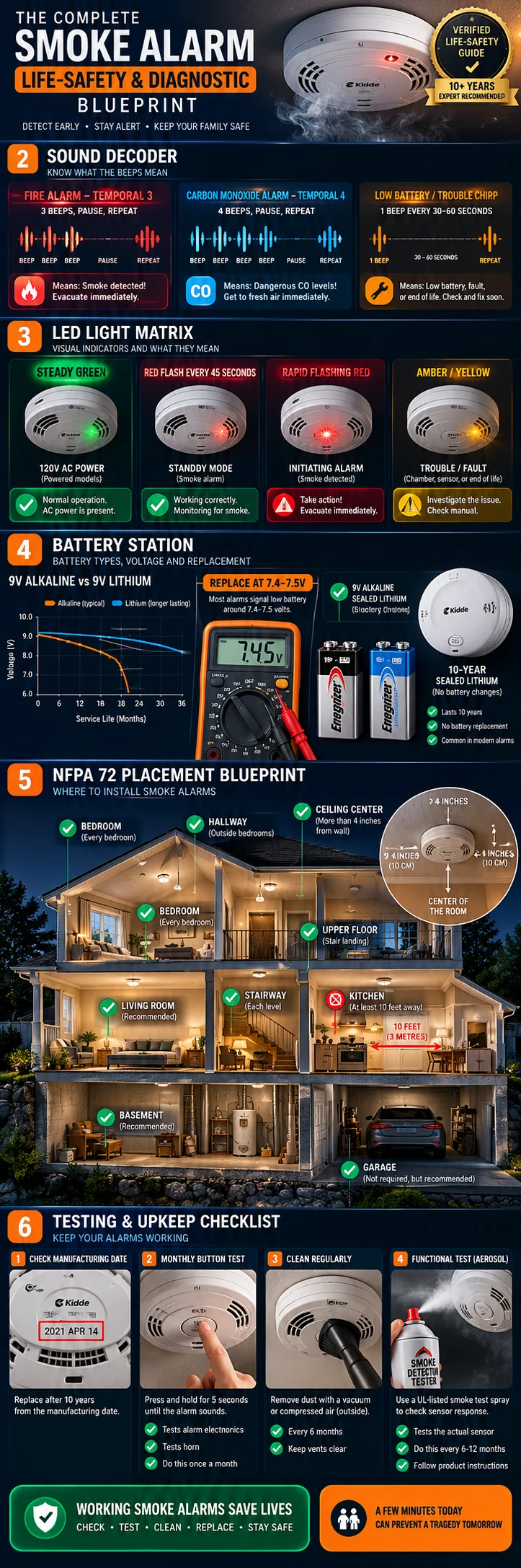
Complete Smoke Alarm & Life-Safety Master Infographic
Open Full 8K Image →
Scroll through this complete technical reference to diagnose chirps, decode LED indicator lights, check battery voltages, and verify NFPA 72 whole-home placement rules directly on this page.
Reviewed by Smoke Alarm Guide Editorial Standards Team
Ratio 6:1 Vertical Scroll • NFPA 72 & IRC Compliant