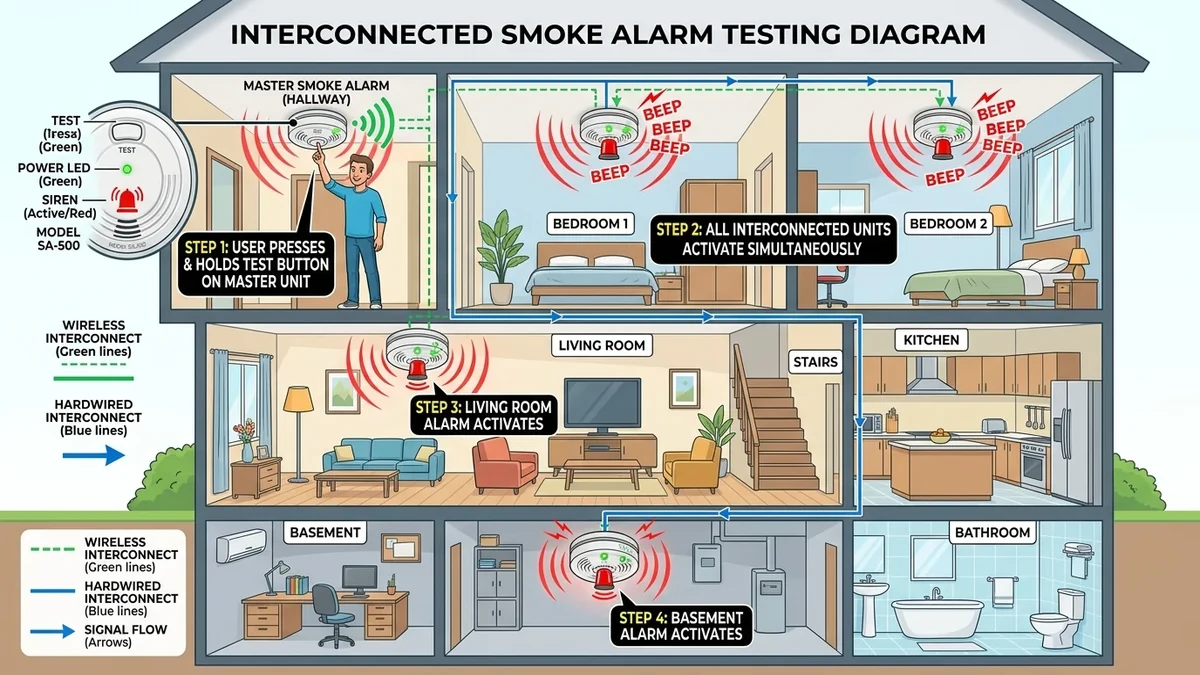
Interconnected smoke alarms provide critical life-safety protection by sounding whole-house alerts when a fire starts in a remote basement or living room. Systematic network testing verifies all units communicate.
Step-by-Step Two-Person Testing Method
- Coordinate Test Positions: Position Person A at the alarm being initiated (e.g., ground floor hallway) and Person B on the upper floor or basement near remote alarms.
- Initiate Test Mode: Person A presses and holds the Test button according to manufacturer instructions until its test signal sounds.
- Verify Network Transmission: Compatible remote alarms on other floors should begin sounding to confirm network transmission. Person B confirms all remote horns activate.
- Test Secondary Station: Walk to a different floor and initiate a test from that unit to confirm bi-directional signaling across the entire hardwired loop or wireless RF mesh.
Troubleshooting Isolated Alarms That Do Not Sound
| Observed Symptom | Likely Cause | Corrective Action |
|---|---|---|
| Single hardwired unit stays silent | Loose red interconnect traveler wire nut in ceiling box | Shut off breaker; inspect wire nut on red traveler wire |
| Single wireless alarm stays silent | Wireless RF pairing lost or out of mesh range | Re-pair alarm following manufacturer wireless enrollment procedure |
| All alarms sound but tone is weak | Low backup batteries across multiple units | Replace backup batteries in all interconnected units |