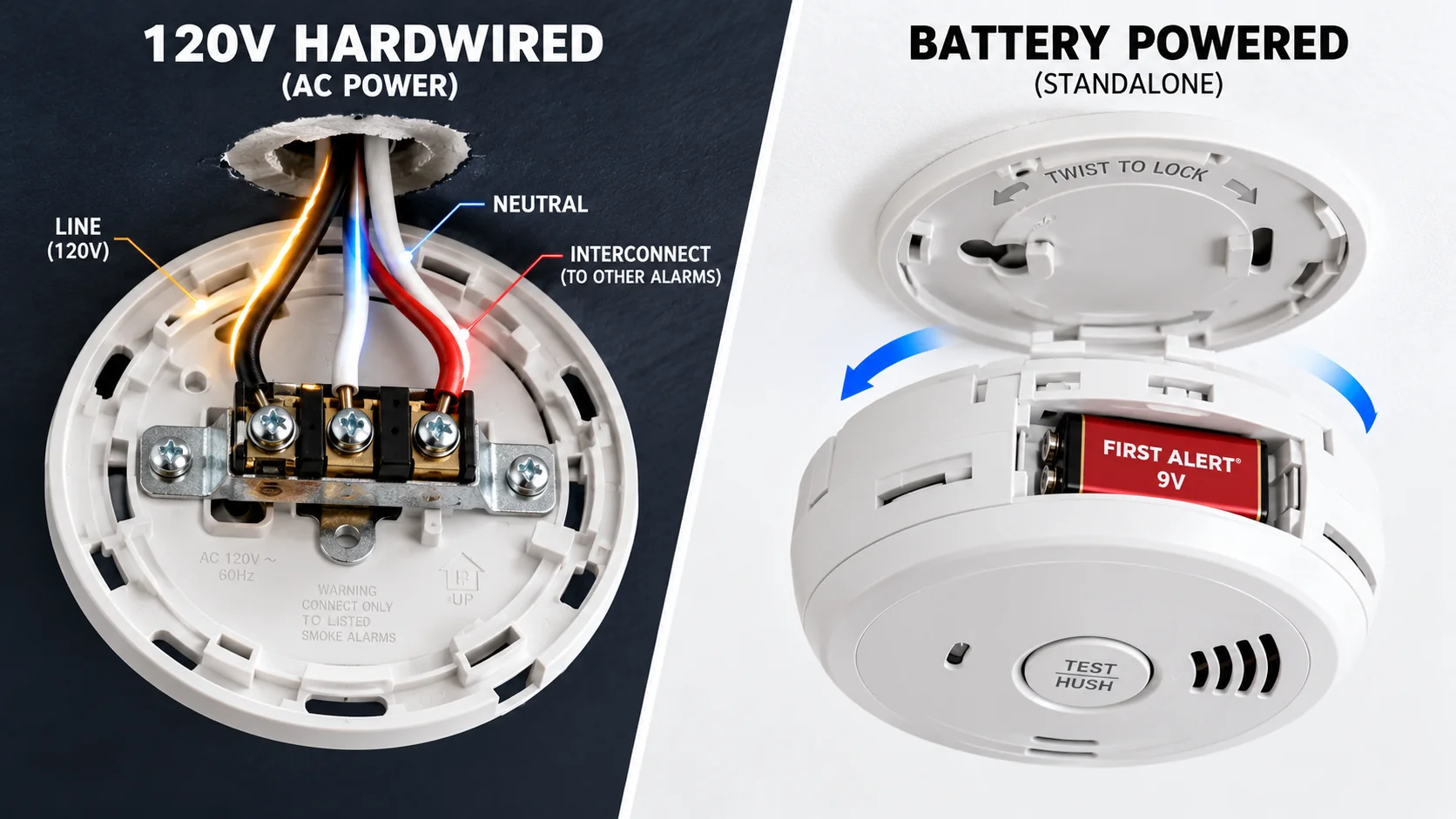
Hardwired vs Battery Smoke Alarms: Technical Safety Comparison
Hardwired, interconnected smoke alarms are the gold standard for residential life-safety. They provide continuous 120V AC power and, critically, support parallel signaling-where a single trigger activates every horn in the home simultaneously. Battery-operated units are equally sensitive to smoke, but their isolated operation may delay life-saving notification to occupants in distant areas of the dwelling.
Safety Comparison Matrix
| Reliability: Hardwired (Continuous 120V AC) vs Battery (Primary/Backup dependence).
| Synchronization: Hardwired (Whole-home interconnect) vs Battery (Individual alert).
| Code Compliance: Hardwired (Mandated for new construction/IRC) vs Battery (Permitted retrofit).
| Maintenance: Hardwired (Semi-annual battery backup check) vs Battery (Annual replacement/sealed lithium).
| Installation: Hardwired (Skilled trade/licensed labor) vs Battery (DIY mount).
Selecting the Correct Protection Strategy
- Infrastructure Assessment: Are junction boxes available in all required NFPA 72 locations? If yes, opt for hardwired. If no, consider RF wireless-interconnect units.
- Maintenance Capacity: Can you commit to the battery change schedule? If not, select 10-year sealed lithium battery units to bridge the gap.
- Whole-Home Connectivity: Does the current setup allow for a signaling traveler wire? If not, wireless RF bridging is the modern alternative to rewiring.
- Regulatory Review: Check with the local building inspector; some states have strict legislation requiring all existing dwellings to upgrade to interconnected systems upon the sale of the home.
Operational Reliability: The Power Architecture
Reliability is defined by the detector's capability to operate during power failures, which often correlate with fire events (e.g., electrical short circuits).
- Hardwired Systems: These systems are not "grid-reliant" for life safety because they mandate redundant energy storage. Every hardwired unit must have a backup source (typically a 9V battery or a long-life lithium cell). The 120V AC serves as a "trickle charge" and a signaling medium; the device inherently stays alive when power is severed.
- Battery Systems: Reliability here is entirely contingent upon adherence to strict battery replacement schedules. The "low battery chirp" is the system's way of informing the occupant the protection has ceased. Occupants frequently silence the alarm and fail to replace the battery, creating a period of total vulnerability.
Code Compliance & Modern Standards
Modern life-safety codes (International Residential Code / NFPA 72) heavily favor synchronization.
- New Construction: Hardwired, interconnected units are mandatory in every new home. The logic is definitive: the danger of fire propagates rapidly, and fragmented alerting (an alarm ringing in a basement while residents sleep upstairs) is a statistically significant failure point.
- Retrofit Scenarios: Many existing homes utilize battery-operated units because hardwired electrical access is structurally inaccessible. Wireless-interconnect battery units are the industry-standard "middle ground" for retrofitting these homes to match the synchronized performance of hardwired networks.
Maintenance & Lifecycle Economics
Economic efficiency and maintenance burden differ between the two primary technologies.
- Economics: Battery-operated units are cheaper at the point of purchase but require constant battery supply replenishment. 10-year sealed battery units effectively "lock in" the maintenance cycle, costing more upfront but eliminating the annual battery cost entirely.
- Lifecycle Integrity: Regardless of power source, the detector *head* (the sensors and processor) reaches EOL in 10 years per NFPA 72. Owners often confuse "battery life" with "sensor life." Replacing the battery but leaving a 12-year-old detector on the ceiling is a critical failure of oversight.
Strategic Troubleshooting for Interconnected Systems
If you are migrating from battery to hardwired, recognize that the biggest maintenance challenge is "false activation."
- Traveler Signal Noise: In hardwired systems, an electrical spike on the interconnect line can trigger every unit in the house simultaneously. This is typically due to loose wire nuts or unshielded electrical cable runs near inductive motor loads (pumps, blowers).
- Sensor Sensitivity: In both systems, excessive dust or small insects in the sensing chamber trigger false alarms. Frequent false alarms are a signal to perform a deep chamber cleaning, not to disconnect the unit.
Smoke Alarm Guide Editorial Team
Our life-safety engineering documentation is curated by certified fire alarm designers, electrical inspectors, and fire protection experts. All diagnostics and emergency response procedures are mapped directly to UL 217/2034 safety standards, NFPA 72 codes, and recognized municipal fire marshal protocols.
Related Guides & Next Steps
Verified Primary Sources & Reference Standards
- NFPA 72: National Fire Alarm and Signaling Code.
- Underwriters Laboratories UL 217: Standard for Smoke Alarms.
- International Residential Code (IRC 2024): Building and Life Safety requirements for residential dwellings.
- Consumer Product Safety Commission (CPSC): Guidance on residential smoke alarm power sources and maintenance.
Frequently Asked Questions
Are hardwired smoke alarms safer than battery-operated units?
Do modern building codes require hardwired alarms?
Can I convert battery-operated units to interconnected units?
What are the maintenance requirements for both types?
Is one technology more prone to false alarms?
Do battery-operated alarms have reduced protection?
What is the expected lifespan for each type?
Which type is cheaper over 10 years?
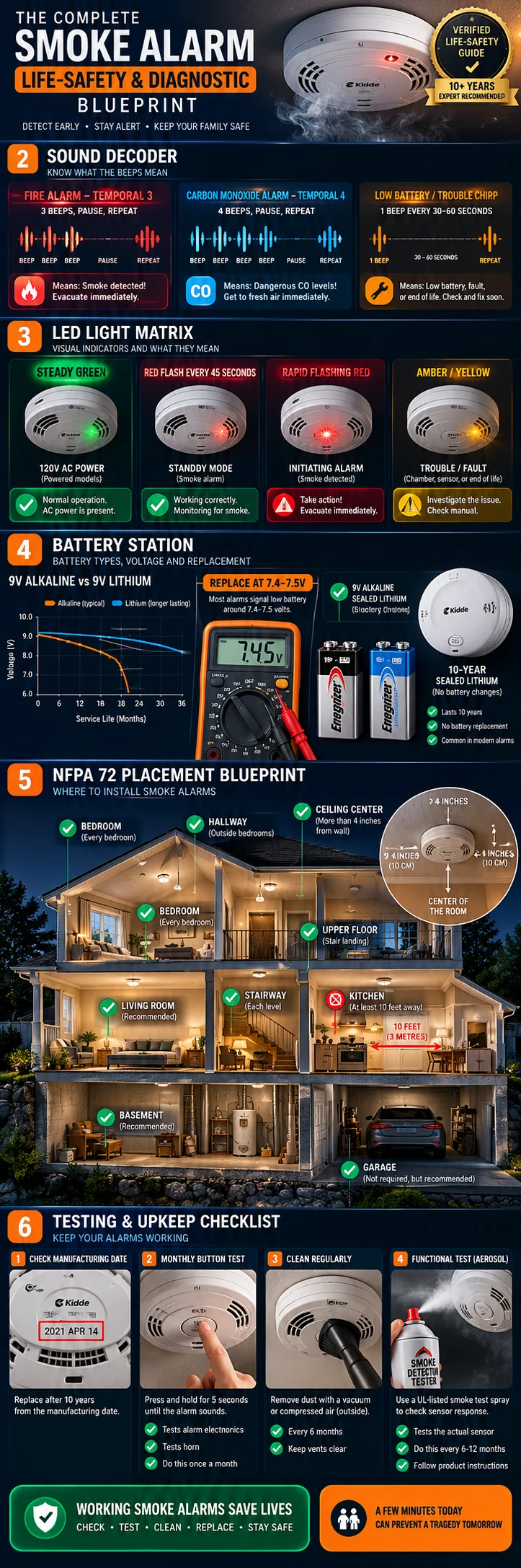
Complete Smoke Alarm & Life-Safety Master Infographic
Scroll through this complete technical reference to diagnose chirps, decode LED indicator lights, check battery voltages, and verify NFPA 72 whole-home placement rules directly on this page.