Commercial scope
Duct-detector requirements and testing procedures depend on the applicable fire/mechanical code, system design, manufacturer instructions and authority having jurisdiction. This guide is not a substitute for the project’s approved design or inspection procedure.
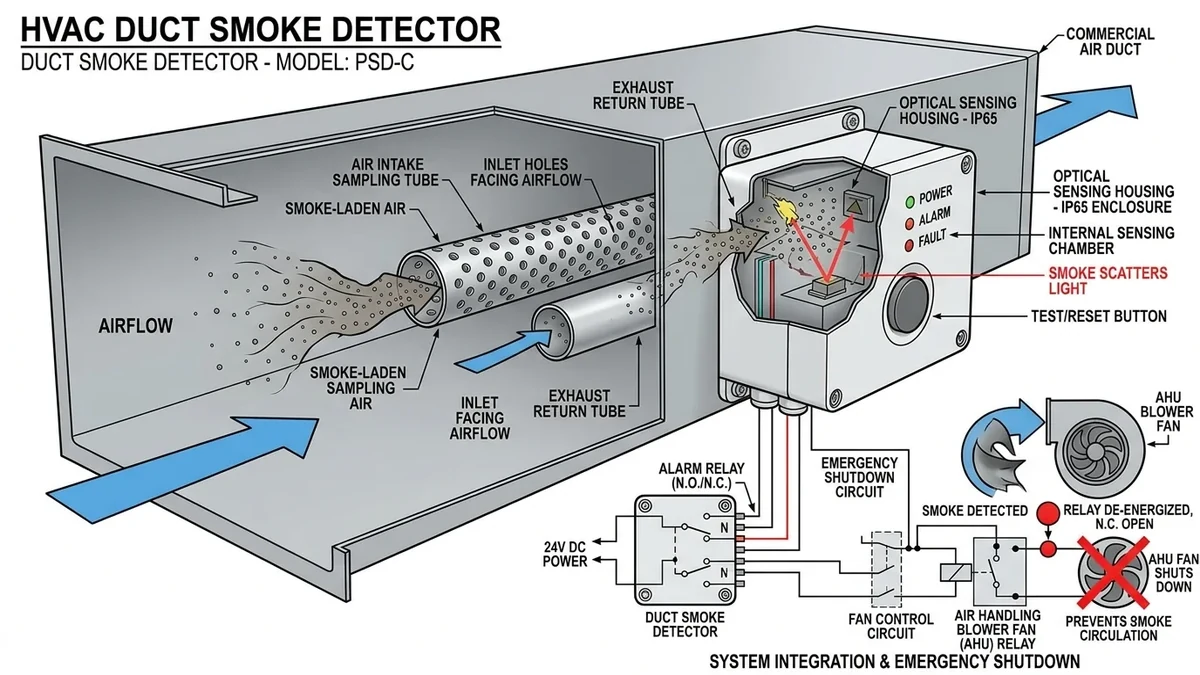
Duct smoke detectors sample airflow moving through commercial HVAC ducts to detect smoke and toxic gases before they are recirculated across building zones. When smoke is detected, the unit triggers an emergency signal to the Fire Alarm Control Panel (FACP) and automatically shuts down air handling supply fans per NFPA 90A.
Commercial NFPA 72 ITM Architecture Overview
Duct Detector System Architecture:
• Sampling Tubes: Inlet tube captures air across duct width; exhaust tube returns sample to duct stream.
• Differential Air Pressure: Requires specific velocity (typically 100 to 4,000 FPM) measured by digital manometer.
• Safety Interlock: Direct relay contact shuts down HVAC motor contactors upon alarm.
• Remote Test Stations: Key-switch and LED annunciators mounted at floor level for accessible testing.
In commercial buildings, heating, ventilation, and air conditioning (HVAC) systems can rapidly circulate toxic smoke from a small isolated fire across entire floors within minutes. Duct smoke detectors prevent toxic smoke spread.
NFPA 90A & Building Code Mandates
Under NFPA 90A (Standard for the Installation of Air-Conditioning and Ventilating Systems) and the International Mechanical Code (IMC Section 606), whether duct smoke detection is required depends on the applicable fire/mechanical code, building design, HVAC system and jurisdiction in the following locations:
- Supply Air Systems: On the supply side of air handling units with a design capacity exceeding 2,000 CFM (cubic feet per minute), downstream of all filters.
- Return Air Systems: On the return air stream of air handlers exceeding 15,000 CFM and serving more than one story.
Sampling Tube Aerodynamics & Differential Pressure
A duct smoke detector housing is mounted on the exterior of a sheet metal duct. Two metal tubes extend into the airstream:
- Inlet Sampling Tube: Features multiple intake holes drilled along its length. It must span across the duct (at least 80% to 100% of duct width) with holes facing directly upstream.
- Exhaust Tube: Shorter tube that uses the Venturi effect to draw sampled air through the photoelectric detector chamber and exhaust it back into the duct.
Important Safety Guideline
Duct smoke detectors do not provide open-area life safety warning because they cannot detect smoke when HVAC fans are turned off. Standard ceiling smoke detectors are still required.
Annual Differential Pressure Testing
NFPA 72 may require periodic testing under the applicable standard, manufacturer instructions and authority requirements verification that differential air pressure across sampling tubes remains within the manufacturer certified velocity range (typically 0.01 to 1.2 inches of water column).