
Printable Emergency Fridge Card & Home Escape Plan
Print this standardized emergency reference card to keep on your refrigerator, home safety board, or main electrical panel. It provides instant sound decoding, emergency contact lines, primary escape routes, and a monthly testing log.
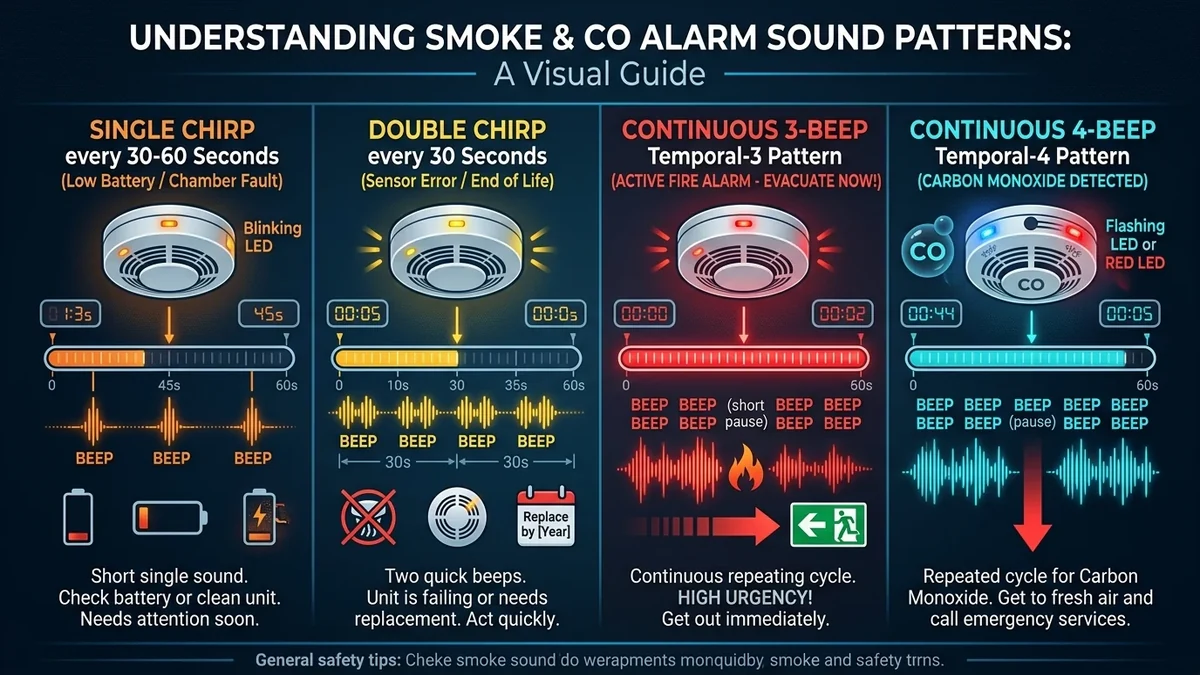
Household Emergency Fire & CO Reference Card
| Audible Pattern | Condition / Hazard | Immediate Life-Safety Action |
|---|---|---|
| 3 Loud Beeps (Beep-Beep-Beep... Pause) | SMOKE / ACTIVE FIRE | EVACUATE IMMEDIATELY. Crawl low under smoke. Close doors behind you. Call 911 from outside. |
| 4 Loud Beeps (Beep-Beep-Beep-Beep... Pause) | CARBON MONOXIDE | EVACUATE TO FRESH AIR. Open windows if along exit path. Call 911. Do not re-enter until cleared. |
| Talking Voice Warning ("Fire!" or "CO!") | Voice-Enabled Alert | FOLLOW SPOKEN INSTRUCTION. Evacuate immediately based on the specific verbal threat. |
| 1 Single Chirp (Every 30 to 60 Seconds) | Low Battery / Sensor Fault | Replace 9V or AA backup batteries. Clean sensor chamber with a vacuum brush. If chirp persists, reset residual charge. |
| 2 to 5 Periodic Chirps (Model-Dependent) | 10-Year End-of-Life | Standard 10-year sensor lifespan has expired (First Alert: 5 chirps, Kidde: 2 or 3 chirps). Replace the alarm unit immediately. |
Verified Primary Sources & Reference Standards
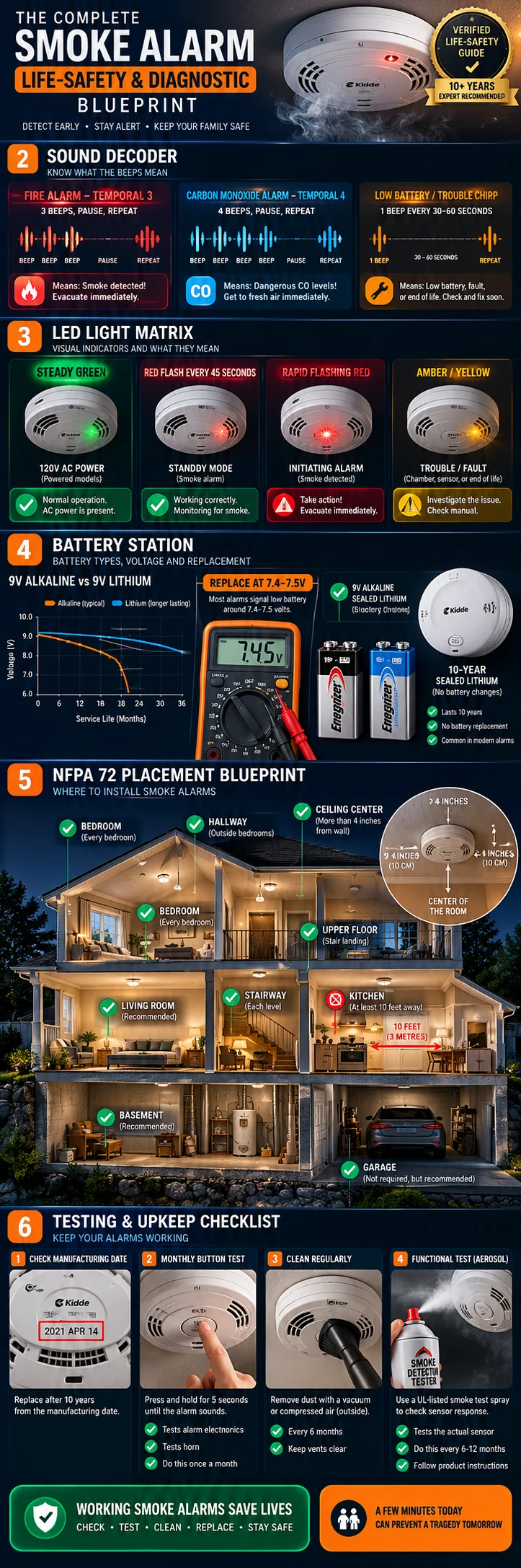
Complete Smoke Alarm & Life-Safety Master Infographic
Scroll through this complete technical reference to diagnose chirps, decode LED indicator lights, check battery voltages, and verify NFPA 72 whole-home placement rules directly on this page.
Family Fire Escape Plan Checklist & Drill Schedule
A working smoke alarm alerts you to a fire, but an escape plan gets your family out alive. Under NFPA 101 Life Safety Code recommendations, every residential household must establish and rehearse a primary and secondary escape route from every bedroom and living space.
- Practice Day and Night Drills: Conduct at least two family fire drills each year. Rehearse one drill during daylight and one after bedtime to ensure sleeping children awaken to smoke alarm sirens.
- Teach Low Crawling: In a real fire, superheated smoke and toxic gases rise to the ceiling. Train all family members to drop to their hands and knees where cleaner, cooler air remains within 12 to 24 inches of the floor.
- Check Door Temperatures: Teach children to touch bedroom doors with the back of their hand before turning a doorknob. If the door or metal knob feels hot, do not open it; proceed immediately to the window escape route.
Two Ways Out of Every Room: Primary & Secondary Escape Routes
Every bedroom must have two designated ways out: a primary exit through the hallway door, and a secondary emergency exit through a window or exterior patio door.
For second-story bedrooms, verify that emergency escape windows open smoothly without sticking. If windows are higher than 12 feet off the ground, purchase a certified two-story emergency escape ladder and store it beneath the bed or inside the bedroom closet for immediate deployment.
Designating an Outside Meeting Place & Accountability Rules
Select an easily identifiable, stationary outdoor meeting spot at a safe distance in front of your home, such as a designated street mailbox, a specific mature front yard tree, or a neighbor porch. Never choose a location near an attached garage or driveway where arriving fire department apparatus and emergency vehicles park. Once outside, stay outside. Never re-enter a burning structure for pets, phones, or personal possessions.
Frequently Asked Questions
How should families use this printable emergency fridge card?
Print the card and post it on your refrigerator at eye level. Fill in primary and secondary escape routes, outside meeting place locations, local fire department direct lines, and emergency contact numbers.
How often should households practice their fire escape plan?
The NFPA recommends practicing home fire drills at least twice a year, including at least one nighttime drill to verify children wake up to smoke alarm sounds.
Why is an outside meeting place important on an emergency card?
Having a designated meeting spot such as a specific tree, mailbox, or neighbor porch ensures all family members are accounted for immediately, preventing people from running back into a burning structure.
What key emergency information belongs on a refrigerator card?
Include 911, the direct local emergency dispatch phone number, poison control, home street address with nearest cross street, and primary emergency contacts.