Smoke Alarm Placement Calculator: NFPA 72 Blueprint
Determine the exact number, sensor technology, and statutory room locations required to protect your home. This calculator applies the National Fire Alarm and Signaling Code (NFPA 72 Chapter 29) and International Residential Code (IRC R314 and R315) specifications.
Property Specifications
Configure building profile and hazards for code compliance
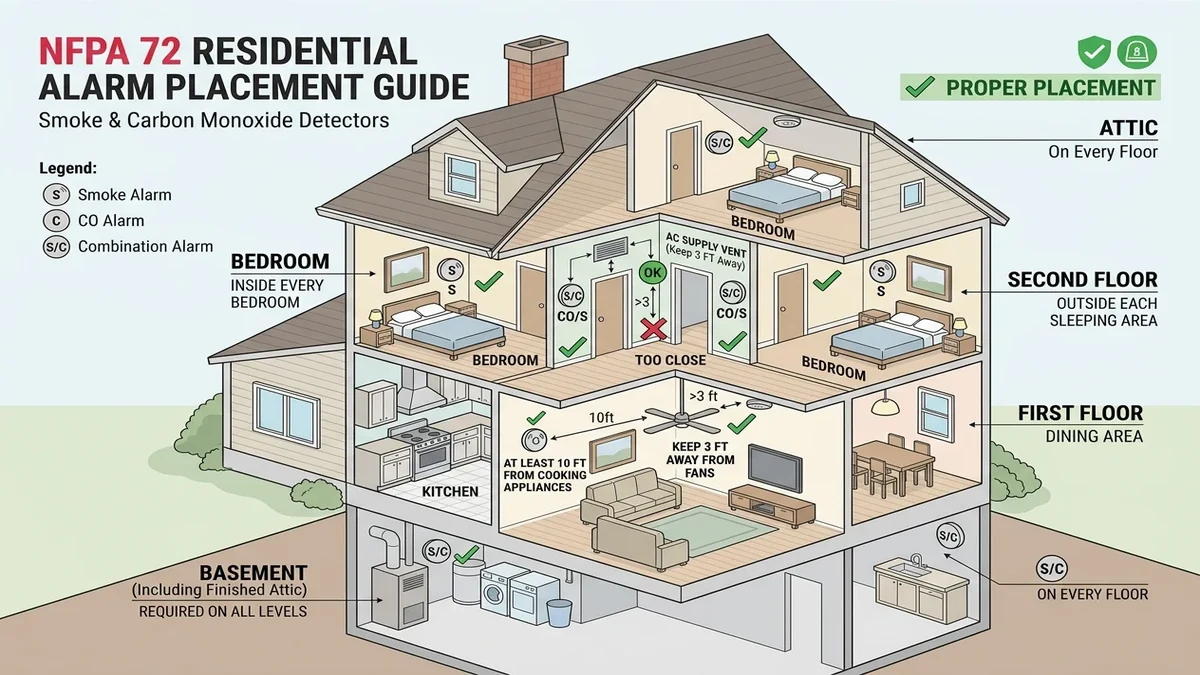
Core Statutory Placement Rules (NFPA 72 § 29.5.1)
Building codes specify distinct placement boundaries to prevent false alarms while ensuring early smoke detection:
| Boundary Zone | Statutory Dimension | Engineering Rationale |
|---|---|---|
| Sleeping Rooms | Inside every bedroom | Closed doors attenuate hallway alarm volume by 15 to 20 decibels. |
| Kitchen / Cooking Appliances | Minimum 10 feet (3 m) horizontal | Primary 10-foot radial exclusion zone. Between 10 to 20 feet, alarms must be photoelectric, listed for nuisance resistance (UL 217 8th/9th edition), or equipped with an alarm-silencing switch. Listed photoelectric units may be installed as close as 6 feet if layout constraints prevent meeting the 10-foot rule. |
| Bathroom Separation | Minimum 3 feet away | Steam condensation in optical chambers causes false ion/photoelectric chirps. |
| Ceiling Corner Clearance | Minimum 4 inches from wall | Prevents installation in static dead air pockets where thermal plumes bypass sensors. |
| Wall Mount Boundary | 4 to 12 inches below ceiling | Keeps the sensor within the rising buoyant smoke layer without entering corner dead air. |
| Basement Location | Bottom of stairway ceiling | Detects rising convective heat and smoke before it travels upstairs into living areas. |
| Attached Garage (Best Practice) | Rate-of-rise heat detector (UL 521) | Smoke alarms are prohibited in garages due to vehicle exhaust and temperature swings. A 135 deg F heat detector provides safe thermal detection. |
Local Authority Having Jurisdiction (AHJ) Advisory
Model building codes (NFPA 72 and IRC Sections R314 and R315) are adopted and amended by state and municipal building authorities. Always verify the specific code cycle and local amendments enforced by your municipal building department or fire prevention bureau.
Verified Primary Sources & Reference Standards
Smoke Alarm Guide Editorial Team
Technical Standards ReviewResearched from verified statutory standards, public safety publications, and official manufacturer manuals. Review our complete research methodology and primary source hierarchy.