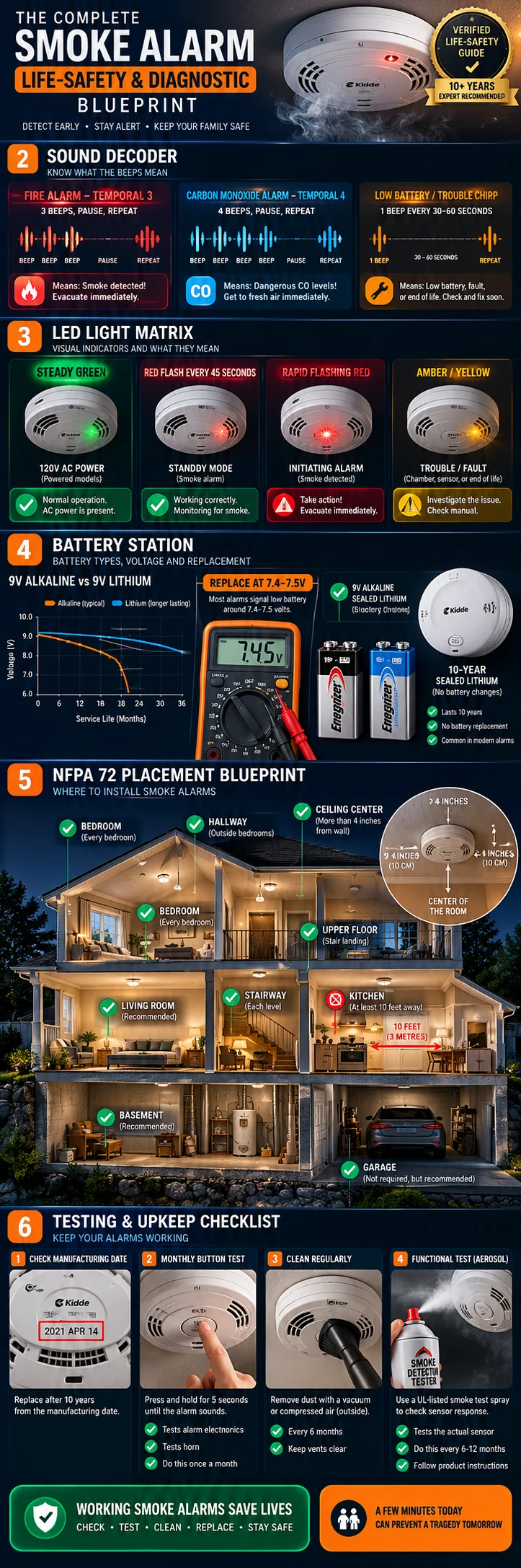
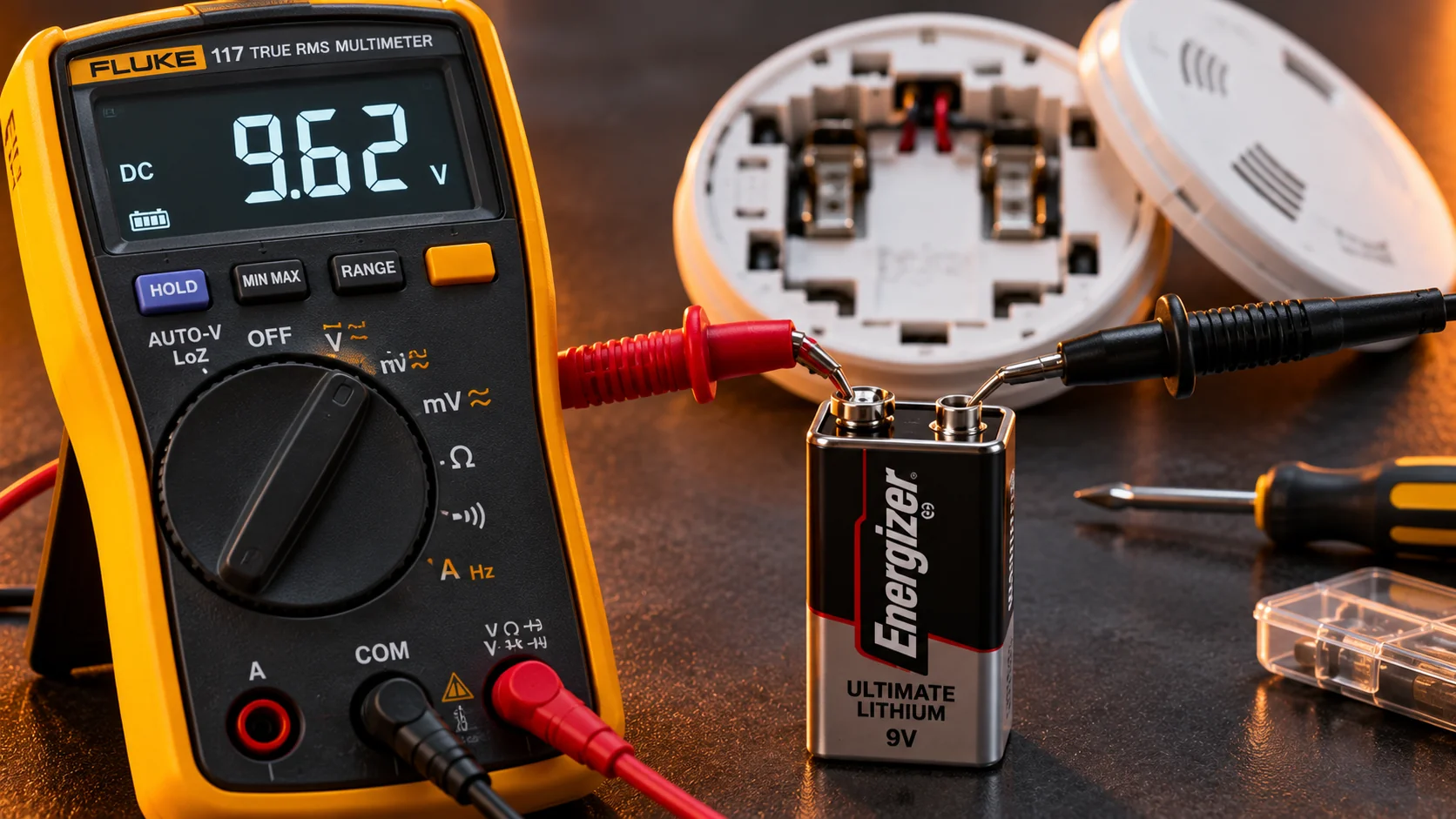
The 9-volt (9V) battery remains the most widespread backup and standalone power source for residential smoke alarms. Understanding the electrochemical differences between 9V alkaline and 9V lithium chemistries, terminal contact mechanics, and low-voltage chirp thresholds under NFPA 72 ensures uninterrupted fire protection without annoying middle-of-the-night trouble chirps.
Electrochemical Comparison: 9V Alkaline vs 9V Lithium
| Performance Parameter | 9V Industrial Alkaline (Zn/MnO2) | 9V Long-Life Lithium (Li/MnO2) |
|---|---|---|
| Internal Cell Construction | 6 internal 1.5V cylindrical AAAA cells in series | 3 internal 3.0V lithium-manganese cells in series |
| Fresh Open-Circuit Voltage | 9.20V to 9.60V DC | 9.60V to 9.85V DC |
| Nominal Energy Capacity | 500 to 600 milliamp-hours (mAh) | 1,000 to 1,200 milliamp-hours (mAh) |
| Operating Temperature Window | 32°F to 120°F (0°C to 49°C) | -40°F to 140°F (-40°C to 60°C) |
| Discharge Curve Profile | Sloping; voltage gradually declines over time | Extremely flat; maintains >9.0V until final depletion |
| Recommended Service Life | 12 Months (replace annually) | 5 to 10 Years of continuous standby |
| Top Certified Brands | Duracell Coppertop, Energizer Max, Procell | Ultralife 9V Lithium (U9VL-J-P) |
The Low-Voltage Trip Threshold & Microprocessor Sampling
Modern smoke alarms do not draw constant DC power. To preserve battery longevity, the internal microprocessor operates in low-power sleep mode, waking up every 40 to 45 seconds to draw a brief 50-to-100 milliamp pulse current to fire the infrared LED and test horn continuity:
- During this pulse, the microchip measures battery terminal voltage under actual load.
- When terminal potential drops below the factory threshold (typically 7.5 volts DC), the analog-to-digital converter flags low-voltage status.
- The unit emits a sharp, single 30-millisecond chirp once every 30 to 60 seconds to signal mandatory replacement.
Why Heavy-Duty (Zinc-Carbon) Batteries Fail Immediately
Discount store batteries labeled "Heavy Duty" or "Super Heavy Duty" utilize obsolete zinc-carbon chemistry. While an unloaded multimeter may read 9.0V across their terminals, zinc-carbon cells possess high internal DC resistance.
The moment the smoke alarm fires its 100mA sensor pulse, the high internal resistance causes instantaneous voltage sag below 7.5V. The alarm perceives the brand-new battery as dead and immediately begins chirping. Never install zinc-carbon batteries in life-safety smoke alarms.
Why Rechargeable NiMH Batteries Are Strictly Prohibited
Standard rechargeable 9V nickel-metal hydride (NiMH) batteries consist of 6 or 7 small internal cells, delivering a nominal operating voltage of only 7.2V to 8.4V when fully charged. Because 7.5V is the low-battery alarm trip point, a fully charged rechargeable battery will trigger low-voltage trouble chirps within days of installation.
Maintaining 9V Snap Terminal Contact Tension
Over multiple battery swaps, the split circular female contact on the 9V battery harness stretches outward. Loose physical contact introduces contact resistance:
- Disconnect AC power and remove the battery.
- Inspect the female snap terminal on the alarm wiring harness.
- Use small needle-nose pliers or fingertips to gently pinch the split circular prong inward by 0.5 mm.
- Re-snap the battery; it should require positive thumb pressure, ensuring zero electrical resistance.